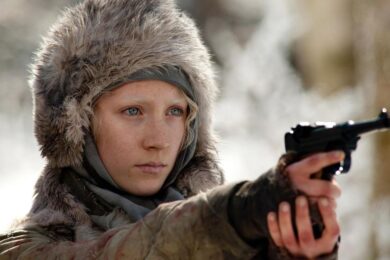

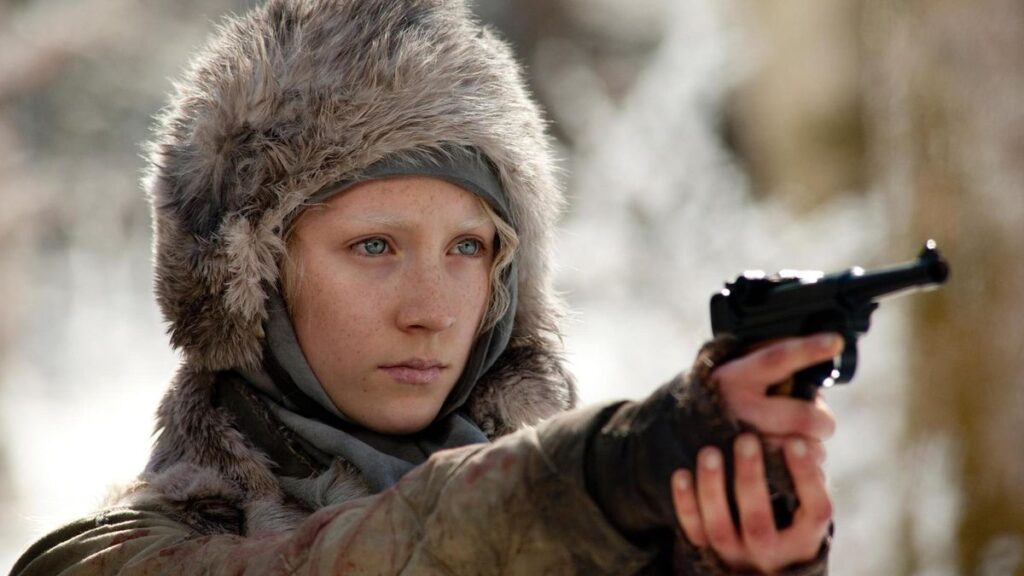
Hanna does not live with music to guide her, at least at first. Her life is scored solely by the openness of the tundra, the crackling of fire. The stillness of open air, of onyx-drenched night. A dwelling shared only with her father, far from any others, from any chatter or clamour. No incandescent hums or white noise whirrs or industrial thrums to speak of. Hanna will not find music here, not until the world beyond this one encroaches. Not until she finds her tune beyond the silence she has known.
It’s a curious start for a film scored by one of the biggest electronic music acts on the globe. Joe Wright’s 2011 action film Hanna wasn’t loudly advertised as a vehicle for the Chemical Brothers’ soundtrack in the same way that, say, Tron: Legacy was for Daft Punk around the same time. Coverage was fairly muted, treated as more trifling novelty for a duo just settling into a place as elder statesmen of their genre. Reviews were decidedly mixed, both for the film and the score. Wright, who had just begun to establish himself as an acclaimed director of period drama adaptations like Pride & Prejudice and Atonement, was not known for directing sleek thrillers; The Chemical Brothers had never composed original work for a film and, as of the time of writing, have never done anything like it since.
Nevertheless, I’ve felt a continued pull to this coming-of-age tale in the years since its release, and an even deeper fascination with its score. I’ve spent countless hours pouring over the peculiar record that Ed Simons and Tom Rowlands birthed, one that contorts their festival-ready brand of ecstatic (in more than one sense) rib-pulsing beats into a warped compositional framework. I’ve come to see the soundtrack album as a narrative in itself, one that takes its own path toward the film’s throughlines of discovery and sense-making in a world far bigger, far more complicated than the pocket of life where you began.
I also see in the record a parallel story to my own history as a trans woman – I, too, initially lived as a girl decontextualized, shapeless, drifting without a melody to call my own. I, too, gave myself new meaning upon leaving the siloing bounds that confined me for years, claiming a tune for myself, and seeing that music reshaped time and time again by the world that I found waiting for me.
My first brush with Hanna came as mere passing intrigue. I caught the movie after its theatrical run in 2011, in the doldrums of post-school DirecTV rentals that became all too typical for me, a way to fill time I could not fathom putting to better use. The film entered my life as no more than stylish post-Bourne action flick, though I always thought it a cut above its peers – in its game lead trio of teen-aged Saoirse Ronan in the title role, Eric Bana, and a scenery-engulfing Cate Blanchett; in its heightened visual expressions of color and long takes; and in its explicitly fairy tale sensibility.
That last element, specifically, is a tell for the larger story Wright evokes. The film is one of maturing, leaving home, disillusionment, and accepting what waits beyond the “once upon a time.” The beats are fairly simple on paper: girl lives with father in wilderness, isolated. Father trains girl in survival. Girl leaves home to kill the woman who murdered her mother. Girl learns her father is not…