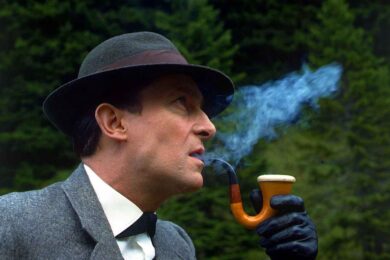


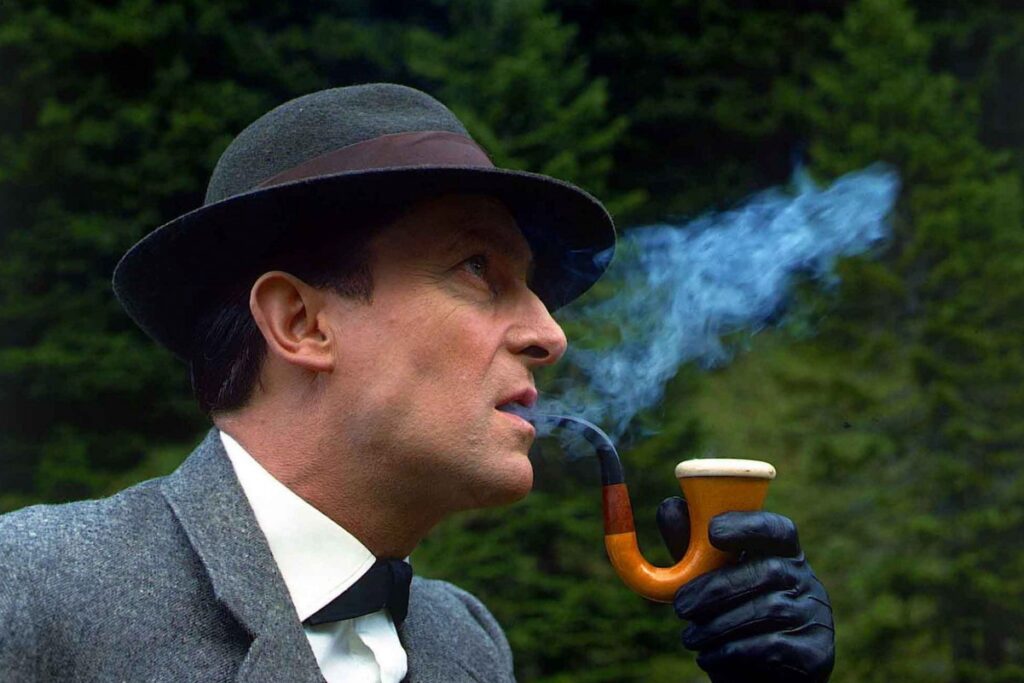
I did not fully believe in Sherlock Holmes’ existence until I first set eyes on Jeremy Brett, the actor smirking mischievously at me from our small television screen in a manner his literary model would have rejected as unserious. As befitting a fictional detective, a fact not altogether obvious on my tour of his ‘house’ 221b Baker Street where he was referred to as a real person throughout, Holmes has been played by over 300 performers. The Sherlock Holmes Society hails Douglas Wilmer, the Grand Vizier in The Golden Voyage Of Sinbad, as the “definitive Sherlock Holmes” (a judgement the actor unsurprisingly agreed with), regarding Brett as “rather embarrassing”. For a role which encompassed everyone from Dracula (Christopher Lee) to Moses (Charlton Heston) opinion on whom the cap best fits is inevitably contested, but for me no one has ever come close to the deranged necromancy of Jeremy Brett, the all seeing eye and keeper of secrets, who played the fictional detective from 1984 to 1994, overseeing my intellectual development and the first fissures in the dominance of terrestrial broadcasting. If Conan Doyle created a deductive case solving machine, venerated for his ability to see past the world of appearances into truth itself, Brett bequeathed Holmes with the missing pieces that turned him into a credible being a precocious boy could hope to one day emulate.
What makes Brett’s efforts comparable to the American telly-titans that followed in his wake (the most obvious being James Gandolfini’s portrayal of Tony Soprano), is the way he occupied his assumed identity with Shakespearean levels of immersion for over ten years, fairly well destroying his life in the process. Nobody played Holmes more time than Brett – 41 episodes, out of 64 stories written by Doyle, several of them film length. He insisted that the screenwriters did not deviate from the original stories, and prepared for the role with close textual analysis bolstered by his personal identification with the character (which he always referred to as ‘you know who’). As a consequence Brett ended up cannibalising his own sense of self in an artistic triumph and personal tragedy that ranks among the most disturbing achievements of British drama.
Watching his inspired histrionics influenced my idea of what it was to be a genius, not always for the better, in an era when television was the first art form many of my generation would encounter. With only three (then four) terrestrial channels the much derided ‘idiot box’ was the social media of its day, derided by intellectuals for its lack of imagination and stupefying effects on the young. True as this so often was, television was also a progressive powerhouse and great leveller, which like rationing and conscription, high taxes and non-existent consumer choice, imposed a form of equality which if somewhat forced, guaranteed an elitism for the masses, or at least a level below which culture could not fall. Granada Television understood that any programme which occupied ITV’s prime time slot would have to appeal to working stiffs who would suffer a Pinter play to get to Terry And June, as well as budding aesthetes who could not wait for Last Of The Summer Wine to finish so they could watch …