
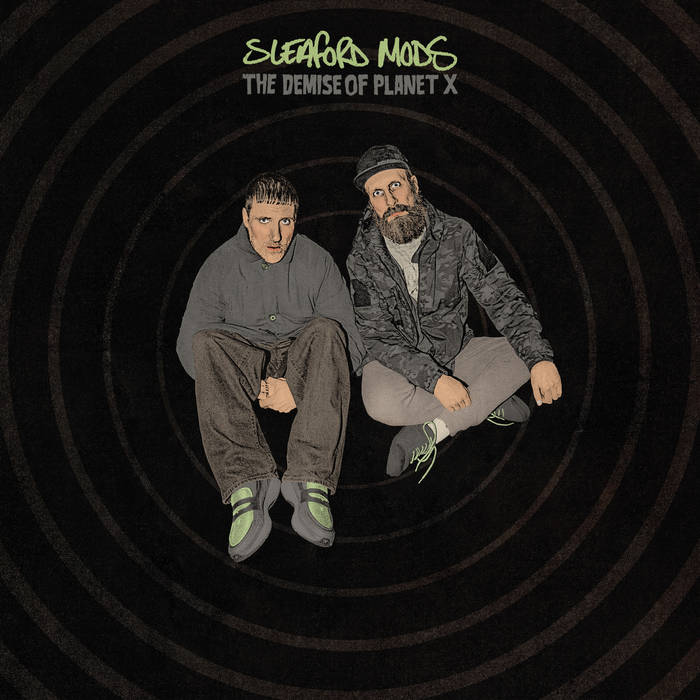
Throughout history, most religions and cultures have a rough idea about how the world might end. Abrahamic ones, like Christianity, Judaism and Islam prophesy their own individual doomsdays, fronted by damning omnipotence, while Dharmic religions, like Hinduism and Buddhism believe a new world will replace ours when it kicks the bucket. For Sleaford Mods, though, the world has already been diagnosed as terminal.
This decline is precisely what drives Jason Williamson and Andrew Fearn’s latest studio album, The Demise of Planet X. In Britain’s slow pitch drop towards the £9 meal deal, don’t expect any large-scale Armageddon, nor a spiritual rebirth: The apocalypse has already happened, and all we’re left with is Fred Again, artisan scotch eggs and shit post-punk bands.
But, as any apocalyptic horseman worth their salt will tell you, the end of the world can still mean a good laugh, no matter its mediocrity. It probably isn’t surprising to note, then, that The Demise of Planet X contains some of Sleaford Mods’ most fun music yet. Williamson’s vocals offer the same appraisals of British life and culture – chesty, plosive monologues, where “cunts” catarrh and regular rhythms dissolve inside dented enjambment.
On ‘Kill List’, ‘Flood the Zone’, and ‘Don Draper’, characters like Rishi Sunak, MAGA, and Tarka the Otter (the animal created by notorious British fascist Henry Williamson) find themselves rightfully in the firing line. And Williamson’s frenetic writing still yields lines that couldn’t conceivably come from any other group, like an elaborate threat to “Take your mum out for dinner / get her to WhatsApp you / in-between sheets of my paint thinner / in a town called bastard”, or making “minging” and “McMuffin” rhyme.
Improvements are small and subtle, but perhaps most apparent in Fearn’s production, no doubt sparked by a week of sessions at Abbey Road Studios and the liberating presence of an assistant engineer. Tracks manage to sound both in-your-face and over your head, making austere, cold soundscapes – like on ‘Gina Was’, or ‘Bad Santa’ – sound even more biting than before. The production also manages to sound punchy where it needs to – fitting for a project that leans further into melody than Sleaford Mods have ever done before.
On ‘Elitist G.O.A.T.’, which features New Zealand folk singer Aldous Harding, crisp production allows the interplay between Williamson’s shouty rants, and Fearn’s grimy bass, punched-out drums and Stooges-style sustained piano note to sound like a dad going mental at a school talent show, before being humbled by Harding’s airy chorus. Elsewhere, collaborations are abundant and fruitful. Sleaford Mods draw on a cabal of UK artists and creatives, ranging from Notts rapper and sometime collaborator Snowy – who drops a heater on the squelched-out ‘Kill List’ – to visual artist and Life Without Buildings vocalist Sue Tompkins, as well as actor Gwendoline Christie.
At The Demise of Planet X’s release, nearly three years have passed since Williamson and Fearn’s last album, UK Grim, and Britain feels a considerably different place. Far-right politics is no longer a looming threat but a terrifying reality; apathy isn’t edgy but increasingly seen as complicity. All of this begs the question of whether The Demise of Planet X can really be a progressive state-of-the-nation appraisal when its concept is based on narratives of cultural decline – claims that don’t actually feel far from those espoused by the likes of Farage, Musk and Tommy Robinson. After an apocalypse, it’s probably helpful to accept that things are over and might never return to their original state. But in times of political desperation, to frame Britain as already ruined, rather than something in need of unity, risks stepping away from the critique Sleaford Mods have always wielded so effectively.
The duo have never pretended that their music should hold any answers, and their latest effort is no exception. Yet conceptually, it sometimes feels as if Sleaford Mods retreat a little too far on The Demise of Planet X – diagnosing collapse with sharp wit but leaving little in direction or galvanising force. In a Britain that could use art to provoke unity as much as amusement, that distance feels not just like an easy route, but a missed opportunity, no matter how enjoyable the chaos remains.