

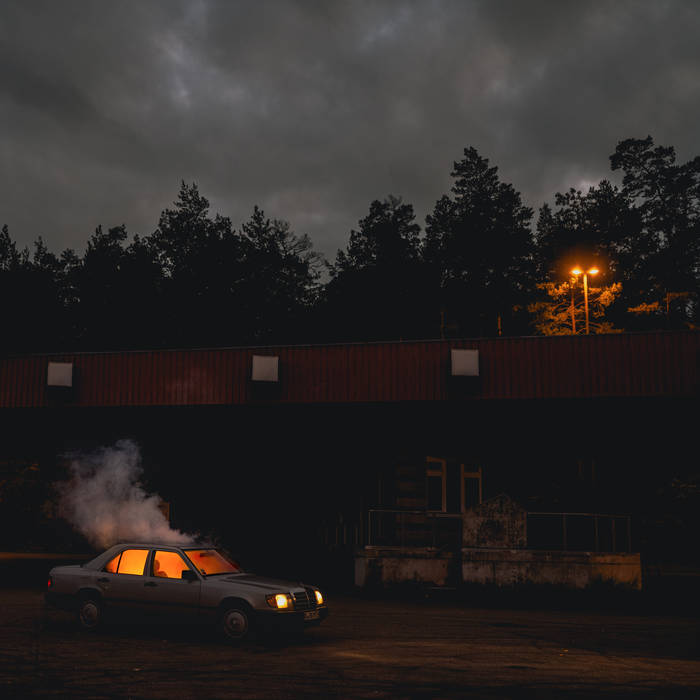
Lunng is the title of Sam Slater’s third namesake LP. With two N’s. I say it out loud. Roll it around my mouth a little bit. Lunnnnnng. It becomes less an organ and more like some new disease you get from living next to a data centre that’s burning through methane and fresh water to disrupt the sex-crime chatbot industry.
On the cover, it’s night. There’s a car on fire all by its lonesome. The aftermath of something. No people but its headlamps are on. How long does a car have to burn before its headlamps stop working? Out in the world, on the ground, in Minneapolis, Minnesota, ICE has just shot a man to death. It’s half past 10 AM EST on 24 January, a Saturday. My coffee is still warm. It’s well below zero degrees Fahrenheit outside. I take a sip.
In my headphones, the sound is heavy, the mood is funereal. A guitar-as-slo-mo-explosion, guitar-as-screwed-down-chainsaw floods the right stereo channel. A voice, wounded, hissing sibilance, cuts through. The voice, a surprisingly fragile thing given the vibe of the instrumentation, is Slater’s. Eventually, all gives way to memorial brass like a burial at sea.
You’ve likely heard of Slater as one-fourth of much-celebrated experimental heavies OSMIUM, a supergroup of sorts featuring Hildur Guðnadóttir, Senyawa’s Rully Shabara, and emptyset’s James Ginzburg. And sure, Lunng shares at least a little aesthetic and conceptual DNA with Slater’s more well-known side gig. For a start, both projects seem propelled in part by a compulsion to explore the idea and feeling of metal without really playing metal as such. But where OSMIUM’s thrilling, alien sturm und drang rigorously explores a relentlessly dark palette, Lunng’s proto-dystopic swatch book is much broader and more varied in hue. Slater’s heaviness makes ample room for moments of delicacy and fleeting beauty and vulnerable humanity. Shafts of pink and purple light breaking through seasick grey skies over a blasted and thrumming industrial landscape.
So, Lunng occupies a somewhat new space for Slater. While considerably less intense than OSMIUM, at its peak it reaches a fearless level of grit and intensity his previous, very worthwhile “solo” output just doesn’t. (I doubt that was even the goal with those records.) Here, he’s aided and abetted by sax idol Bendik Giske, Hilary Jeffery on brass, composer Maria W. Horn on vocals, Adam Betts on drums, Yair Glotman on double bass, and the aforementioned Ginzburg on that gnarly plank thing he’s so fond of. This is a certified wrecking crew of heavy hitters whose continued presence on a record could smother a lesser artist, but Slater has a keen ability to incorporate distinct creative voices into his own personal, idiosyncratic artistic vision without overwhelming that vision – and a maestro’s sense of when to impose himself on the proceedings and when to recede into the background. Take the elegiac ‘Praya’, for instance. Clearly meant to showcase the wonderful interplay between Giske’s looping, measured playing and Horn’s wordless, droning vocals, Slater’s impact on the track is almost spectral. He’s ever-present but his contribution registers like smoke in your peripheral vision. Still, the track could only be “his”.
Despite playing out like an elegy for a world and way of living we’ve yet to lose but are on the verge of losing, Lunng is never dour. There’s a certain palpable collaborative camaraderie on these tracks, reminding us, the listeners, that we aren’t alone in facing the Doomsday Clock. And while never an optimistic record, through recurring moments of beauty, Slater & co. remind us that, even now, mired in broken systems that serve only an extractive elite, the world is capable of providing so much more than struggle and suffering.
I rub my right wrist and check my texts. A medical bill. Just after the new year, I found out I’ve got two torn ligaments, a torn tendon, some degenerative stuff. I got the scans done last year, but the doc didn’t check the MRI until 3 January, so my insurance won’t cover it. I rub my wrist again and read about water bankruptcy. Increasingly, nothing seems tenable. Or everything seems more untenable, anyway.
An aggrieved processed voice gurgles unintelligibly through the Bluetooth speaker in my kitchen. Nauseous, acid-reflux electronics held in check by Giske’s sax and some appropriately gouty plonks. (They say gout is on the rise in America.) It strikes me as uncanny that a British guy in Berlin could orchestrate such a fitting soundtrack to this American moment, but maybe that’s me projecting. It’s probably the global moment. The everywhere moment. The burning car is Minneapolis but also Gaza but also Tehran. Lunng is music for a world toeing the precipice, but it’ll be no less compelling if we manage to step back from the ledge.