
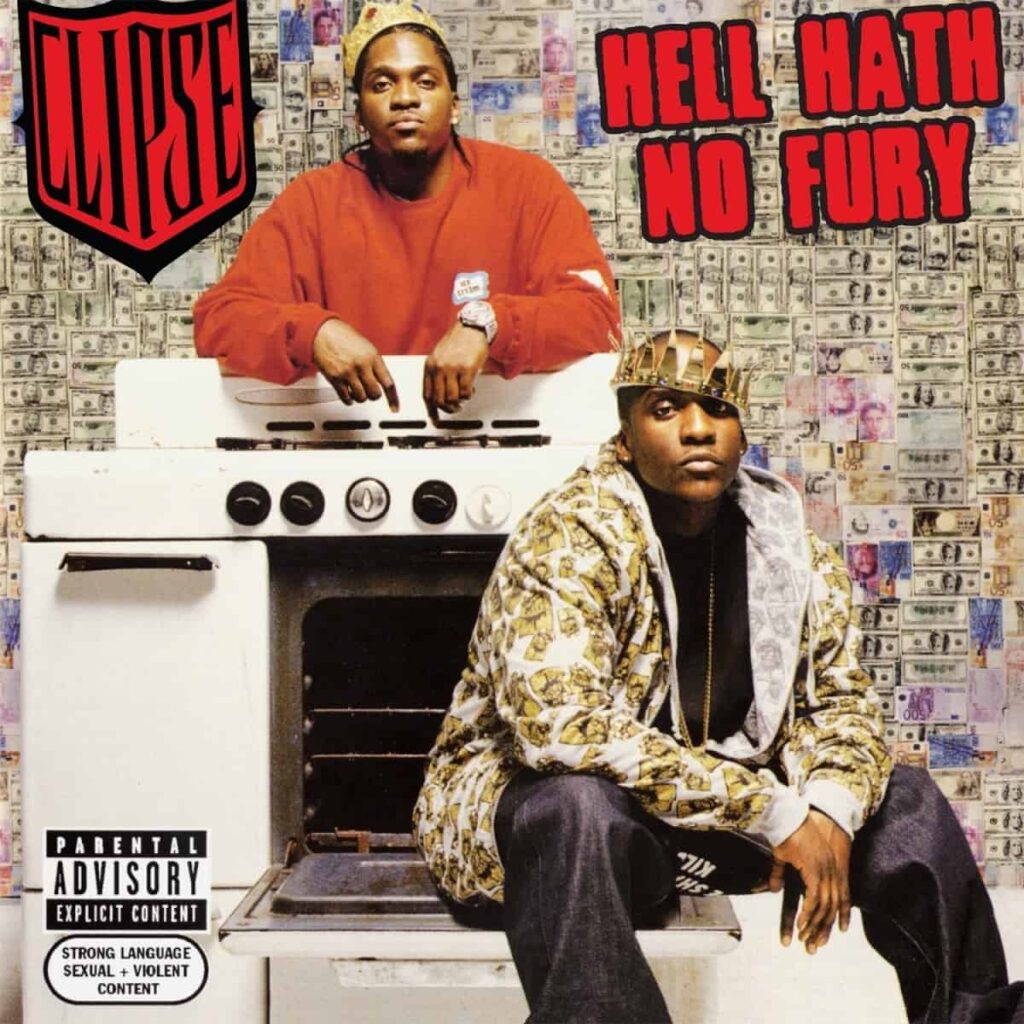
There’s a particular moment in an artist’s life when experience finally catches up with ambition — when the years of work, mistakes, refinement and persistence begin to cohere into something deeper than momentum. It’s the sense of having gathered your forces, learned enough about your craft, and lived enough life to finally say something with clarity. Listening to Hell Hath No Fury in 2026, nearly twenty years after its release, that feeling becomes impossible to ignore. What once sounded urgent and confrontational now sounds assured – not because the record has changed, but because the world around it has.
From 2006 to 2026 is a distance that contains a split, a name change, two reinventions, and a long solo detour – enough history to dismantle any sense of inevitability. And yet the return of Hell Hath No Fury to record store racks now, with Clipse newly Grammy decorated for their latest work, feels less like coincidence than convergence. This album itself has always straddled worlds: carrying the cadence of an underground hip hop album while radiating the aura of a mainstream release, its lean precision and eerie minimalism as compelling now as it was twenty years ago. Time hasn’t softened it. If anything, time has revealed it.
The sound remains as distinct now as it was in 2006. Produced under The Neptunes banner – the creative partnership of Pharrell Williams and Chad Hugo – the beats are skeletal, ominous and exacting, leaving space for Pusha T and No Malice to deliver razor-edged verses with surgical clarity. There is tension in every measure, a sense that the record was forged under pressure: label disputes, contractual limbo, industry frustration, and the duo’s own ambitions. That austere minimalism, once stark and confrontational, now reads as deliberate architecture – a blueprint for how rap could be cerebral and visceral at once, underground yet undeniably commanding.
Even in their early work, Clipse exhibited a rare sense of self. They understood who they were as artists – their textures, their environment, their moral tensions – and translated that awareness into music that was uncompromising yet precise. That clarity is what allows the album to resonate as vividly in 2026 as it did in 2006. From the opening declaration – ‘We got it for cheap’ – there’s both triumph and warning. Success obtained, yes, but at a cost. The line functions as bravado while hinting at fracture, a unity already under pressure.
Tracks like ‘Keys Open Doors’ and ‘Ride Around Shining’ also capture a very specific cultural moment: the height of mid-2000s bling rap, when brand names, diamond-flooded watches and iced-out chains functioned as both aspiration and armour. The references feel almost anthropological now, documenting a pre-financial-crash economy of visible excess – a world before “quiet luxury” reframed wealth as discretion. Clipse weren’t simply participating in that era; they were reflecting it, refracting it, interrogating it. Beneath the shine, anxiety was already present.
At the centre of Hell Hath No Fury, though, is something more enduring than cultural context: brotherhood. Their chemistry carries the authority of shared origin – Virginia Beach, family, risk, ambition. In their case, blood really is thicker than water, not as cliché but as structure. Yet the album also contains the earliest hints of divergence. Listening now, it feels like a moment suspended just before paths begin to separate.
That separation would eventually arrive: solo careers, spiritual transformation, new identities. Two simultaneous reinventions. No Malice’s evolution from his earlier persona was not a rejection of the past so much as an expansion of it – proof that artists, like people, are allowed to change their minds. In interviews, No Malice has spoken about watching his brother navigate the industry independently and within the orbit of G.O.O.D. Music with almost a parental attentiveness. “I watched him close… like my mother would watch him,” he said, describing Pusha T as a lone wolf, precise and self-directed in his pursuit. The remark reframes the narrative surrounding Clipse: separation not as rupture, but as extension. Distance did not dissolve the bond; it tested it.
Time, of course, is the element no artist controls. Nearly two decades later, experience has rewritten the emotional architecture surrounding their music. On their 2025 album Let God Sort Em Out, particularly on the Kendrick Lamar collaboration ‘Chains & Whips‘, the precision of their delivery and the density of the writing feel less like commercial rap and more like performance art – rhythm as structure, imagery as architecture, voice as instrument. It’s a reminder that hip hop, at its highest level, has always functioned as poetry as much as music.
That maturity is even more apparent in songs shaped by loss. Where Hell Hath No Fury included ‘Momma I’m So Sorry‘, a track charged with ambition, guilt and distance – the tension between pursuit and responsibility – newer work reflects grief with a tenderness that would have been almost unimaginable in 2006. The deaths of their parents, occurring only months apart, reframed perspective entirely. Across the years, what emerges is not contradiction but continuity. Family was always present; what changed was the vantage point. In 2006, they were sons moving further outward into the world, negotiating consequences in real time. Nearly twenty years later, they are sons looking backward, holding memory, loss and gratitude. The emotional sphere of reference has expanded.
This evolution also signals a broader cultural shift. Hip hop, long framed as a young person’s arena, is beginning to confront its own longevity. If painters, sculptors and writers are allowed to practice their art until the wheels fall off – refining, evolving, beginning again – there is no reason rappers should be denied the same grace. Some artists produce their most profound work later in life, once experience deepens perspective. Clipse embody that possibility. Now in their forties and fifties, their continued relevance and importance challenges the genre’s historical ageism, proving that maturity does not dilute authenticity; it intensifies it.
What becomes clear in 2026 is that Clipse are operating less like legacy rap figures and more like career artists in the classical sense – two artists in residency committed to lifelong refinement. What we’re now witnessing isn’t nostalgia. It’s maturation. A genre beginning to recognise its own capacity for longevity, complexity and depth. A quiet renaissance.


Ultimately, Hell Hath No Fury endures because it functions as both artifact and living text – a document of a moment that continues to reveal new layers as the artists themselves evolve. Hearing it now, with everything that followed – separation, reinvention, grief, survival – reframes its tension as foundation rather than crisis.
Twenty years later, the circle doesn’t close so much as expand. The pressure that once shaped the record now reads as permanence. The brothers who recorded it in uncertainty return to it with history behind them, occupying space fully – not just as survivors of an era, but as artists still expanding on what that era made possible.
Clipse’s first three albums are reissued by CMG today