

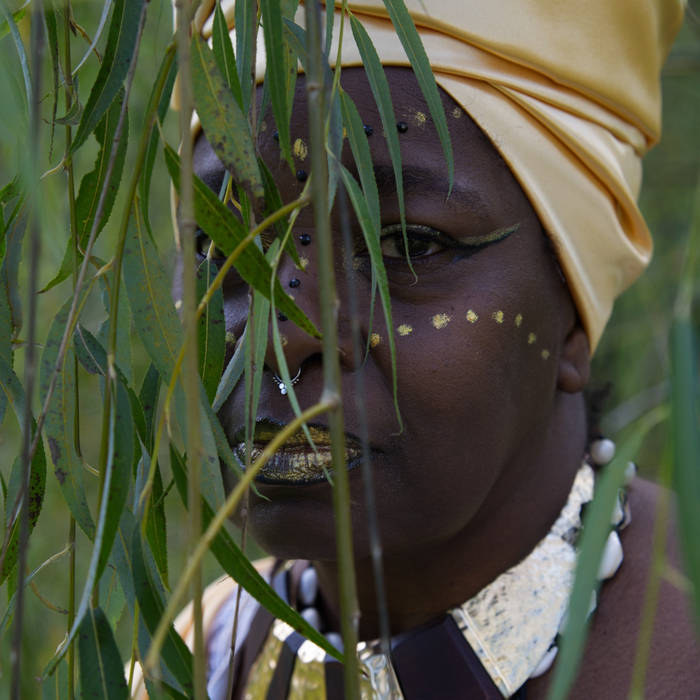
Do you need a sensitivity to divine forces to be drawn into Nilza Costa’s new album? Not necessarily. But it does require a willingness to listen to music that resists explanation. Nilza Costa is a Brazilian singer and songwriter from Salvador de Bahia, now based in Italy. Her new album revolves around cantigas – sacred songs from the African diaspora – sung in Yoruba, Kimbundu and Brazilian Portuguese. These songs function as direct invocations of the orishas: spiritual entities that, in traditions such as Candomblé and Santería, connect human life with nature, history, and the divine. Rather than presenting this tradition from the outside, the album positions itself within it, as a continuation in sound.
Costa’s voice anchors the album. It carries a finely balanced mixture of sorrow and calm, in which traces of violent displacement and historical trauma are held with notable dignity. The expression is never sentimental; instead, it is marked by a grounded assurance that gives the songs weight without tipping into pathos.
Each track is dedicated to a specific orisha – from ‘Exu’, the spirit of movement and crossroads, to ‘Yemanjá’, the Great Mother – and the compositions follow a consistently pared-down form. The album opens and closes instrumentally, and percussion is the dominant driving force throughout. On most tracks, Costa’s voice is tightly encircled by drums, holding the music in a circular, almost hypnotic motion. This is ritual music in the most literal sense: repetition is not a device, but a condition.
Musically, the album moves confidently between tradition and the present without falling into the familiar “fusion” trap. Nothing feels overproduced, and even when the bass takes on a subtly funky edge, it does so with restraint, adding momentum without undermining the ritual gravity. While the cantigas function as prayer and storytelling, the album’s strength lies in the fact that the songs also stand as compelling pieces of music.
‘Oxum’ is a clear highlight, as percussion gradually opens the space for trumpets and a spacey, Joe Zawinul-worthy keyboard solo in a sensual celebration of the Lady of Gold. ‘Oxumaré’ is more ballad-like, reflecting its theme of uniting masculine and feminine, life and death, while the brief, string-led ‘Nanã’ provides the album’s most contemplative pause. Listeners drawn to Milton Nascimento’s spiritual introspection or Cesária Évora’s quiet gravitas will find much to resonate with here. Costa’s album succeeds not by explaining its meaning, but by trusting that ritual – carried with clarity and conviction – can speak for itself.