
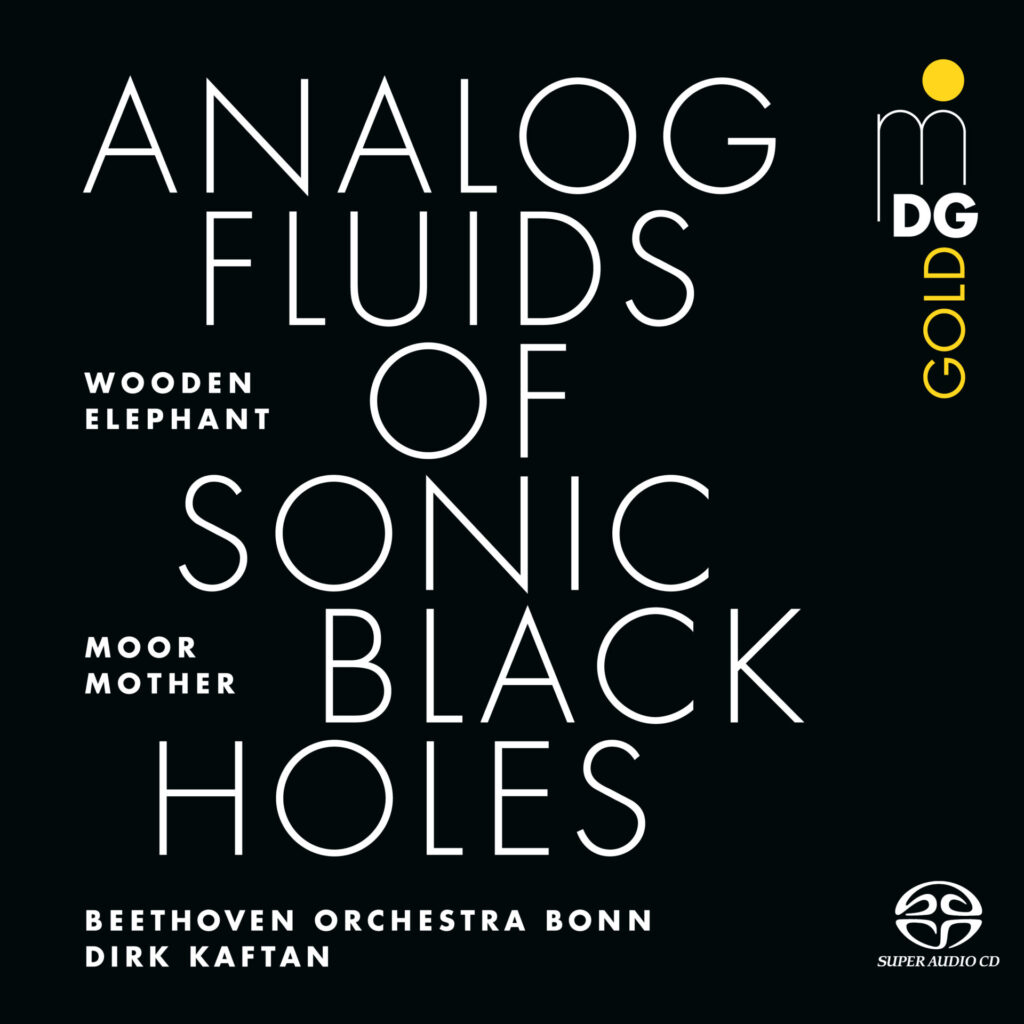
For around a decade, Philadelphia’s Camae Ayewa has been constructing sonically experimental and thematically radical works of art. As Moor Mother, the musician and poet’s art often offers searing takedowns of structures of oppression and on the imperialism, colonialism and brutality that has resulted in generations of Black trauma. She delves deep into this on her 2019 album Analog Fluids Of Sonic Black Holes, the sense of widespread socio-political discontent illustrated by the record’s brutal, auditory chaos. Now, in her latest release, Moor Mother reissues that same album as a brand new orchestrated edition, featuring the string quintet Wooden Elephant and The Beethoven Orchestra Bonn, conducted by Dirk Kaftan, once again blurring the boundaries between genre and art to present something viscerally powerful.
This new version of Analog Fluids Of Sonic Black Holes starts ominously, a legato string melody sliding around as the droning backdrop intensifies. It builds to a cacophonous wall of noise before Ayewa enters solemnly with “Over our head, repeater, deceiver / Over our head, death receives me.” As with the original album, the intensity of the competing strings coupled with the urgency in Ayewa’s words sets the tone for the rest of the record, preempting discomfort, rage and resistance. In tandem with the album’s second track ‘Don’t Die’, it’s an opening that packs a punch, the latter’s wailing vocals mimicked by the strings with dissonant glissando. “They’ve been killing since the beginning of time,” she seethes, with the track’s original distortion-heavy ending replaced with erratically descending strings, which powerfully crescendo into the start of ‘After Images’.
In ‘After Images’, the track’s industrial percussion becomes a single, steady drum beat and screeching strings, with the addition of brass and a staccato snare drum amplifying the strain in her voice as she repeats, “5, 4, 3, 2 / Cause after they come for me they gonna come for you”. Throughout Analog Fluids Of Sonic Black Holes, Ayewa’s vocal delivery and gripping spoken word is what helps to place emphasis on the poignant themes and the album’s overall message of defiance against white supremacy, which also remains the case in this new version. The poetry of ‘The Myth Hold Weight’ is augmented by the quiet murmur of the strings, which ebb and flow around Ayewa’s words. And likewise ‘LA92’, which tells of the riots that were triggered by the LAPD’s assault on Rodney King, introduces bells which punctuate the track’s chant-like vocal line.
Additionally, the loud, abrasive electronic soundscapes that make up the 2019 album are superseded by fascinating orchestral arrangements, without any of the original potency being disrupted. On ‘Engineered Uncertainty’ and ‘Master’s Clock’, for example, what sounds like col legno and pizzicato strings take over, having the same pay-off as the original but with an added dose of dramatic tension.
On the whole, the symphonic version of Analog Fluids has the effect of enhancing the album’s cinematic undertones, the arrangements adding weight to Ayewa’s imagery. Closing track ‘Passing Of Time’ exemplifies this beautifully, a solo violin melody floating gently above her tender storytelling: “And my mama, my grandmama, my great great great grandmama, picked so much cotton, they saved the world, all by themselves”. That’s not to say that one album is better than the other; rather, both hold their own space. When listening to each side by side, it’s clear that this new edition of the album complements the original in a way that only works to highlight the evocative power of Moor Mother’s artistry and activism.