As we hurtle into yet another new year, I’m still catching up on great records from the end of the last one – or great tapes, to be precise, with a couple of essential releases landing on cassette after even the tardiest music publications had finalised their year end lists.
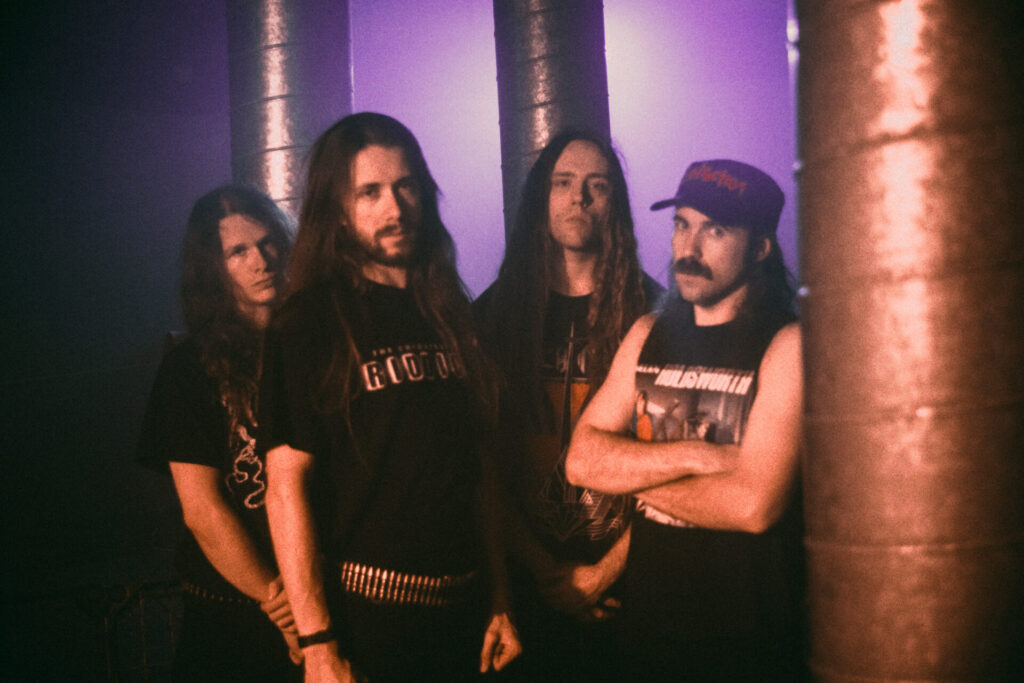
Nottingham psych-sludge legends Dead In The Woods returned out of nowhere with a self-titled album, almost 13 years since the band had originally called it a day. The members have all been active in other projects since of course, such as Moloch, Bloody Head and Burial Rot to name just a few, but it’s remarkable just how well they’ve slotted back into the Dead In The Woods sound here. For the uninitiated, the band have knowingly referred to themselves as His Hero Is Hawkwind, and both sides of that equation seem massively dialled up here. The punkier sections hit harder than ever, with songs like ‘Dies Irae’ conjuring His Hero Is Gone’s massive, sludgy, crusty din, whilst the psychedelic parts sound even more hallucinogenic, thanks in large part to vocalist Jérémie Cauchois’ freewheeling theremin bursts. The swirling, cosmic leads, rolling groove and seismic bass frequencies of opener ‘Transmission I: Crossing Damnation Alley’ almost sound like the original Electric Wizard line-up busting out a hazy rendition of Led Zeppelin’s ‘No Quarter’, but then crunchy hardcore bangers like ‘Leeches, Ticks & Mites’ temper such astral outbursts with a more grounded, earthier wallop, resulting in an album that’s as cerebral as it is visceral.
Chinese by way of Edinburgh powerviolence trio C.H.O.U. recently released their new EP 患聲 on tape too, which roughly translates to ‘Sound Of Distress’. The band have absolutely nailed that 90s powerviolence sound, with a crushing bass tone, both high-pitched shrieks and guttural caveman barks, and songwriting that violently lurches from lightning fast to ultra slow and back again, but they also put their own unique spin on this sound in the process. The trio have never shied away from incorporating elements of more traditional Chinese music into their chaotic sound (the song ‘Caledonian Nostalgia’ from their 2024 demo, for instance, was inspired by Taiwanese songwriter Lo Ta-yu), and ‘何殇‘ goes one step further here, utilising the eerie sounds of a yangqin without diluting any of the band’s furious energy. At time of writing, both C.H.O.U. and Dead In The Woods have tapes still available via Bandcamp, so you know what to do!
Speed freaks shouldn’t miss the debut album Rosszabb, Mint A Halál… from Hungary’s Retorsion either. I’m usually a little dubious of projects that base their entire identity around ripping off one particular band (come on, just throw one more influence into the melting pot and see what happens. Endless bands ripping off Discharge? Boring. Dishammer ripping off Discharge whilst also ripping off Hellhammer? Genius. You see how this works?), but in the case of Repulsion worship, I can be a bit more lenient. After all, the legendary grindcore pioneers never followed up their late 80s masterpiece Horrified, and despite leaving such an enormous shadow across extreme metal in general, nobody else has ever really come close to that classic Repulsion sound – but Hungary’s Retorsion certainly give it a good go here, with whirlwind blastbeats, throaty roars and an oppressively crispy bass tone. The record is even structured like Horrified, blasting through a series of brisk, fat-free grinders before dropping a handful of more mid-paced chuggers at around the same spot as ‘Black Breath’ would have been. It may not have the slightest ounce of originality, but it rips so hard you’ll barely care.
ConvergeLove Is Not EnoughEpitaph
It’s wild to think it’s been almost a full decade since Converge’s last full-length proper, 2017’s sorely underrated The Dusk In Us; not taking into account their 2021 collaboration with Chelsea Wolfe Bloodmoon: I, that’s their longest break between studio albums ever. At a lean 31 minutes, Love Is Not Enough is comfortably their shortest album yet too – but if that seems disappointing after such a long wait, take comfort in the fact that it is very much all killer, no filler. With no special guests this time round, no yearning epics and no experimental detours, this is something of a return to form for Converge, dishing out half an hour of intensely focussed aggression – with the exception of atmospheric mid-way breather ‘Beyond Repair’, the album just seems to keep ramping up the intensity throughout.
Barnstormers like the incendiary title track and ‘Distract And Divide’ are absolutely seething with rage, ruthless little nuggets of bone-crunching hardcore with nary an ounce of fat on them whatsoever, whilst ‘Force Meets Presence’ brings in more blastbeats and nimble speed metal riffs whilst retaining the band’s punk intensity. ‘To Feel Something’, meanwhile, fuses that abrasiveness with some of Jacob Bannon’s most tortured vocals, with the band sounding perhaps the most they ever have like Relapse-era Today Is The Day. Even the record’s slower, more atmospheric cuts have an uncomfortable urgency to them – the caustic ‘Gilded Cage’ is built around an absolute fucking monster of a bass line that recalls the noise rock flavour of The Dusk In Us highlight ‘Trigger’, but with a much moshier, 90s mathcore sensibility, whilst ‘Bad Faith’ and ‘Amon Amok’ are both powerful chuggers, seemingly custom built for inciting chaos at live shows with the former’s brute force riffing and gang vocal barked hook bringing to mind fan-favourite ‘Black Cloud’.
With rumours of a second Bloodmoon album swirling around, it’s likely Converge’s more expansive, experimental tendencies will still have plenty of space to blossom in the future, but for now, Love Is Not Enough is a very welcome return to the band’s more visceral, venomous hardcore roots, refined into a particularly potent and efficient package. There’s a certain group of Converge fans that have been crying out for a record like this, so if that’s you, do not miss this.
Cryptic ShiftOverspace & SupertimeMetal Blade
It’s now also been six years since Leeds’ most cosmic death metallers Cryptic Shift released their debut album Visitations From Enceladus – the band clearly haven’t been slacking in the interim, mind, with three of the four members also playing in the much more primordial Slimelord, who’ve been busy with their own debut album and a heap of touring over the last few years. Even without these extracurricular concerns, however, it’s clear that the ambitious Overspace & Supertime isn’t the sort of record you could just bang out in an afternoon – whilst the last album boldly kicked off with the 25 minute ‘Moonbelt Immolator’, this almost 80-minute behemoth boasts a pair of songs breaching the twenty minute mark, and none clocking in under nine minutes whatsoever. The songwriting manages to feel both extravagantly maximalist and surprisingly focussed – even ‘Hyperspace Topography’, arguably the record’s most direct and straight-forward track, makes room for some jazzy breaks and swirling sonic vortexes amongst it’s pummelling blasting and razor sharp riffing. From the first second ‘Cryogenically Frozen’s crystalline, jazzy clean guitars spring into earshot, it’s clear this isn’t going to be your average death metal record – and when the band do ramp up the distortion and blast into furious riffing mode, they sound even sharper, tighter and more focussed than ever before. If Visitations From Enceladus was like being caught in a tractor beam emanating from the underside of a UFO, this record feels like having thoughts instantly and telekinetically implanted in your consciousness direct from some unfathomable alien species therein; it’s more streamlined, evocative and visceral despite seeming far more unlikely and difficult to comprehend.
The band cite both Mahavishnu Orchestra and Teutonic thrash metal as inspiration for the 29-minute ‘Stratocumulus Evergaol’, and you can certainly hear it as psychedelic jazz fusion licks gradually morph into fiddly, breakneck riffing, whilst frantic palm-muted chugs collide with dazzling leads and the sounds of distant lasers zipping past during the song’s ‘Skirmish’ section, a slice of pure sensory overload designed to evoke a madcap space battle. Of course, there are echoes of late 90s prog death heroes like Atheist, Pestilence and Cynic all over this record, but there’s a clear Nocturnus influence here too – obviously in the band’s sci fi death metal aesthetic, but also the way they use sound effects to prop up the record’s narrative structure. There’s an even stronger focus on that narrative element here compared to the debut, with songs like ‘Hexagonal Eyes (Diverity Trepaphyphasyzm)’ offering up an even more cinematic take on the band’s space-faring sound – in fact, the whole album plays out like a death metal space opera, with myriad different parts and suites working in tandem to create a dauntingly ambitious whole.
The Ruins Of BeverastTempelschlafVán
January’s release schedule kicked off with a bang this year, as Alexander von Meilenwald’s project The Ruins Of Beverast continues to be one of extreme metal’s most unique and distinctive outfits. The sinister melodies, tribal drumming and mournful, baritone vocals of the opening title track might suggest that this seventh full-length is going to be a direct continuation of its predecessor The Thule Grimoire’s more gothic sound pallet, but don’t be fooled – it doesn’t take long before ‘Day Of The Poacher’ busts out some of the most aggressive, blackened material the project’s put to tape in years, all belligerent oompah beats, robust tremolo riffing and hoarse, harsh roars. ‘Babel, You Scarlet Queen!’ is even faster and harsher, whilst retaining the evocative, arcane atmosphere we’ve come to expect from the band, and ‘Alpha Fluids’ marries forlorn, sepulchral melodies to furious blasting to curiously anthemic effect. ‘Cathedral Of Bleeding Statues’ and 13-minute closing epic ‘The Carrion Cocoon’, meanwhile, drop the tempo down to crushing, lumbering doom territory without dispelling any of the record’s brooding intensity.
In many ways Tempelschlaf feels like a neat summary of the band’s journey so far, marrying both the more psychedelic pastures of 2017’s Exuvia and the gothic romanticism of 2021’s The Thule Grimoires with the darker, more subterranean doom and black metal elements of earlier works like Rain Upon The Impure, whilst still retaining a rich and distinct character all of its own. There’s a certain efficiency to the songwriting this time round too, that’s perhaps unsurprising given how much the project has blossomed in a fully fledged touring band in recent years; whilst the album still allows for the expansive vistas the band has always excelled at crafting, this is a much tighter, punchier collection of songs in general when compared to something like the sprawling Foulest Semen of A Sheltered Elite, seemingly written for the stage over anything else. Whether you’re a diehard fan or a total newcomer, this comes highly recommended.
RefugiumIn Hope Of Eternal LifeDesert Wastelands
This Denver-based solo project dropped two pretty intriguing EPs in 2024, both taking cues from the Peaceville school of melodic, melancholic death/doom metal – but whilst songwriter Garret Smith seemed to have nailed the aesthetic right out of the gate, neither EP quite lived up to its full potential, both seeming a little rough around the edges, albeit in an endearing way. This debut full-length is exactly what I wanted from Refugium however, tightening up the songwriting and boasting a much more impactful production, without entirely ditching the EPs’ ramshackle, homemade charm. Songs like ‘Fate’s Final Gasp’ and the sultry, almost bluesy ‘Frostbitten Millennia’ do a good job of capturing the dour, forlorn atmosphere of early Anathema, with a few eerie Disembowelment-esque clean guitar licks drifting atop palm-muted chugs to an agreeably hypnotic effect.
Smith’s guttural vocals sound suitably deep and imposing here, and whilst his whispy clean vocals still feel a little lacking in comparison, they have an earnest, honest quality to them that adds to the album’s yearning atmosphere, especially on ‘Luster Of Solitude’ as he layers up distant, forlorn chants to sound like a group of terminally depressed monks. Paired with those aching, drawn out guitar harmonies, it makes for quite a potent combo, before the track erupts into some of the record’s most aggressive and deathly riffing. In Hope Of Eternal Life isn’t any kind of huge step forward for the genre, but if you’ve worn out your old My Dying Bride and Paradise Lost records and need a similar flavour of misery to see you through the winter months, this should hit the spot.
FleshvesselObstinacy: Sisyphean Dreams UnfoldedI, Voidhanger
Having firmly established themselves in the arena of weirdo prog death with both their ambitious 2020 EP Bile Of Man Reborn and 2023’s unhinged debut album Yearning: Promethean Fates Sealed, Illinois’ Fleshvessel have gone fully off the deep end with this second opus. The four lengthy pieces on offer here stretch far beyond the admittedly adventurous death metal of past releases, with spiralling keyboard solos and sporadic bursts of flute, viola and harp punctuating their dense, oddly whimsical prog metal. Perhaps most immediately striking, however, are frontman Troll Hart’s bizarre vocals, which range from guttural death growls to squawking King Diamond-esque falsetto and even histrionic spoken word passages this time round – and that’s all before you’ve even finished the first track ‘Mental Myiasis’! To call his approach here an acquired taste is perhaps underselling it, but he ensures there’s never a dull moment across the almost 50-minute long LP, and there’s a certain whacky charm that becomes quite endearing, provided you’re not the kind of person who will instantly and viscerally hate it, of course.
The music here certainly matches his obtuse and over-the-top style – the chunky riffing of ‘Cessation Fixation’, for example, abruptly gives way to a percussive segment powered by a surprisingly groovy triangle rhythm and a funky, almost Primus-esque bass line, whilst ‘It Lurched From A Chasm In The Sky’ slips into a robustly crepuscular jazz-fusion workout complete with burbling fretless bass, twinkling piano keys and disarmingly soulful guest vocals from Hannah Goldenstein. Similarly, it’s not long before ‘Am’’s churning death metal squelch gives way to a folky interlude with operatic female vocals and flourishes of ocarina rubbing up against tremolo riffs and blastbeats (which sound much more organic and powerful now that the band have ditched the drum machine in favour of percussionist Colin MacAndrew). The record seems to embody the most excessive and flamboyant tendencies of both modern extreme metal and 70s prog in a gloriously nerdy manner – if Blood Incantation’s recent fusion of these styles on 2024’s Absolute Elsewhere felt streamlined and, for want of a better word, cool, this record is much messier and dorkier, but in a strangely engaging way. The “anything goes” approach to song-writing combined with the varied sonic pallet on offer here reminds of a more theatrical, playful Kayo Dot at times too, especially on some of the jazzier outbursts. It already seems like this record has somewhat divided the band’s fans, and whilst I’m not at all surprised, I have to say I’m finding it very entertaining. For the more open minded metal nerds out there (I’m looking at you, Quietus readers!), there’s much to enjoy here.