

“The objects outside the head control the mind,” says Florence Shaw, less than a minute into Secret Love. “To arrange them is to control people’s thinking.” She’s backed by a distant rhythm made to sound like heightened breaths – raised just above resting pace, perhaps by distress, perhaps giddiness, perhaps something else. Her words are pushed to the front of the mix so that you hang on each one of them.
At first, it’s easy to view this line merely as one of many others. Shaw’s writing has always offered tightly crafted little vignettes that briefly emerge and then disappear to make way for another. And yet, as Secret Love progresses in this way, knotty and complex, it’s that first line that I keep returning to. “The objects outside the head control the mind” emerges gradually as the theme of the record writ large. The mind and the head in question – the one being “hit all day”, as the name of the opening track has it – are Shaw’s own. It’s a mercurial mind, flittering from moments of confidence to self-consciousness, from longing desperately for connection to revelling in it, from piercing observation to meandering half-thoughts. Outside it swirl the things that control it in one way or the other, for better and worse – the devotion of a loved one or the joy of organisation on the one hand; sinister influencers, warmongers, and societal expectation on the other.
Adept as Shaw is as a songwriter, these twists in tone would be harder to pull off were it not for the rest of the band, whose instrumental offerings have taken a noticeable leap forward since 2022’s Stumpwork. Whether an angular groove so watertight that it can serve as a song’s foundation, or a little lick of slide guitar that ups the sweetness just the right amount, or a tactically deployed backing vocal to emphasise Shaw’s words, Dry Cleaning as a foursome have never felt so closely intertwined, nor as broad in their capabilities. This is likely the product of having widened the net when it comes to collaborators. The presence of producer Cate Le Bon is felt heavily in Secret Love’s blend of spikiness, loucheness and groove, while sessions with Jeff Tweedy of Wilco seem to have deepened their existing ability for intricate earworm melodies. When Dry Cleaning plunge into darker territory, their work with Gilla Band’s Alan Duggan and Daniel Fox bears fruit, the woozy mania of ‘Rocks’, for instance, or the raging, osmium-heavy guitars on ‘Evil Evil Idiot’.
That last song is one of a few in which Shaw directly inhabits the characters peddling the darker of those objects outside the mind, a first-person portrait of a dunderhead advocate for the nutritional benefit of burnt foods, who decries medical consensus that they’re carcinogenic as “malicious studies”, Shaw imbuing just the right blend of snarl and pathos in her performance. ‘Cruise Ship Designer’ presents a more pathetic figure still, searching desperately to find greater meaning in the cold opportunism of his profession, his inconsistency as tragic as his refusal to acknowledge the ugly, monetary truth.
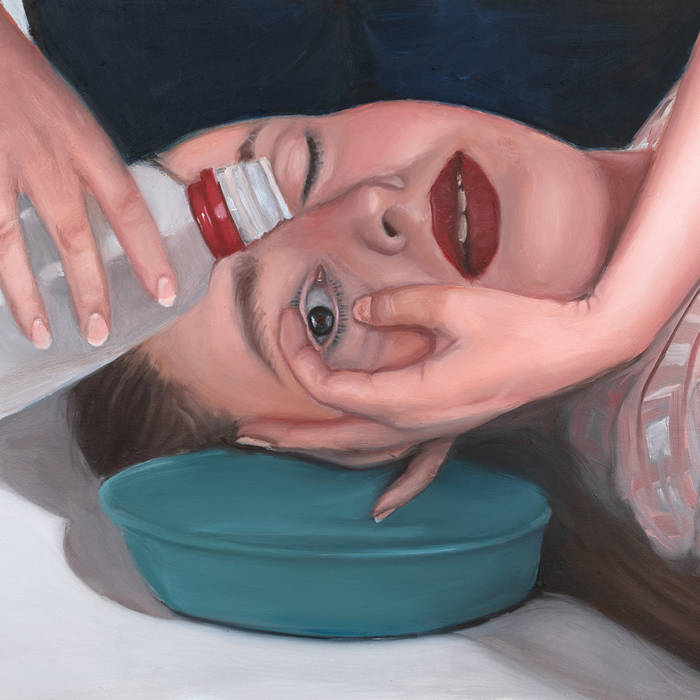
Despite the character studies, however, Secret Love is ultimately a personal work. Shaw has spoken in press material about a “tension between feeling like I want to hide, but at the same time a certain yearning to be seen by people and to grow,” and here she’s shifting markedly towards the latter. It’s indicated by the album cover, where she is depicted by the painter Erica Eyres having her eyeball washed, one eye shut and the other forced open. Like those breathing sounds in the backdrop of the very start, there’s no direct emotional reading – it could be a painful procedure or a cleansing one, the open eye could be fixed on something horrible or beautiful, the closed one could be wincing or it could be relaxing – but whatever the reading it shows her in a vulnerable state. It marks a contrast from the only other time she’s appeared on a cover, 2020’s debut New Long Leg, then just a shadow on a pavement.
That element of openness (whether forced or offered) is mirrored on the record itself, particularly those points when focus shifts from the exterior to the interior – from the objects outside the head to the mind that’s grappling with them. Sometimes, the relationship between the two is made clear. On ‘Blood’, for instance, it’s explicit how the stream of horrific imagery beamed from Palestine, Ukraine and beyond (“blood on my screen, blood for breakfast”) is now so constant as to invite nothing more than “numbness without end or change”, a point underpinned by the instrumental’s disarming juxtaposition of urgent rushes of guitars and moments of eerie calm.
Elsewhere, however, it’s more subtle. The delicate ‘Let Me Grow And You’ll See The Fruit’ paints a tender, though disarmingly funny (another Shaw hallmark), portrait of self-consciousness (“move away from me / I constantly think there are spiders on me and around me / enjoyed your gig, even though I thought there were spiders all over me”), but in the wider context of Secret Love it’s worth considering this sense of unease with the world within the context of the Cruise Ship Designers and their ilk who are making it so uneasy.




Similarly on ‘My Soul Half Pint’ Shaw draws a distinction between a love of organising as a mental balm (“it gives me an achievable goal, clears my mind”) and a deep resentment for the similar-yet-completely-different act of cleaning, intensified by the way society has stratified it as a woman’s work, all the while acknowledging a simultaneous sense of self-consciousness (“something I gotta get over / it’s pretty immature”). In a world of Evil Evil Idiots, however, you’re left wondering whether that frustration is in fact a manifestation of something deeper bubbling in the subconscious.
All of this makes the record’s final song ‘Joy’ intriguing. Immediately following the penultimate ‘I Need You’, which has drifted along gently on a slow and tender current of bass clarinet, ‘Joy’ begins with a sudden crack of snare and a whip of jangling guitar, as if snapping out of a reverie. “It’s a horrorland. Destruction,” says Shaw with confidence suddenly restored. “Don’t give up on being sweet.” Later, she proclaims “macho” to be “in its death throes” and rejects the toxic visions offered by the “muscle cult”, promising instead to “build a cute harmless world.” Having plumbed so deep into an unsettled conscious thus far, such unabashed optimism is disarming, perhaps even a delusion. And yet, the record acknowledges, if our minds are ever to improve, we must first re-arrange the objects outside them.