

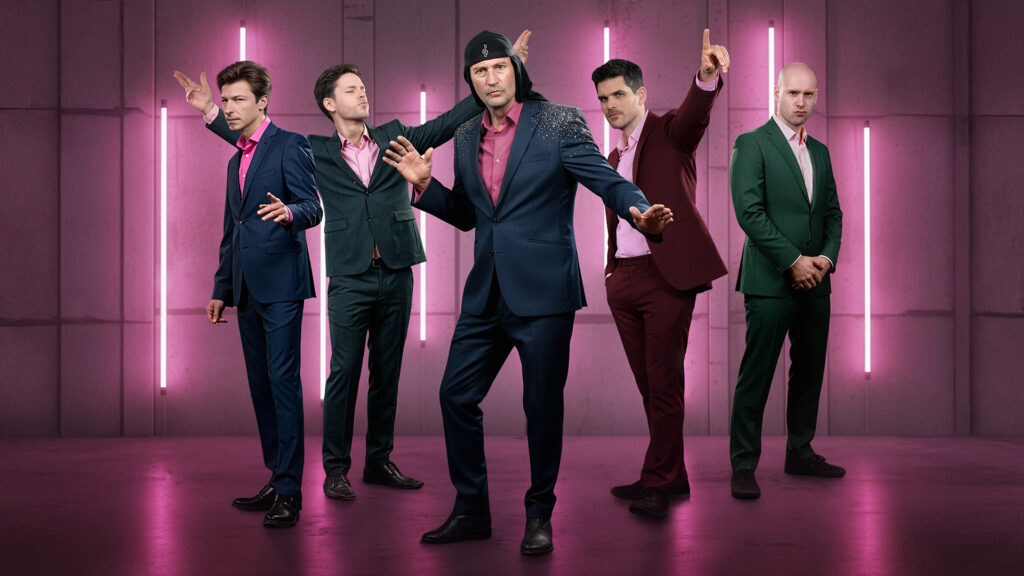
In a small, smoky room in Sarajevo some time in the early 80s, socialist apparatchiks in suits discuss the problem of youth delinquency and the horror of “Western influence”. One comrade makes a deadpan joke that they should form a rock band. His logic is that the kids are getting restless and rock music already exists: “So let’s channel it; institutionalise it; give it a socialist framework.” The cadres nod and discuss it with the same level of seriousness they would apply to talking about agricultural quotas.
Anyone who recalls the beginning of Emir Kusturica’s first feature film, Do You Remember Dolly Bell? may have suspected it all along: the Socialist Republic of Yugoslavia [SFRJ], far from banning rock music, actually organised it.
A new book by Dr. Nele Karajlić, the stage persona of Nenad Janković — a musician, writer, TV star and standup comic from Sarajevo, best known as the frontman of Zabranjeno Pušenje and as a star of cult TV show Top lista nadrealista – goes one step further. He suggests that the entire Yugoslav rock scene happened because of conspiracy carried out by the regime.
The third volume of Solunska 28 by Karajlić essentially carries on telling the history of a building in Belgrade and its inhabitants during the late 20th century, as Yugoslavia falls apart at the seams and private lives intermesh with civic disintegration. Halfway through the book Karajlić introduces a character from the “Service” – shorthand for the Yugoslav state security apparatus – who makes the bold claim that the Yugoslav rock scene was carefully engineered by state security to suppress nationalism, create an illusion of freedom, give the youth a shared cultural identity, and pacify political tensions through music. It’s written like a confession. Almost like insider testimony.
“We issued directives, quietly, discreetly, so no one would notice us. Under the radar, so we wouldn’t draw attention… directives about everything…to youth organizations, managers, record labels, cultural centers… We had reliable people everywhere, from directors down to drivers. We gave instructions to all the bands and songwriters. We even came up with songs, with the image for the singers. To everyone, it all looked normal, spontaneous… no one suspected it was a coordinated operation. That’s how it went – from the beginning to this day. Those who didn’t listen disappeared from the scene. Those who did became famous.”
“I was shocked when I heard about this from Nele Karajlić,” recalls Berlin-based Balkan Beats DJ Robert Šoko. “Yugo rock, I am now inclined to believe, was the brainchild of the socialist state. As such, it ended up outliving the SFRJ and still to this day, after 40 fucking years – manages to fill stadiums. Nele opened my eyes to this. I didn’t want to believe him, to tell the truth. I felt he was exaggerating a little bit. But he was right.”
Last year Šoko and myself published an oral history of the Balkan Beats movement – Balkan Beats: An Oral History – which delved into this idea in some detail. We bounced Karajlić’s theory off a wide variety of artists from the former Yugoslavia, including Balkan superstar Goran Bregović, Laibach, and effervescent Belgrade art-rocker Rambo Amadeus – who, among other things, coined the term “turbo folk”. While keeping the debate open-ended and avoiding tidy resolutions, Šoko and I were able to come to the conclusion that Karajlić’s words indeed bore truth: the system of SFRJ didn’t fight youth culture. It absorbed it. What we discovered turned some of our long held certainties and assumptions about Yugo rock & roll on their head.
What we discovered begs the question: “Why does a half-joking theory from a Sarajevo satirist’s memoir suddenly look like the most convincing explanation for the strangest rock scene in socialist Europe?”
At this point you may be asking yourself, ‘Why does the rock scene in the former Yugoslavia matter at all?’
To a British reader in 2026, Yugoslav rock might sound like a charming regional footnote. But in the early to mid 1980s, it absolutely was not. For a few years, the Yugoslavian rock scene was the biggest in continental Europe, with an abundance of venues, serious labels and media, which visitors from the West routinely remarked upon with awe and admiration.
Yugoslavia was a patchwork of republics where everyone spoke more-or-less the same language, which meant that bands could tour from Ljubljana in the north to Skopje in the south, and everyone would get the gist.
Additionally, there were dozens of dom omladine – youth centres, municipal halls, and university spaces – where bands could play. Plus, there were major state labels like Jugoton who pressed up, promoted, and distributed punk, new wave, and experimental rock records nationwide. Bands such as Azra, Idoli, Haustor, and Zabranjeno Pušenje, whose records sold in the tens of thousands across the federation, in a domestic market roughly the size of Spain or Poland, all without crossing a border. Borders to the West were also porous, so ideas flowed freely. Music and Western consumer goods could be procured with ease.
“You could still buy Western and American music in our record shops, at least in the 80s,” says Robert Šoko, a native of Zenica, an industrial town in central Bosnia. “Not all of it. But a lot. That was something that we Yugoslavs were proud of. The situation was different in other communist countries, such as Romania and Hungary. People would come to us in order to buy records from the West.”
“In Sarajevo, before the war, we dressed in the latest fashions and had the pick of what we felt was good from the West – Levis, Converse All Stars, rock & roll, jazz, everything that we liked,” says Srđan Gino Jevđević from Seattle-based punk band Kultur Shock, recalling the Yugo 80s.
In 1980, in the mining town of Trbovlje, in Slovenia, originating from a circle of artists who fused industrial sound, totalitarian imagery, and conceptual art, came a deliberately unsettling cultural project, which right from the get-go treated music as political theatre, using uniforms and symbols, as an ambiguous mirror to mock the language used by those in power during late Yugoslav socialism. The group came to be known as Laibach, and they would go on to become one of the most internationally influential acts to emerge from the former Yugoslavia, reshaping the aesthetics of industrial music and avant garde performance far beyond the region.
Part of Laibach’s mystique rested on a carefully cultivated countercultural cachet, whereby provocation, secrecy, and aesthetic severity blurred the line between underground art and ideological theatre. I spoke to Laibach, and they maintain they sustained continuous pressure and restrictions from the Yugoslav authorities.
The band points out that in 1983, after an infamous appearance on RTV Ljubljana, in which they delivered a stark, deadpan interview in uniforms and rigid postures, speaking in an austere, clipped, quasi-totalitarian tone, the authorities in Ljubljana effectively banned them from from using their own name. The authorities also cancelled appearances and treated the group as politically suspicious, which generated something of a moral panic, spread by the Slovenian media.
And yet, interestingly – and importantly – Laibach were never gaoled. They were not silenced. They were not erased. On the contrary, within a few years, Laibach were performing across Yugoslavia, touring internationally; essentially becoming a cultural export. This career trajectory does not fit neatly with the often brutal manner with which Yugoslavia dealt with political dissidents.
Viewed through the lens of Dr. Nele Karajlić’s hypothesis of a state-engineered rock scene, one may ask: how much was Laibach itself – if not totally a product of SFRJ – a tolerated, or even encouraged artistic entity?
“If the ban on performing that we were subjected to between 1983 and 1987 means that the regime supported us, then your statement is correct,” says a spokesperson for the group today. “It is true, of course, that most of the music scene in Yugoslavia was tolerated by the regime, mainly because the regime was already radically disintegrating in the 1980s, after Tito’s death, and was mostly concerned with keeping itself in power. Therefore, it really wasn’t too interested in what was happening on the music scene as such. In spite of that, Laibach did receive some continuous persecution, but we successfully used it to our advantage.”
Robert Šoko, however, regards the group as a distinct product of its socialistic time and place, even venturing to see in the band Rammstein – in many ways, aesthetic heirs to Laibach – a bizarre sort of continuation of the Yugoslavian socialistic zeitgeist.
“When you think that Laibach were one of those bands in the 80s in Yugoslavia – a product of the time – we can conclude that Rammstein, by extension was the result of what was pushed by the socialist regime of Yugoslavia,” says Šoko. “Can you imagine this? It’s mind-blowing when you think about it. Somehow when you put it all together you can see the socialist regime of Yugoslavia still echoing all these years later in bands like Rammstein.”
“That we influenced Rammstein – this is a question for Rammstein, not for us,” counters the Laibach spokesperson. “They have repeatedly explained that Laibach had a fatal influence on them. In reality, we are not that similar and most comparisons are misguided and superficial. If we simplify heavily, we can say that Rammstein are Laibach for the masses, and Laibach are Rammstein for the gourmets.
“We may not be very fond of their aesthetic paradigm, but their shows are impressive and what they do, they do extremely well. The fact that they may have borrowed some ideas from Laibach is not really important. We have also borrowed most of our ideas from elsewhere. To draw a cooking analogy – the ingredients may be the same, but the final dish is completely different. The difference between Rammstein and Laibach could perhaps also be comparable to the difference in economic, geographical and political power between Germany and Slovenia. But Slovenians have always been able to be better Germans than Germans, if necessary.”
Like no other act before or after them, Bijelo Dugme [White Button] represents the still glimmering spirit of Yugo-nostalgia. To this day they have managed to incite widespread dugmemania in all seven ex-Yugoslav statelets. Not wanting to hurt anyone’s feelings, band mastermind and hitmejker Goran Bregović even composed a song in Albanian, ‘Kosovska‘. In a region that has had so much evil befall it, Bijelo Dugme is something to believe in.
“You have to be in dialogue, always,” Bregović tells me. “Music is how I deal with these kinds of messy identity issues. I have in me this great mix of stuff, which comes out as art in the end.”
Born in 1950 to professional parents, Bregović grew up in the multicultural city of Sarajevo, where he failed as a music student. His teachers at university had him down as untalented and lazy. It was there that he founded Bijelo Dugme in 1974, and it was there, as Yugoslavia tilted towards nationalism and war, that Bregović announced the breakup of the band in 1989. By that time, they had become the largest ever Yugoslavian group. Just when it seemed he could aspire to no higher musical accolade, Brega embarked on a wildly successful solo career, buoyed by his collaboration with Emir Kusturica, writing film scores for flicks like Time Of The Gypsies and Underground, and ultimately fronting his own Wedding & Funeral Orchestra.
According to Dr. Nele Karajlić’s hypothesis, Goran Bregović – known as “Brega” – as well as his band, Bijelo Dugme, were products of the Yugoslavian apparatus: “For each of them, we had experts who followed them, advised them. Brega, Džoni, Bora… For all of them, we had people they trusted, who were supposedly their advisers – people we assessed they would listen to, who had influence over them.
“That’s why they believed it was all spontaneous. They never dreamed that behind everything stood a whole machinery – the Service – and that each of us had our own task: to guide someone, to encourage them, or to calm them down a bit.”
Goran Bregović is now 75 years old and still tours regularly with his Wedding & Funeral Orchestra, sometimes appearing his old band Bijelo Dugme. Catching up with him before one of his shows in Berlin, I put Karajlić’s theory to him that Yugo rock – and his projects – were the result of SFRJ cultural engineering.
“Saying that rock & roll in Yugoslavia was organised by the state is ridiculous,” says Bregović. “I was the biggest star there was, and I didn’t even want to know anyone in the establishment.
“I was always trying to provoke. I remember I had one record where I had the singer on the front cover like President Tito in a white uniform and on the back like a concentration camp prison guard, in black. From today’s point of view, it is a little bit childish, you know. But back then it was important for everyone to leave little traces of rebellion behind, during that time. Of course, you try to avoid going to jail.“
Rambo Amadeus, otherwise known as Antonije Pušić, is a Montenegrin musician and the self-styled inventor of “turbo-folk” – a term he coined jokingly long before it became a real genre label. He, too, rejects Karajlić’s thesis. Speaking from his home in Belgrade, he had this to say: “The idea that the socialist state somehow subsidised rock & roll in Yugoslavia is total bullshit. Of course, Bijelo Dugme were hugely popular. Maybe the government of Yugoslavia did want to harness the popularity of Bijelo Dugme by inviting them to play for Tito. But the idea is nonsense. It is not possible to make music which is that good or to invent a band like Bijelo Dugme inside a police office.”
Karajlić, in turn shoots back: “Of course, it’s true. But not everything is linear. Brega won’t admit it and Rambo doesn’t know much about the subject. The fact that they can so confidently claim the contrary just shows that SFRJ had good PR management.”