
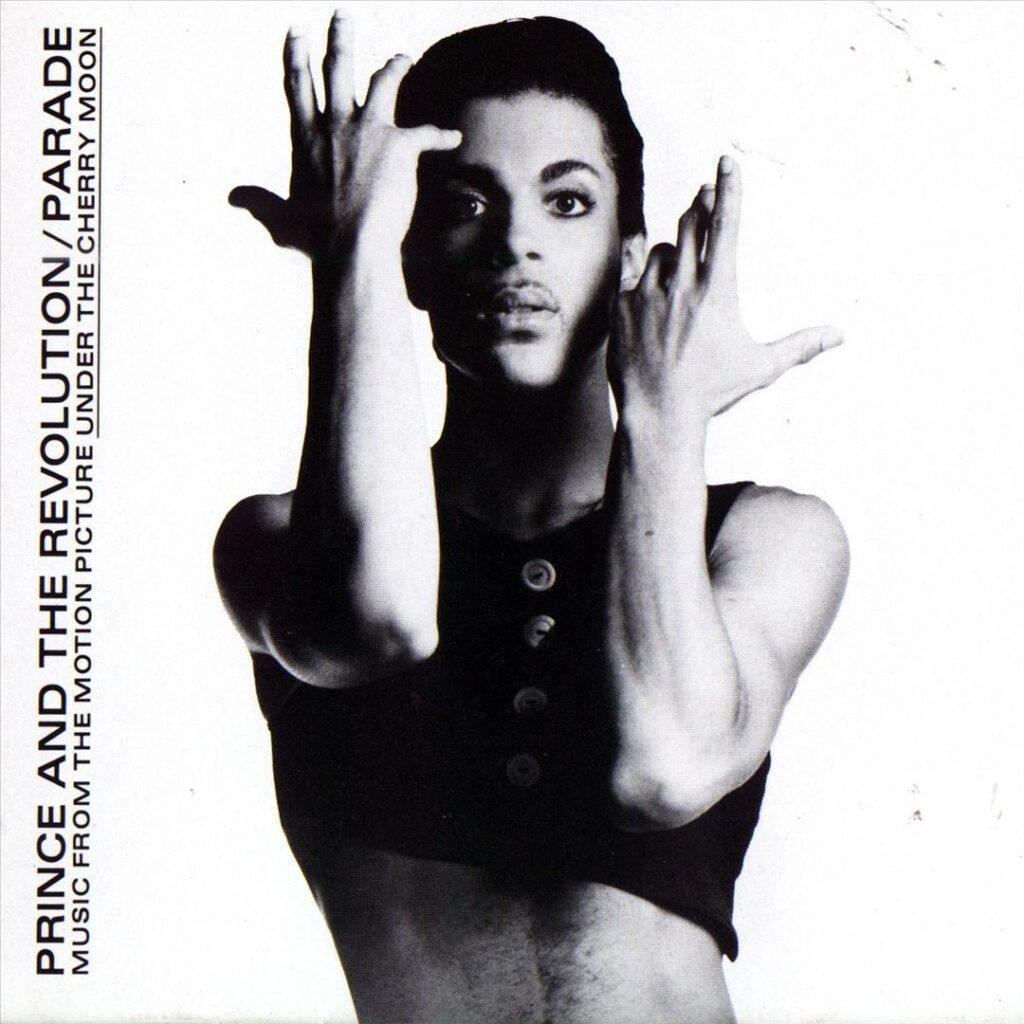
Prince always had a strange relationship to individualism, the ethos that was as constitutive of the 80s as his own music. As a one-man band, Prince pioneered the nervy, synthy new-wave/disco hybrid that became 80s pop, though his hits tended to be band productions like 1983’s ‘Little Red Corvette’ or the previous year’s ‘1999’. Paradoxically, once he formed a proper band, The Revolution, Prince often still played every instrument himself, as on 1984 smash ‘When Doves Cry’. Yet this control freakery didn’t extend to billing or composer credits: Prince even attributed the solo-written ‘Purple Rain’ to bandmates Wendy Melvoin and Lisa Coleman in the 1984 film of the same name. So integrated were Prince’s solo and The Revolution’s band-numbers that they rendered individualism collective, which, given 1985’s psychedelic Around The World In A Day, was a very countercultural thing to do. Such hippie heresy was only one way in which Prince was as antithetical as he was integral to the 80s.
When our own individualist era has revived 80s hippiephobia with 80s nostalgia, it’s pertinent to distinguish between individualism and individuality. It was 1950s conformity to which the 60s counterculture was reacting, and hippie individuality was asserted collectively at love-ins and demonstrations. Yet in the 80s, hippie-hater Ronald Reagan cynically libidinised market economics via a merger of countercultural individuality and competitive individualism. This individual / collective tension runs through Prince’s work, the 60s in dialectic with the 80s. So, on Parade’s carnivalesque opener ‘Christopher Tracy’s Parade’, the psychedelic brass filigrees, collective vocals and anarchically avant orchestration hit the conformity of the then ubiquitous LinnDrum. Equally, the lyric’s utopianism – “goodness will guide us if love is inside us” – coexists with contemporary cynicism (“the man above has been paid”). Indeed Tracy, Prince’s character in Parade’s parent film, Under The Cherry Moon, is that very 80s avatar, an avaricious gigolo.
For most, Prince is straightforwardly emblematic of the 80s, a hyper-individualist whose relation to others was as band-boss, svengali or lover – sometimes simultaneously. While there’s some truth in this, it overlooks other contributors to the Minneapolis sound: Jam & Lewis were Prince’s contemporaries before his employees. It also reduces The Revolution to a prop – or, given the number of women involved, eye-candy. While the whole band only play on two Parade tracks (the same as the ‘solo’ Sign O’ The Times), Wendy & Lisa play on three, and their vocals are foregrounded throughout, alongside Wendy’s twin Susannah, whose intertwining duet with fiancée Prince absolutely makes ‘Anotherloverholenyohead’. Usually mistaken for Prince, Wendy is the lead vocalist on wondrous electro-orchestral oddity ‘I Wonder U’. Yet, in a sign o’ the times Prince would soon decide Wendy & Lisa were having too much input, break up the band and go solo.
It’s not just about The Revolution, though: there’s the small matter of the 67-piece orchestra that adorns half the tracks on Parade. This means the technically solo ‘Under The Cherry Moon’ sounds anything but. Prince’s gorgeous jazz-informed piano-chords, whining synths and clicking percussion are fulsome enough to fool the ear even before the track’s sonic space is stretched out by horns and strings. So pervasive was the Prince-popularised plasticisation of pop that such orchestral organicism was by the mid-80s, highly unusual, even individualistic. Prince was effectively breaking his own rules.
The social nature of music is more complex than the number of people physically playing it, however. Pop is full of the ghost-traces of previous tracks and contributors, with Parade’s most famous cut providing a metatext. ‘Kiss’ is indebted not just to James Brown’s ‘Papa’s Got A Brand New Bag Part I’ (that ringing guitar intro) but to a knockoff of Brown’s Lynn Collins and Vicki Anderson productions, Helene Smith’s 1969 ‘You Got To Be A Man’. Smith’s list of admonitions includes, “You don’t have to be rich”: naturally, Prince flipped the gender and gave the repurposed song to funk band protegees Mazarati. But on hearing David Z’s backing track, with its backing vocals inspired by Brenda Lee’s country-pop ‘Sweet Nothin’s’ and its oddly attenuated funk, Prince laid claim to the lot. Having also half-inched Mazarati/Revolution bassist Brownmark’s “You got to not talk dirty” verse, Prince removed Mark’s bassline, adding to the track’s air of amputation. And just to finesse the who-did-what-and-with-what-and-to-whom ambiguity, Wendy mimes Prince’s guitar part in the video: he even gives her a callout before the solo. This is music as palimpsest, individuality as composite, the self dissolving into the other.
As a result, while ‘Kiss’ is a shoo-in for any 80s disco, it’ll always sound distinct from anything around it. Where 80s pop was soaked in reverb, ‘Kiss’ sucks all the air out of the room: tinny synths replace rhythm guitars, remedial drum machine hits substitute for a snare’s syncopations, while heavily accented breaths serve as kick-drum. Yet ‘Kiss’ still sounds as upbeat, indeed euphoric, as any of its contemporaries, with much of this coming from Prince’s exultant vocal. Fans who came in with Purple Rain wouldn’t know that Prince’s early albums were sung exclusively in falsetto, yet even Purple’s ‘The Beautiful Ones’ wouldn’t prepare anyone for the phenomenal, pheromonal force of ‘Kiss’s screamed final chorus. Throughout, therefore, ‘Kiss’ produces power by strategies seeming more likely to disempower it. And yes, that’s individuality, but it’s standing on collective shoulders.
‘Kiss’ isn’t the album’s sole venture into the “new funk” Prince proclaims on ‘New Position’, further evidencing his contradictory relationship to the 80s. Funk had been eclipsed by disco by the mid-70s, and even Chic’s re-funking of disco (as on 1978 Prince-fave ‘Le Freak’) was abandoned after 1979’s ‘disco sucks’ backlash. In reorientating to ‘post-disco’ pop, Michael Jackson and Lionel Ritchie drained Black music of its sweat and dirt. By contrast, Prince managed to be both pop and funky without compromise to either. ‘New Position’ is another contradiction, a ‘solo’ track with Wendy & Lisa on vocals; a rote funk rut which mutates into a celebration of otherness: “Let’s go fishing in the river, the river of life”. And only Prince could render “a shot of new spunk” utopian. The equally skeletal ‘Life Can Be So Nice’ is almost the obverse: just organic and electric percussion, synth stabs and synthetic flute, its utopia privatised to Prince and his lover. But then Wendy & Lisa barge in, their vocal harmonies splitting the difference between avant and dissonant, rendering their attestation of utopia equivocal.
The full band cut ‘Girls & Boys’ – the album’s second single – is both more fulsomely funky and more fizzingly pop, while still being flamboyantly odd. Its heteronormative title and atavistic male gaze (“she had the cutest ass he’d ever seen”) contrasts to the campness of the production and to Prince being styled as Josephine Baker in the video. Ambiguously reflecting the film’s French setting. Prince’s vocals is equal parts horndog and sensitivo, tempered by Wendy, Lisa and Susannah singing as if English is their foreign language, and a proto-‘girl boss’ ‘French seduction’ by one Marie Claire. Even the backing track is ambiguous, deploying both electronic and organic drums, bass-synth and electric bass. The whole song teeters between ebullience and cartoon-theme novelty, from its bird-call guitar-synth to, at the other end of the sound spectrum, Eric Leeds’ bullfrog baritone sax interjections. With the guitar-synth increasingly at odds with the melody, the track ends by abruptly stripping every element back to an electro-funk chassis.
The other full-band funkathon, ‘Mountains’ is straighter in all senses, more instrumentally conventional, possessed of a more regular song-shape and sentiment: love can move mountains, essentially. Again, it’s absolutely joyous-sounding, peaking with Prince’s none-more-funk holler of “guitars and drums on the one!” followed by an aptly Brownsian “whoo!” (on the two). Not even the ricocheting electronic drumbeats can reduce the grandeur of ‘Mountains’: it makes the vast tinniness of most 80s productions seem like molehills. Pertinently, ‘Mountains’ is one of Parade’s two cowrites between Prince, Wendy & Lisa: the other is the album’s stunning closer, ‘Sometimes It Snows In April’.
One of the 80s signature musical forms was the power ballad, an overstuffed, greed-is-good extravaganza that, melodramatic, manipulative and mawkish, rendered sentimentality corporate. ‘Sometimes It Snows’ is, by contrast, an anti-power ballad, a song of such acoustic starkness that its intimacy better befits a bedroom than a stadium. Featuring just Wendy’s acoustic guitar, Lisa’s piano, and the pair in perfect harmony with Prince’s vocal, it’s the sound of three people playing in a room, picking up each other’s cues, responding to each other’s breaths: in symbiosis. This perfectly fits the lyric, an elegy for Christopher Tracy which is as much an expression of empathy as of loss, an affirmation of life (spring as a “time for lovers holding hands in the rain”), as much as a lament for death. If the melisma – the soul technique of making multiple syllables from one word – would become a corporate cliché by the 90s, Prince’s enunciation of “sometimes I feel so ba-ay-ay-aaad” isn’t grandstanding, it’s heartbreaking. Rather than hammering you over the head with stadium-sized sentiments, the very smallness of ‘Sometimes It Snows In April’ gives you space to feel, paradoxically enhancing its impact.
Of course, it wouldn’t be Prince if even simplicity were sosimple. Given that Under The Cherry Moon bombed, ‘Sometimes It Snows’ shorn of context, sounds like a love song to another man (named Tracy, for that matter). Whether the song’s sentiments are heard as homoerotic or platonic, their unusual intensity gives it an ambiguity that’s individualistically Prince, not least in its very un-80s valorisation of the ‘other’, and hence its anti-individualistic solidarity. While this in turn is complicated by the fact that Tracy is Prince’s own character in Cherry Moon – when D’Angelo sang ‘Sometimes’ on The Tonight Show in tribute, he choked up as substituted ‘my Prince’ for ‘my Tracy’ – Prince is simply ventriloquizing the feelings of Tracy’s bereaved friend. Again, what could have been a distancing effect actually brings the listener closer.
With all this ambiguity and eccentricity proving extremely successful – Parade hitting no. 3 in the US; no. 4 in the UK – Prince redefined what popular music could encompass. Having stripped 80s pop down to its electro-skeleton in the first half of the decade, he built it back up from bones in the mid-80s, with Parade’s electro-orchestral pop this process’s peak. Whether late-80s’ pop’s expanded sonic and stylistic palette was Prince’s influence or whether Prince was a weathervane is a moot point. Pop is a social, mutually interdependent form, and nothing speaks this more articulately and ebulliently than Prince & The Revolution’s Parade.