


Simon Reynolds is releasing a new book.
Set to arrive via publishing house White Rabbit Books in June, Still In A Dream: Shoegaze, Slackers And The Reinvention Of Rock, 1984–1994 follows emerging underground guitar music sounds across the titular decade, looking into the rise of shoegaze, slacker rock, grunge and dream pop. It serves as a sequel of sorts to Reynolds’ 2005 book Rip It Up And Start Again, which was a history of post punk.
Drawing on Reynolds’ own writing and memories of the time – he first started working at Melody Maker covering these sounds in 1986 – the book touches on the work of artists such as My Bloody Valentine, Sonic Youth, Slowdive, Pavement and Cocteau Twins, among others. The book acts as both a historical and personal reading on the time period covered in the title.
The book’s cover, developed by White Rabbit Books in-house designer Henri Holz, also nods to visual signifiers of the time, including My Bloody Valentine’s infamously colourful, psychedelic Loveless album cover. See the cover below, and pre-order the book here.
To find out more about Still In A Dream, we spoke to Reynolds and Holz below.
This new book picks up where Rip It Up And Start Again left off in covering the big developments in guitar music that followed. That last book was published 21 years ago, so how long has the idea existed in your head to follow it up in this way?
Simon Reynolds: Hardly any of the bands that featured in Rip It Up reappear – it’s a whole new cast of characters. While they might have been initially sparked during post punk, now they want to do something completely different – turn their own time into an adventure – which is what I wanted to do as a young critic. Late 80s underground rock is really the opposite of post punk – it’s woozy, overloaded, druggy. A second psychedelia. It’s far less obsessed with modernism, more in dialogue with rock history – specifically the 60s.
The impulse to do this book emerged quite suddenly. After a long period of not thinking about that era, I suddenly fancied revisiting this incredibly exciting period of my life, when I was starting out as a music journalist at Melody Maker, during the last blast of the weekly music press. I also noticed that the music of that time was coming back into relevance. My youngest son was listening to current shoegaze alongside music from back in the day. A lot of the students I teach at CalArts are obsessed with shoegaze and slacker rock. So when I was writing Still In A Dream, as well as speaking to the shared memories of my own generation, I had this younger generation in mind – I wanted to put together a story that would give the context for this music they love and to evoke a feeling of what being a music fan was like then, in those ancient analogue days before the Internet changed everything.
There are obviously significant stylistic similarities in the sound of the noise pop and shoegaze that emerged from the UK, and the slacker rock and grunge that largely came from the US. In writing the book, did you seek to weave together common paths between them or more simply approach it from covering all bases across the set decade period?
Beyond the obsession with guitar-noise and guitar-texture, what connects the groups in this book are leitmotifs – ideas of the dreamer and the loser. Even before the word slacker became such a buzz concept in the early 1990s, many of the artists fit that archetype – whether it’s Cocteau Twins trying desperately to avoid ordinary employment, or My Bloody Valentine living in squats. Young people evading the crushing mundanity of workaday life and creating a life organised entirely around aesthetics. The irony of the word slacker is that these groups put tons of energy into coming up with new sounds and building an audience – they weren’t slacking off at all. They just didn’t want to have normal jobs and careers.
How did you go about putting the book together in terms of research and using your own personal archives as somebody who joined Melody Maker towards the start of the decade outlined in the book’s title?
New interviews and a lot of research went into Still In A Dream, along with rethinking the era. It certainly helped to have interviewed nearly all the groups, often more than once, back in the day, and to be able to draw on an archive of music papers I’ve amassed from that time. My biggest resource was my own memories of covering the music of the era as it unfolded. This was the most fun I’ve had writing a book – almost like time travel.
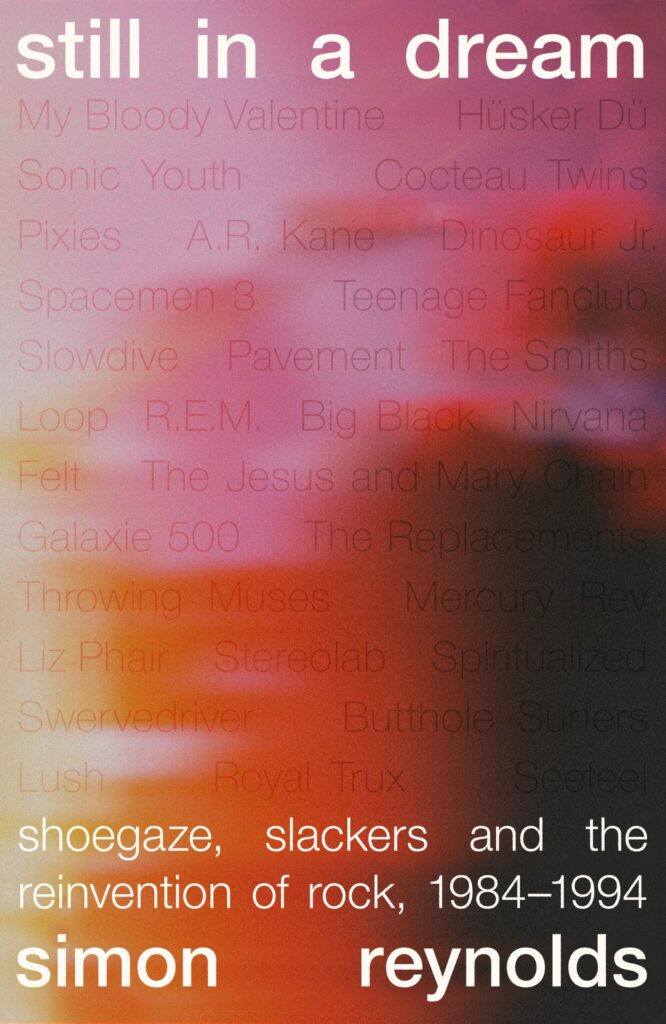
Henri, can you talk us through the art direction you opted to use for this project? There is a clear stylistic similarity to the colour and tonal palette of My Bloody Valentine’s Loveless artwork.
Henri Holz: Steve Marking (the art director on the project) and I had a vision for what the book cover should achieve: reflect the aesthetic of the album covers of the genre and period, visualising that dreamy haziness and distortion in the same way.
We wanted to make a cover that wasn’t pretending to be of the time, but was paying homage to it; rather than emulate the heavy editing style of albums like MBV’s Loveless, Flying Saucer Attack’s Further and Slowdive’s Just For A Day, we wanted to use an authentic image from the time. Early on, we were looking at photography of gigs and I loved the idea of getting a photo from the period at one of these concerts.
We found this incredible photograph of Kevin Shields from My Bloody Valentine at the Roxy in 1992. It’s an amazing image that between the stage lights and blur of the gig achieves the visual of the era with little intervention from us. And so it felt really exciting because it was an authentic way to represent this time for the fans, who we’re ultimately doing it for.
With the typography we just wanted to keep it simple. Again, we liked the idea of referencing the design of the time, which was minimalist and understated, such as Seefeel’s Quique or Lilys’ In The Presence Of Nothing. It was Lee Brackstone (the editor) who had the idea to put all the band names on the front, which I loved as it’s that instant welcome in for fans. We needed to find a way to list the bands and artists featured in the book, but keep it subtle, with the names almost hidden within the image. To do that the band names aren’t actually printed but just gloss-varnished, giving it a tactile, shimmery effect.
White Rabbit Books will publish Still In A Dream: Shoegaze, Slackers And The Reinvention Of Rock, 1984–1994 on 18 June 2026.