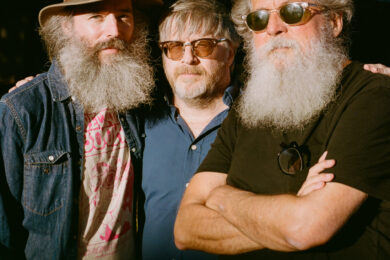
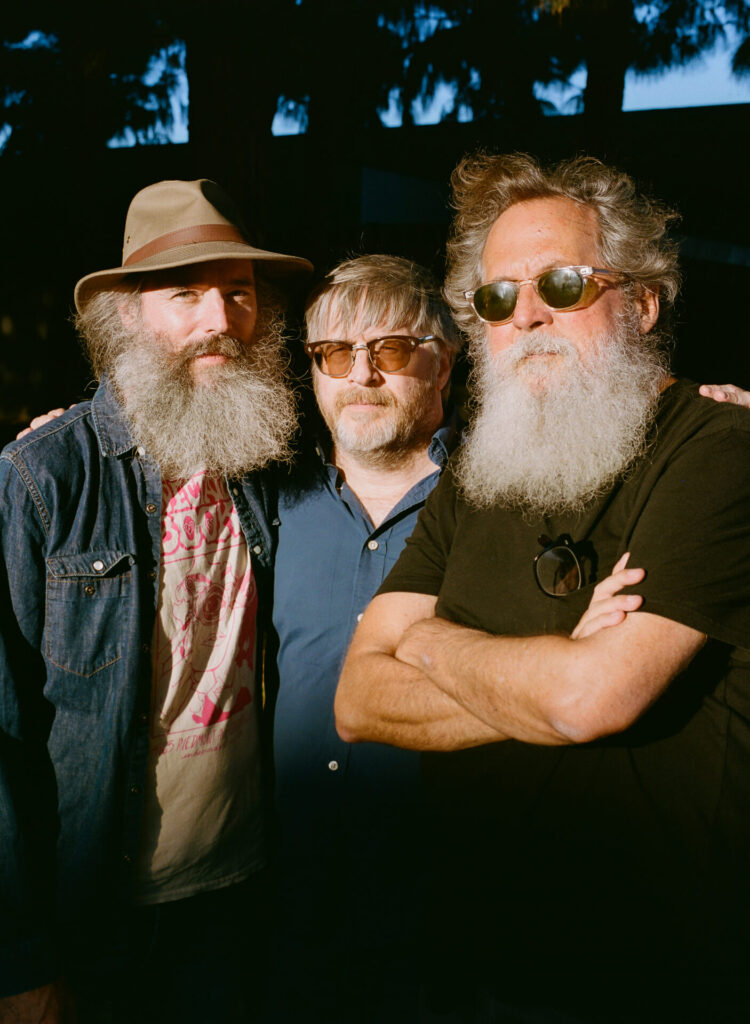
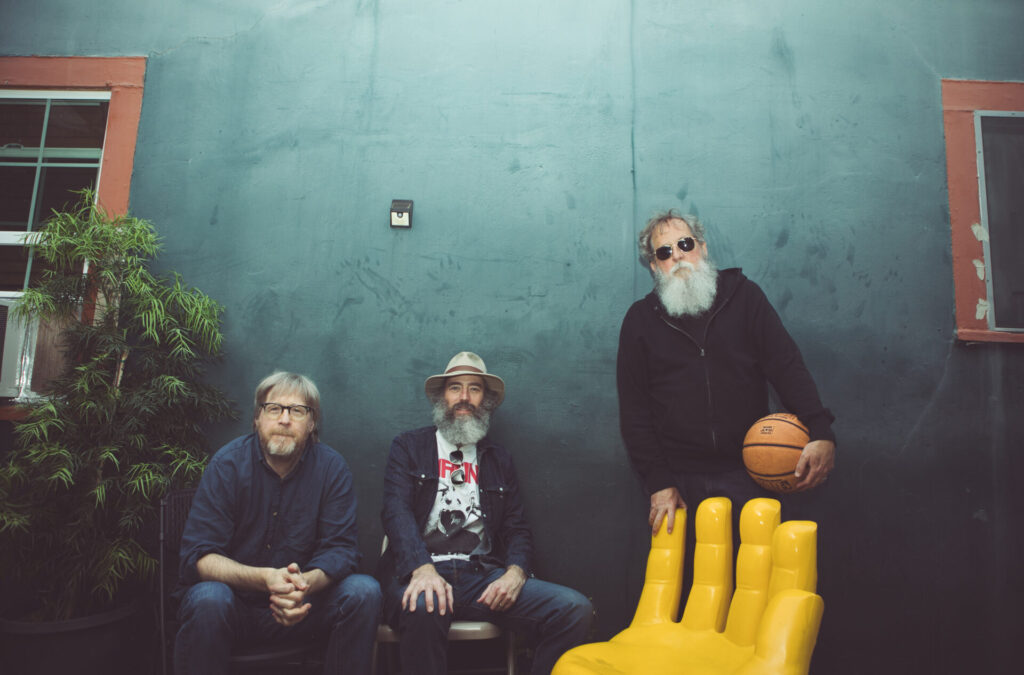
“Our delightful origin story takes place around a Grateful Dead tribute show that Bill and I played together,” says Ethan Miller, when I ask how he, guitarist Bill Orcutt, and drummer Steve Shelley came to form a trio. “Don’t tell anybody that though!”
I regretfully inform him that we are on the record. “Bill isn’t a huge Dead fan,” he explains, “but after that show, Bill told me how fun it was to play with a band.” Orcutt hadn’t played in a rock band with a full rhythm section since high school. Miller took the hint and started making plans, later shelved during the pandemic, but picked up again in 2024. They brought in Steve Shelley on drums, met up in Los Angeles, where they “booked an Airbnb, booked a studio, booked a gig,” says Miller. “We’d never played together and didn’t know how it would go, but that first gig at Zebulon ended up yielding our first album.”
I ask Orcutt how he sees the combo. “It’s a Venn diagram of our different styles and interests,” he says, which is true, but modest. It is by all accounts a supergroup, given that between them, they’ve worked on some of the best and most important rock albums of the late 20th Century. Miller is Howlin’ Rain and was a key player in Comets On Fire, among other groups. Steve Shelley was drummer in Sonic Youth, and has played with or on records by such a long list of luminaries it’d take my whole word count to list them. Orcutt has cut a run of solo records, has long running collaborations with Chris Corsano and others, a current guitar quartet playing marquetry-tight patternwork with Wendy Eisenberg, Ava Mendoza, and Shane Parish, and in the 1990s was in the fast ‘n’ raw radical trio Harry Pussy, among a similarly extensive list of previous and existing collaborators.
To say this is a supergroup also does them a disservice – supergroups often yield fairly predictable results at best, and at worst, record the sound of a few hulking egos clanging into one another for the duration of a tour or a few studio sessions. Not so with these three. Firstly, none of them seem to sport the self-importance warranted by their catalogues, but more importantly, there is a complementary solidity and skill each brings, with a well-honed power and happy swagger, that fills the frequencies from the album’s opening minutes.
Orcutt Shelley Miller was recorded at Zebulon in April 2024. A rough mix was dubbed to a run of cassettes to be sold on merch desks, before the album proper came out in September last year. On it, Orcutt flexes fierce riffs, galvanised by Miller and Shelley, whose bass and drums add muscle and bone. It rides in triumphant with ‘A Star Is Born’, the snow-capped peak of the album, with a riff that sounds like the passage of metals through vaulted clouds, Miller and Shelley carving out solid topography beneath. There’s much in the way of riff and groove, Miller often letting loose bold and nimble melodic motifs on bass, matching Orcutt’s fleet fingers. ‘Unsafe At Any Speed’ cuts in more jauntily, finds a looping groove, with Shelley throwing out rounds that resolve and restart, where longest track, ‘Four Door Charger’ is a pace setter for Orcutt to go long, tracing out curlicues and rosettes. It’s not all explosive riffage – ‘An LA Funeral’ is sombre, and ‘A Long Island Wedding’ is perhaps the most traditionally Orcutt of the tracks, a near-lament; this band’s version of a lighters-up power ballad forged in knives and hot metal.
Titles were drawn up when their internal references were too revealing to be written on stage. Miller insists Orcutt named most, but Orcutt denies this. “The only title that’s mine is ‘Unsafe At Any Speed’ because Ethan wanted to call it ‘corn dogs’ or something,” he says. “I was like, man, I can’t – that’s my riff – I’m not calling it corn dogs,” and so – naturally – renamed it after a book by consumer activist and presidential candidate Ralph Nader.
Released on Miller’s label Silver Current the cover design mimics 1960s bootleg label, Trademark Of Quality, with shelf-worn, stickered and rubber-stamped cover. It’s part of a series on Miller’s label. “Trademark Of Quality was only bootlegging the biggest and best bands: Bob Dylan and The Rolling Stones and Jimi Hendrix,” he explains, “I save it for the giants”. Also in the series is a live album by Sonic Youth, archive material by Galaxie 500, Earthless and Osees.
“I always liked bootlegs, then once I got involved doing my own like bootleg-style series I became a bootleg maniac – now I’m out there buying a $50 record that should never be that much – with mould and shit all over the cover that looks horrendous and is basically valueless. It should be thrown in the trash, but I’m desperately trying to get it to scan it. I think I’ve actually tipped the eBay pricing market.”
Shelley has his own deep relationship to the form, as, finding themselves being widely bootlegged, Sonic Youth took up collecting boots of themselves. Shelley has now amassed a great number, and they keep coming – right now he’s awaiting an enormous shipment of CD-Rs. “I’m actually getting a collection of 30 pounds of CDRs of Sonic Youth live recordings this week,” he says. “Someone collected all this, they passed away, their best friend asked, Hey, does the band want this?”
For Orcutt, it’s less the bootlegs than the fact of the live album that connects to the backbone of his catalogue, which has included more live recordings than studio, particularly with Chris Corsano. The difference here though, is the structure of the band: of guitar, bass drums, and what that allows him to do. “When I’m playing with Chris, it’s like a conversation,” he explains ” I don’t really have a chance to monologue. I’m constantly saying something, he says something back to me. We’re constantly pinging back and forth. Whereas in this band, I can extemporise at length – I can do an eight minute solo and I’m being lifted and supported and fed ideas by Steve and Ethan.”
There is a sense of pleasure and camaraderie in the trio – when we talk they’ve just spent time in the studio, and are about to head out on tour. “It’s a total blast. We have a great time. We drive around, we play music to each other,” says Shelley. Bill is tour DJs, orchestrating deep dives and ‘free association’ playlisting – recently they have been excavating the catalogues of Warren Zevon and Waddy Wachtel. “It’s never really good music,” says Orcutt. “It’s always on a weird tangent that would only be interesting to, you know, old musicians.”
I ask if, 18 months deep into the project, if things have shifted in the playing since they began. They’re not so sure, but Miller says “It brings us a little bit back to the Dead… in the way that some things appear that are well beyond our imagination, or that we ever thought might happen. The Dead accepted the super high stuff along with the failures or lows – and this is all just part of the natural evolution of the expression when they play. We start over every night, but I don’t think we’ve ever had a night that we were all feeling glum about it. There’s always something surprising. It’s the joy of hearing things beyond your singular imagination; some kind of group imagination, that you can’t really intellectually quantify.”
Orcutt Shelley Miller perform at this year’s Bristol New Music, which returns for its sixth edition from 22 to 26 April. For tickets, the full line-up and further information, click here.