
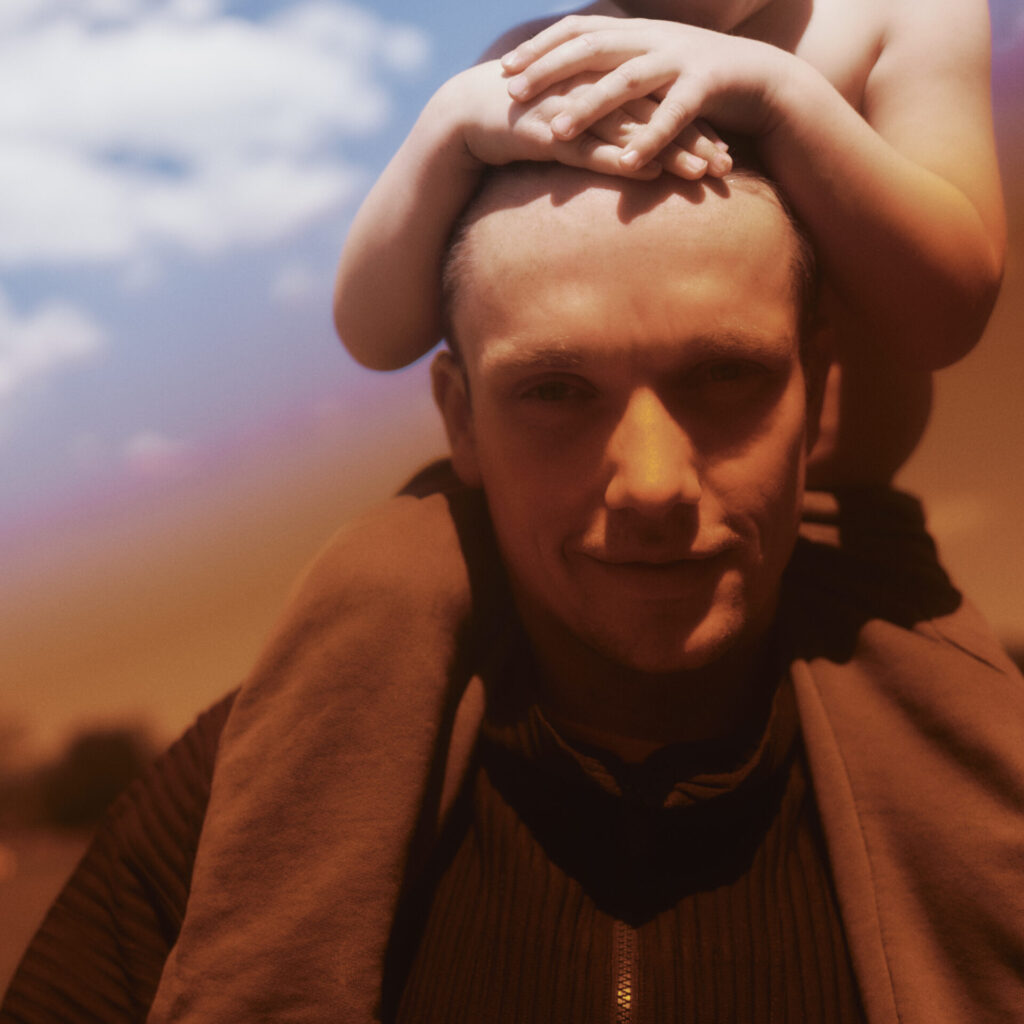
“I’ve had 10 years in the wilderness as an artist,” says Oscar Powell, backlit from the evening light of West London through the window of his studio, which doubles up as the headquarters of his record label, Diagonal. “I ran away from my own success and I feel out of time with everything, but I’ve reached a point where I don’t really care, that’s just who I am.” Powell’s latest album We Do Recover, and the follow-up WDREP1 that came out at the end of of 2025, close out a nine album run that took in anything from theory-inspired minimalism to delicate piano sketches and, from his earliest days, tense bangers that suited the moment in which post punk and gnarled techno collided (to euphoric rather than dour effect) on Europe’s dancefloors.
The rise and not-quite-fall of Powell began with a Damascene conversion to the power of supposedly unpleasant electronic music when he saw Russell Haswell clear the room at the Bloc weekender. Powell instantly became a super fan and ended up babbling excitedly at him on the street not long after. “I was this 27-year-old yuppie advertising guy, going ‘it’s Russell Haswell!’, he couldn’t believe someone recognized him, he stared at me wondering ‘who the fuck is this’.” That night, though, Powell was at Café Oto where he spotted Haswell again. They got talking, and became firm friends – Powell’s label Diagonal, run with his school friend Jaime Williams, would contribute to the revitalising of Haswell’s musical career. This was closely followed by an encounter with Karl ‘Regis’ O’Connor that turned the music fan into a creator himself. When the pair met at a night run by the Blackest Ever Black label, Powell gave Regis a CDR of his music. “I never thought I could be an artist until Karl told me ‘you’re good at this, you should release it’,” he says, adding that he needed that moment of validation. “Without that, life would be a lot easier because I’d just be working and not having to worry about doing the thing I love”. He’s perhaps only half joking.
That moment of generous affirmation from an older mentor led to Powell having the confidence to put out his first record, 2011’s The Ongoing Significance Of Steel & Flesh. It was followed by a string of excellent and hyped EPs for Diagonal as well as The Death of Rave and Mute’s Liberation Technologies imprint, before he signed to indie giant XL. “The music started getting more and more maximal, both in the hype and in life,” he says. Perhaps the peak of this came when Powell put an email from Steve Albini rejecting clearance for a sample on a giant billboard, provoking something of an internet storm (something we reported on at the time). Although Powell speaks fondly of his time at XL, and indeed met his wife there, it’s clear that the pace of things left him feeling discombobulated. “I didn’t know who I was back then,” he says, “I thought it was just going to go upwards, but I couldn’t handle it and it was hurting me as a person.” At the time Powell was “chameleon and divergent” with the way he was making music in all genres, from techno to noise, but felt people wanted him to the post-punk, Mika Vainio-influenced racket that characterised his early releases. “I loved it but it’s not really who I am,” he says “people were calling me a punk and I just knew that I am not a punk.” As Powell started to endure an identity crisis, feeling that the music he was expected to play didn’t necessarily fit the breadth of what he wanted to do, the balloon stopped rising.
At the height of the XL chaos, Powell was given a label bomber jacket, with OSCAR emblazoned on the back. He recently leant it to a friend, who left it in his car boot, from where it was stolen – perhaps a handy symbol for the shift he’s had. “You have a few good years of doing festivals and making a living from it and then you’ve got nothing,” he says, adding that “I think I cared too much about what people thought.” He stopped DJing and playing live, saying “I never enjoyed it, even though I looked like I did.” He laughs, “I looked like Arnie Schwarzenegger, but deep down I was terrified, I panicked before I had to go onstage. Exposing myself in public is not one of my favourite things to do.” It’s an interesting revelation from an artist who might be assumed to posted a peacocking confidence, and explains a lot of how his career evolved.
After the madness of a decade ago, Powell has instead taken an “isolationist” approach to being part of music. He found that philosophy and reading books, rather than going out raving, were a huge help in expanding his ideas. “I don’t profess to be an expert on philosophy but there were some writers who just really helped me,” he says, “there’s a Deleuzian idea of a line of flight, a line of escape, and I thought it was beautiful, and as as somebody who probably wanted to run away from what music had meant to me I just went and took a different flight.” This has been reflected in how Powell’s frequent changes of tack have felt quite gloriously naïve, a sort of Tigger or Mr Toad-esque enthusiasm for music and art. Yet this isn’t something he sees himself, however. “I made all these albums, but I don’t think of them as drastic changes,” he says; “they were just me growing through time, but to everyone else, it was ‘what the fuck are you doing?’”
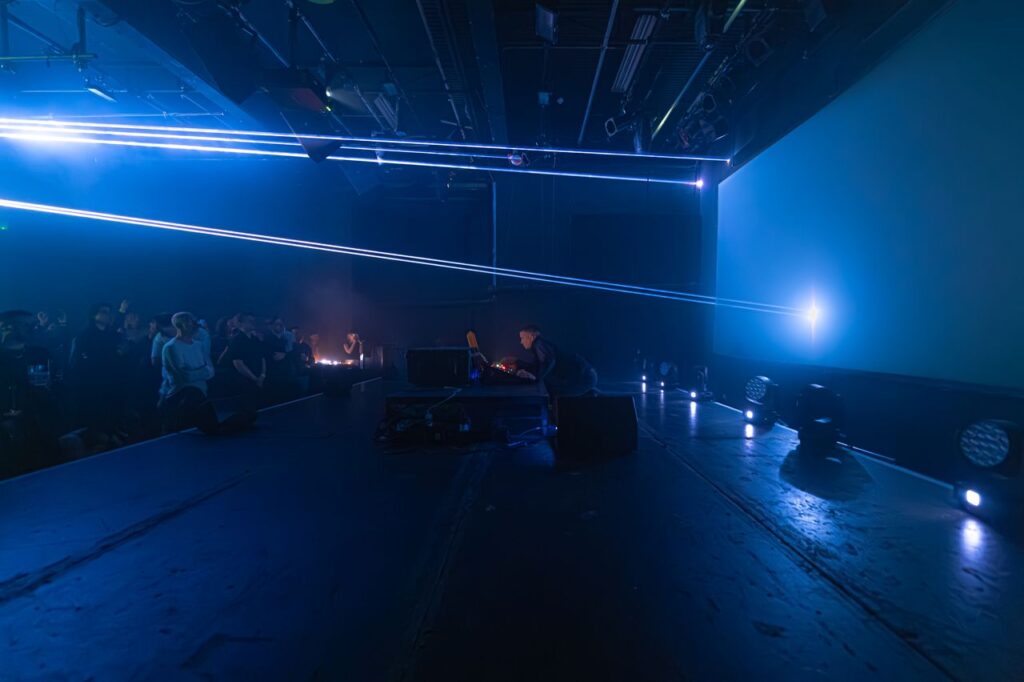
So some expecting the fruity, witty bangers that characterised his earliest releases were surprised by his ƒolder multimedia project, a collaboration with visual artists Michael Amstad and Marte Eknæs, which emerged during the grim may of the Covid-19 pandemic. This was in part about how humans compartmentalise our lives in the digital age, but also became “a way that I could build a space for myself where I could be separate, at the time I wanted to escape from music – I’d been scarred by it. It was a bubble against things”.
If anything, he says, this is a feeling that has only become stronger in recent years, in which he’s become a dad, had to return to his day job in advertising to make ends meet, and recently lost a friend to suicide. “It was a shock,” says Powell, “but I was unable to feel anything – I realised I was numb to the world around me. I had struggles at that time, mentally I was fucked, I was using a lot of drugs, struggling to be father, struggling to make a living, just life. I needed to grow up a bit.”
Oscar Powell is typically and refreshingly honest about his initial “selfish and old school” wariness of having children as an impediment to creating art. “I struggled to adapt,” he admits, “but it has taught me to be less selfish, I don’t resent my son for taking me away from my art, if anything he feeds it, and makes it stronger.” Being a dad, he says, “Is a beautiful chaos, but so rewarding.”
He stopped drinking and taking drugs for a year, giving him a “clarity” that helped shape the music on We Do Recover. However, he’s keen to emphasise that the title doesn’t mean that this is a recovery record about addiction, instead “a collective sense of ‘this can get better’, a message of optimism injected into people’s ears.” Powell also recently came off antidepressants, which he says has been a further help in come back to being able to feel the world. “Now I cry when I listen to the Frozen soundtrack in the car – it’s amazing to be able to cry again”.
It’s striking, as the studio darkens and Powell’s dog snuffles on the floor, just how much a place of transition he appears to be in. He has a huge, cackling laugh, directed most frequently at himself, whether that’s the craziness of his earlier years, bemusement at what is currently going on in electronic music, or the struggles of running an independent label in the mid-2020s. Just as with his music there’s a sense that he charges into making it with a refreshing lack of over-thinking, he’s honest about the issues that have dogged him alongside the waxing and waning of his commercial fortunes. “I’ve been trying to find a way to have balance in my life,” he says, explaining that this has always been a struggle, whether it’s about how to put making music against the need to work, or the extra-curricular activities and intakes that come with electronic music. “I’ve always loved to party and that would never change. I’ve had periods of being good and sobriety but I don’t think I’ll ever stop liking the party, nor do I want to, to be honest.” He pauses. “Maybe nihilistically. I do think I’m prone to self-destruction, evidence suggests. I don’t by any means feel like I am expert in balance now either, but I’m getting better at it and God it’s good, but I love chaos as well, when I’ve had periods of being sober, I miss this energy I get from feeling like I’m out of control that ends up driving me on. That’s not about drugs and alcohol, it’s about doing basic tasks in life – opening post or whatever – things that would make it easy for me.”
If he has a regret, it’s that he could have known all he does now when he had the power and resources of XL behind him. I suggest that there’s a paradox in that he’s learned all he has perhaps because things didn’t quite work out in the mainstream. If there is a balance in Oscar Powell’s life it’s that he can accept this is the case. “I don’t really care anymore,” he reflects, “I don’t want a big label, we don’t need it as artists – where does it go? You just run out of steam. I prefer being at home. I like the countryside, a quiet life, I like my dog, I like reading.” A pause. “I quite like shagging.”

Towards the end of the interview, Powell turns on the computer sat on the desk in front of the night and the lights of London, and has a digital rummage in his Dropbox. He digs out a track that was once built around a sample of Gareth from The Office, but has morphed into a thudding anxious monster, a joining of the dots between his early years and his present, something that also applies to his recent WDREP1. I suggest that this is going to be a far easier sell than the records he’s been making lately in what he described as his “wilderness” years. “I can’t understand that,” he says, again bemused by how people might find his more abstract work difficult. “But I’m in this process – I think I had to recover as an artist, I had to go through something to discover who I was and now I know.” He says that, perhaps, 2026 is going to be all about rediscovering the pleasure of making dance music again, but as he wants to do it. I suggest that the “we” of We Do Recover might also be a message of positivity to himself. Powell agrees. “Music for me is a constant battle to love myself, rather than be loved,” he says. “It’s the only thing that makes me feel good about myself sometimes – which is weird.” The laugh again, “because life’s not that bad.”
We Do Recover and an accompanying EP, WDR EP1, is out now on Diagonal Records