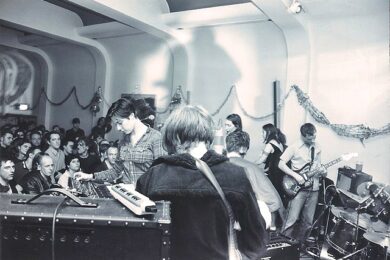

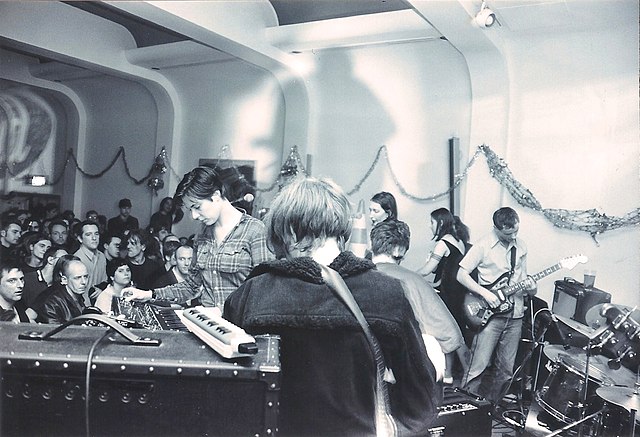
‘Super-Electric’, the title song of Stereolab’s 1991 EP of the same name, feels like the golden moment when a band discovers its destiny, their individual sound emerging from their hodgepodge of influences with the regal purpose of Excalibur being hauled from the stone. Some bands never get there; other bands take years; Stereolab hit on their sound with their second ever record. Which is not to say that all Stereolab sounds like ‘Super-Electric’ – it doesn’t, by any means – but ‘Super-Electric’ exemplifies the raging, driving force that propelled early Stereolab and which was littered throughout their career.
It’s one thing for me to say this, as an outside observer. But the idea of propulsion was important to the band too. In the liner notes for the 2019 reissue of Stereolab’s Dots and Loops album, [guitarist and co-founder] Tim Gane writes of his dislike for the song ‘Prisoner of Mars’, which was slowed down from demo to studio, losing – in Gane’s own words – “propulsion”. Not for nothing did the band choose the voltaic charge of ‘Super-Electric’ to open Switched On, a compilation of early singles, in 1992: it’s a perfect introduction to their world.
“‘Propulsion’ works,” Gina Morris, the co-vocalist on ‘Super-Electric’, says when I suggest my take on the song. “I would probably go for ‘revolution’ though. It really makes me feel revolution, uprising. There was a lot of talk about revolution around a kitchen table… It’s very uprising, for sure, in some form.”
Melodically, ‘Super-Electric’ isn’t that far from ‘The Light That Will Cease To Fail’, on the band’s debut EP Super 45. Paul Cox, co-founder of the Too Pure label, which released much early Stereolab material including the Super-Electric EP, claims that Gane told him – perhaps jokingly – that he set out to write a second single with exactly the same chords as the first. But the small, yet vital, differences, in brightness, tone, purpose and harmony, between the two songs all multiply up, sending ‘Super-Electric’ into orbit, where ‘The Light…’ was earth bound.
“We thought ‘Super-Electric’ itself was the track, the best one that we’d heard so far,” says Cox. “It sounded slightly more hi-fi, which might just be down to them getting their momentum going. It’s like, ‘Oh, this is what Stereolab is.’”

Richard Roberts, Too Pure’s other co-founder, was equally impressed by ‘Super Electric’. “I think that the challenge to them was that thing of [us] saying, ‘OK, here’s an opportunity for you to turn around and deliver.’ They saw that opportunity too. It was like, ‘OK, well, how big do we want to be? How big can we be off a first properly distributed record?’”
Importantly, ‘Super-Electric’ starts with a squiggle of Moog synth, a sonic amuse-bouche that places the listener firmly in the Stereolab world. Insignificant as this 10-second doodle may appear, it cleanses the palate and set the listener up for what is to come.
Neither Teenage Fanclub nor Nirvana nor Chapterhouse nor – in all likelihood – any of the big indie bands of 1991 would have started their record with 10 seconds of Moog, still then a borderline obscure modular synthesiser favoured by 1970s prog rock giants. But this – the Moog is saying – is Stereolab, this is different. “No one else was using Moogs, that’s for sure,” says Cox. “So that was a clear thing that differentiated them…. That was probably almost more radical than Tim’s guitar, which was just chiming and repetitious.”
The Moog is interrupted by a single guitar chord: strident, fuzzed, triumphant, a six-stringed Monolith announcing the birth of a new guitar era, before the band kicks in, drummer Joe Dilworth again riding the Motorik beat. This time, though, his cymbal taps are freed from ‘The Light…’’s distracted murk, as the band lay highly-controlled waste to another two-chord rush.
On the face of it, guitar chords and drum thump might sound like the ingredients of traditional rock and roll music. But ‘Super-Electric’ is far from classic rock; ‘Super-Electric’ is Stereolab music, where economy of change meets propulsion of texture. A single guitar chord remains drifting over the top of the group’s impeccable rhythmic chug, buzzing with the dangerous allure of an electricity pylon, its prickly texture more important than its melodic progress (or lack of). Two thirds in, the same guitar explodes over the top of the mix, its latent menace unleashed with the force of a rocket, in the static-electricity rush of a one-note guitar solo.
Debbie Ball, who played guitar in indie group Electrelane – a band often compared to Stereolab – describes Gane’s guitar playing as “really textural”. “Sometimes he has sort of a metallic effect on it. So it sounds a bit like shards of sounds,” she explains. “I loved his guitar playing so much that when I went and saw them – I think I probably saw them a couple of times in that [early] period – I would look at what he was doing and try and work out how he was making the sounds that he was making.”
It’s tempting to think of the group’s repetitive assault as akin to a drone. And maybe it does constitute one, in the Velvet Underground sense of the word. But for me the term feels wrong. Drone music is often associated with a sense of relaxation, of letting the brain drift away on a series of sustained tones. And ‘Super-Electric’ is quite the opposite. The two chords that the band play are shocking, the sound of pulsing electrical energy delivered straight to the brain, in a way that jerks opens the senses and sweeps away everything that has come before.
Contrast and restraint are key. When the band do eventually move on from their two-note attack, splashing out briefly on four new chords, it feels like ‘Super-Electric’ has snowballed into a rainbow universe of new colour and endorphin release, as if changing the chord has earned the listener a whole new perspective on the world. Four new chords feels like endless, shameless abundance and it can’t be sustained for long.
“Tim used to talk at this time about ‘endless boogie’,” says David Callahan, known for his work with the Wolfhounds and Moonshake but who also played with Stereolab, when discussing ‘Super-Electric’. “This idea of playing one Status Quo riff for 15 minutes, almost like a Krautrock riff. A lot of their songs were based on the idea that you could get this repetitive, wheels-going-around, propulsion and it could last as long as you wanted it to, and it would be exciting the whole way through.”
‘Super-Electric’’s vocal melody pulls off a similarly obdurate trick. Stereolab have scores of brilliant vocal lines, many of which cascade around the octave like bouncing balls. But for a large part of ‘Super-Electric’, singer and co-founder Laetitia Sadier sings just a couple of notes, with the emphasis on the rhythm of the words rather than their melody, the vocal chattering away insistently like a musical morse code.
In tandem Gina Morris earns her place in Stereolab immortality for the song’s brilliant two-part harmony, her voice alternately harmonising with and trampolining around Sadier’s cooly-executed melody. “It started to get to the point that we were both taking quite lead-ish vocals,” Morris explains. “So you can hear [on ‘Super-Electric’] I wasn’t just doing ‘Bubba de bons’. There was a lot more interplay with the two vocals.”
‘Super-Electric’ marked a high point of the propulsive force that was a guiding principle for Stereolab in their early years. It wasn’t until Emperor Tomato Ketchup, the band’s fourth studio album, when Stereolab’s frenetic energy slowed somewhat, as Gane moved towards new ways of writing songs built on interacting loops.
But the band’s momentum never went away. Speaking to The Ringer in 2019, Gane talked about the band’s “intensity”. “I don’t want them just to appear as quite nice, possibly reasonably well-written, songs,” he said. Gane was talking of Stereolab’s first wave of reunion shows. But he could have been laying out the band’s career as a feverish whole.
“Let’s take that [well-written songs] as a given,” Gane continued. “But it’s in the interaction of all the players and the sounds and the intensity. And this has to be kept really hard-wired up. It’s like wound up. It’s just really important that it doesn’t drift into a nice, presentable pop tune.”
This is an edited extract from Space Age Batchelor Pad Music: The Story Of Stereolab In 20 Songs by Ben Cardew, published by Jawbone Press