

There is a peculiarly modern horror at the centre of Schattenfroh, Michael Lentz’ gargantuan, experimental novel, newly translated into English. The horror of the last century preyed on the blind spots of the imagination. This was the horror of H.P. Lovecraft’s stories. A horror borne from knowing too little, intensified by the mystery of an indifferent cosmos. Schattenfroh is the inverse. Across its 1,001 pages, Schattenfroh is a twenty-first century horror borne from knowing way too much. An overwhelming deluge of terror that is crystal clear and disturbingly interconnected. Its horror remains black like Lovecraft’s, but due to density, not darkness. And despite their distinct temporal transmission and frequencies, the two resonate with one another.
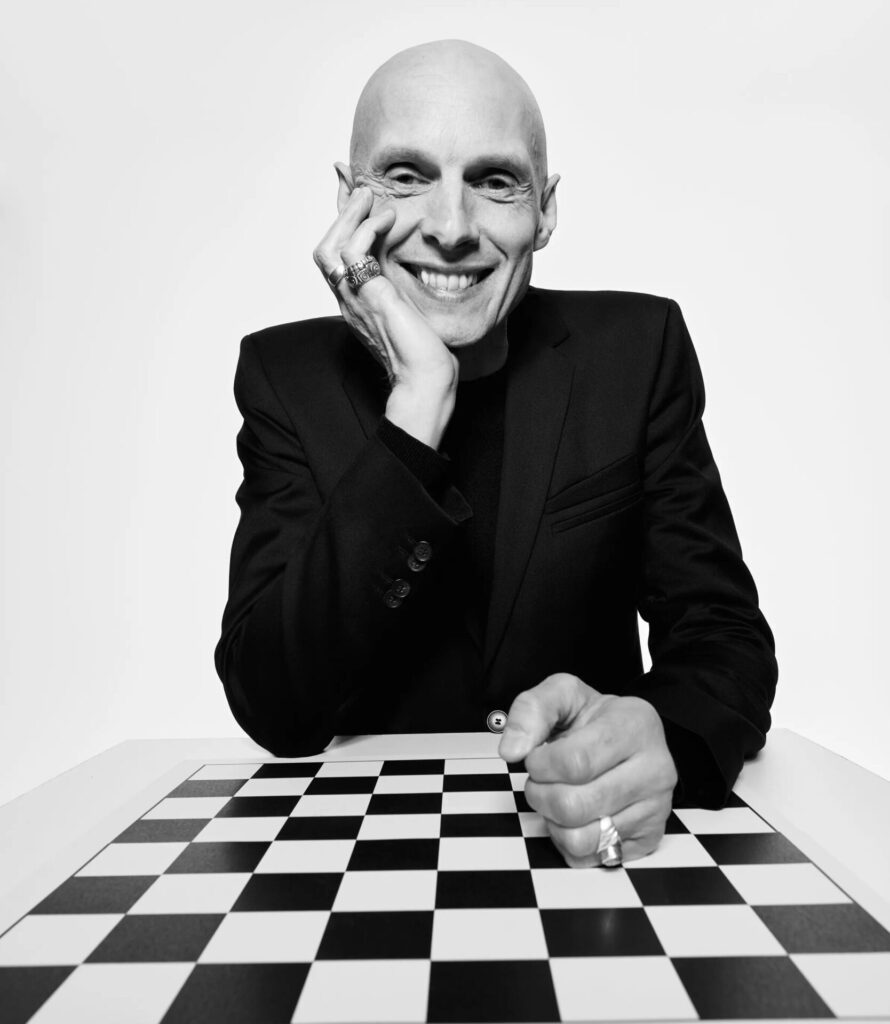
“The figures of the Bible, the grotesque monsters there. They have a kind of revival now. These are the phenomenon of totalitarianism, unfortunately,” Lentz opines when we talk over Zoom, with the author calling in from his native Germany. The current economic, political, and technological climate, he suggests, is just the “right time for this book”.
Speaking alongside his translator, the much in-demand Max Lawton, it’s fair to say that the English-language appearance of Lentz’ claustrophobic and complex novel does feels timely. A book of confounding visions played out across multiple dimensions hinting at some form of augmented reality, Schattenfroh reads like a 21st century Kafka cut with William Gibson’s Neuromancer.
Lentz recalls the book’s origin, “we are living in a technical age of civilization, and I tried to imagine the aim of total totalitarianism – which is to get a step into the brain to control everybody. The thoughts, the imaginations, the pictures, the behaviour and so on. I would say that’s the dream of totalitarianism.”
The book’s protagonist is tasked with a mission by a shadowy force known as ‘Schattenfroh’ (which translates roughly to ‘shadow-joy’ in English) to “write everything down from the beginning”. The protagonist is taken to a scriptorium to execute the transcription and there he is told that his name is now ‘Nobody’. A box is placed in front of Nobody’s face with lenses and a visible aureola that transcribes all his thoughts seamlessly. Nobody is told that if he veers from the task of chronicling history or touches the box itself he will be blown to pieces. Nobody describes the disturbing notation system he is to use to record his reality-history, “I have no paper, no pen, no typewriter, no computer. I am writing into my brain-fluid.”
Lentz explains, “Nobody perhaps has some intention to help. He wants to share the aim of Schattenfroh, but in the beginning he cannot understand them. He cannot say that this person or this institution called ‘Schattenfroh’ in the novel is bad.” And so begins Nobody’s temporal odyssey, one of initial quiet complicity that unravels into a parasitic union of totalitarianism and the self: man reduced to data and merged with capitalism’s hollow soul.
The breadth of subjects and topics in Nobody’s envisaged history is oceanic. Its ceaseless excavation of history (both global and personal) goes all the way back to the dark ages and back again to the present day. During its transit, the book collides with over-arching narratives that have dominated humanity since the beginning: The relationship between father and son (and, by extension, the patriarchy), the nature of faith, the function of recording and the routine of death. This is all examined through the dominant thematic lens of the novel, that of ‘tzimtzum’. Tzimtzum is a Kabbalistic concept that suggests God’s light was withdrawn from a small portion of his omnipotent being and that small portion is where the world was created. It’s a duality that is both liberating and oppressive, that of supposed freedom and covert surveillance.
However, the narrative voice is perhaps the most disquieting and distinct aspect of the novel. Described as a ‘psychogeography of the self’ by the German academic review Literaturkritik.de shortly after its original publication, the prose in Schattenfroh is dispassionate, sprawling and porous. It’s so far beyond the familiar trope of an ‘unreliable narrator’ that it enters another category altogether. It frequently reads as a story re-told by one’s own corrupted data.
On the disorientating clean prose style that reminded me most of the quotidian spiritualism of The King James Bible, Lawton details, “it was about creating this hypnotic tone, [like] a trance state. No matter what was happening, you had to have that [feeling of] almost Sufistic prayer.” Lawton summarises the bureaucratic transcendence of the novel’s atmosphere nicely. “It’s like a regional German functionary developing schizophrenia and writing his own Bible,” he says. “That’s sort of my elevator pitch for Schattenfroh.”
The ordered prose makes the shadow of Schattenfroh all the more unsettling within the novel, feeling like a hyper-radicalised Big Brother in a flow-state of dismantling. We learn that Schattenfroh leads an elite group called the ‘Frightbearing Society’, whose opaque mission is to draw up a quasi-religious text to guide society forward. In the book Schattenfroh asserts that “we shall have to build new arks before the flood of perceptions one day submerges us.” And later that, “we have realised that new words create a new world, thus have we created new words.”
Lentz says, “Schattenfroh is a hybrid of a lot of figures, a lot of institutions. It is a mixture of states, states with a totalitarian government.” He adds, “Schattenfroh is perhaps a person, too. A person who is living in the past, the father of Nobody [who is a recurring character in the novel]. But perhaps a person who is living in the future at the same time. And Nobody has no other choice than to follow him. And while he is following him, at the same time he is thinking about possibilities to escape. And he cannot be sure whether Schattenfroh is observing these thoughts too.”
Lentz is clear that what is omitted from the re-telling of history, as narrated by Nobody, is as deliberate as what is included. In all the passages that discuss World War Two, the Holocaust is notable by its near-absence. “You won’t find too much about the question of [the] Holocaust, or Shoah, in Schattenfroh. It is only mentioned twice. But it is always there in the background.” It’s clear that for one reason or another, the Frightbearing Society don’t want this piece of history documented in their doom scroll.
For all the threads of the esoteric and the medieval, Schattenfroh is a decidedly modern novel. Facebook, smartphones, and data-processing are all referenced, even David Bowie’s Blackstar album is alluded to. Therefore, when reading Schattenfroh, it’s near-impossible to not have the four tech-men of the apocalypse on your mind. Whether it is Peter Thiel’s growing preoccupation with the end of the world and the anti-Christ. Or it’s Mark Zuckerberg’s all-in bet on our adherence to a virtual reality future or his illegal pilfering of countless novels and books to train Meta’s large language models (as reported by The Atlantic earlier this year). Or if it’s OpenAI’s Sam Altman’s belief in the individuation of technology that appears to give no mind to the individual (as the recent spate of ChatGPT-encouraged suicides attests). Or lastly, the shadow of Elon Musk who in his latest AI-powered encyclopaedia initiative, Grokipedia, appears to be doing something similar to the mission of ‘Schattenfroh’; forcibly building a competing consensus history in a self-serving hue. This is without mentioning Musk’s involvement in the brain-computer interface Neuralink and Altman’s co-founding of the competing Merge Labs earlier this year. It appears the 2018 premise of Schattenfroh has become something of a stretch-goal for the Silicon Valley tech-set.
More interesting is how Schattenfroh’s own existence in English translation owes part of its emergence to the same social media enterprises that are now serving as mouthpieces for totalitarian ideals. The novel’s popularity grew via dedicated communities on TikTok, YouTube, Reddit and Twitter / X. I only became aware of it due to the work of a website called The Untranslated which was pushed onto my X feed a year or two ago via the ‘for you’ tab. The algorithmic assumption that it would be of interest to me was, of course, correct.
Schattenfroh along with other books such as Romanian author Mircea Cărtărescu’s Solenoid and Catalan author Miquel de Palol’s The Garden of Seven Delights can be traced back to this niche corner of the internet. The bigger wave from these small ripples is the awarding of the 2025 Nobel Prize for Literature to Hungarian author László Krasznahorkai, another writer of challenging literary fiction that faces the apocalyptic head-on. It isn’t a stretch to say that the re-emergence of challenging translated fiction wouldn’t exist without these platforms.
However, like anything that catches the eye of the algorithm, Schattenfroh has also become part of the conversation on social media since its English publication. The book is lumped together with other supposedly pretentious, male-written novels such as David Foster Wallace’s Infinite Jest (of which Schattenfroh is oddly in-tune with, both stylistically and thematically), William Gaddis’s The Recognitions, and grand-daddy of them all, Thomas Pynchon’s Gravity’s Rainbow. Newspaper articles and opinion pieces discussing the putative pomposity of those who read these books in public or have them on their bookshelves for ‘aura’ have engendered the concept of the ‘performative male reader’, bro literature’ and ‘bromodernism’. These articles appear sporadically, almost as sporadically as concerned articles about the disappearance of the ‘novel-reading man’.
Lawton says, “I think that you want people to read more. Then they start reading and people go, ‘oh, but not that way’. I find it despicable the way that people sometimes politicise reading. If somebody is reading Schattenfroh, they’re engaging with a difficult exegesis of totalitarianism, a very negative book about the notion of patriarchy. So it’s being painted with the brush of ‘bro literature’. I think it’s just a weird form of identity politics that is destructive more than anything else.”
And on the other side of the algorithmic culture-war, the book was published by Deep Vellum, a Texas-based publisher which specialises in world fiction. In a country which is radically transforming its immigration policy to force immigrants out, it’s no surprise that the National Endowment for the Arts (NEA) grant for Deep Vellum was withdrawn by the Trump administration in the early days of his second term. The NEA grant was withdrawn via email, and Deep Vellum’s executive director Will Evans noted that the message put this down to a realignment of priorities for the NEA grant’s usage, which included “fostering AI competency”. Schattenfroh’s journey works as a black reflection of our own world. Lawton is blunt about the parallels, “Donald Trump is like a Schattenfroh for idiots”.
Lentz’ vision in 2018 feels more like an action-plan at the end of 2025. The most disturbing image in Schattenfroh – a book in which there are countless disturbing images – comes near the end. Nobody is describing his surroundings. He writes, “the cell is one honeycomb in a whole complex of honeycombs. I am not so certain that this is the case, but the serial construction of the cell strongly suggests it.” The grand re-construction of reality is not done by a single entity, but an entire society. The great twenty-first century fear at the heart of Schattenfroh is that, cell by cell, this honeycomb is being assembled, but we are too sequestered to realise we are a part of it. For ‘Schattenfroh’ and perhaps for the tech-vanguard, history is a nightmare they are trying to pivot from.