
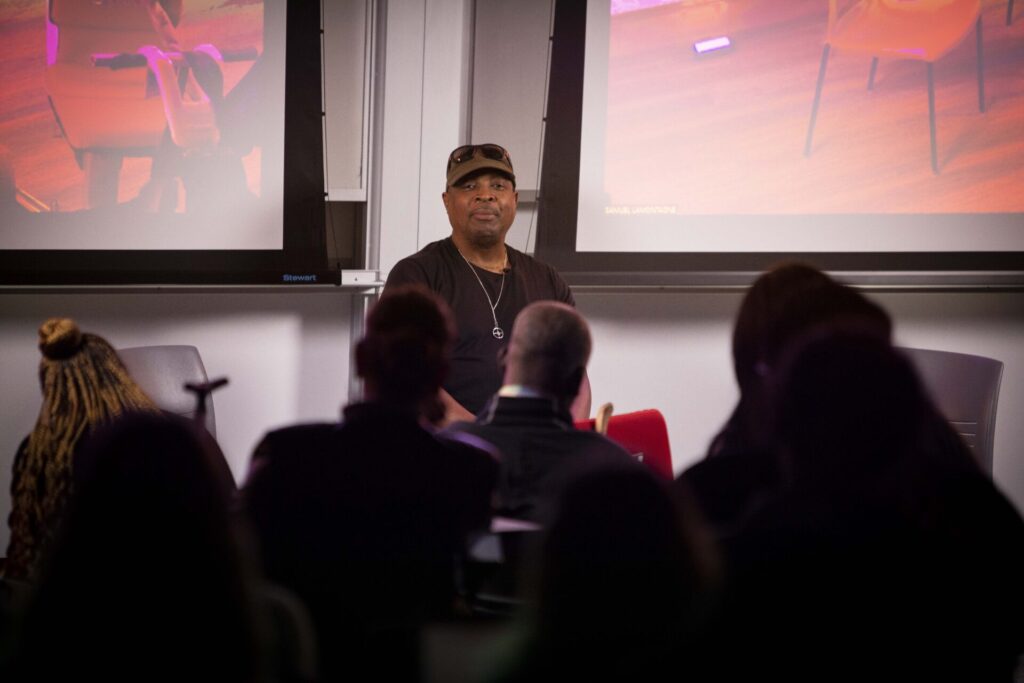
My nearly four-decade career as a professional has been in truth and honesty for the culture. I don’t think I remember a time that we, as Black people, were not in an hour of chaos. But the culture, the art, the music, and the people are what I’ve always been about. That’s what’s always gotten us through the chaos. It’s beyond politics, though we can deal with politics along the way. Hip hop, in that early period, was part of a Black music lineage that made us feel good collectively. In this course, we really tried to tap into that spirit, because I think to feel is the essence of human beings. Give me cultures that end governments. Governments are the cancer of civilization. I’m not here to teach anyone about how to make a better government, but I will tell you this: Culture is what brings human beings together. In culture, and in the arts, we look for our similarities. Through culture, when it’s actually rich so that we communicate with one another, we overcome our differences. Beware when the government says it is in control of culture.
Hip hop, globally, has functioned to counteract the oppressive works of governments. Ever since the 1980s, I have considered myself an ambassador for hip hop, travelling to 116 countries around the world. My mission was not only to assure that hip hop would at least be taken as seriously as all other genres of music, but more importantly, to make the country and the world look at Black people as equal human beings, fighting the powers that be for equal rights. That was my goal in the music. And we connected with artists all over the world who were fighting against oppressive governments, whether it was South Africans bringing down the racist apartheid regime or Palestinians fighting the illegal Israeli occupation.
I am not a politician by any means. I am an artist. In my first album, Yo! Bum Rush the Show, in 1987, the underlying subtitle was, “The government’s responsible. The government’s responsible. The government’s responsible.” My first records were talking about a revolution of the mind. We were never about bombs, bullets, or bloodshed. We knew that technology was going to create the future battlegrounds, and it began with the music. And what music is more evident of a technological takeover than hip hop and rap music? In 1990, I said, “Welcome to the Terrordome,” a decade before the turn of the century and the millennium, two years after ‘Don’t Believe the Hype’ and nine years before There’s a Poison Goin On. The inspiration for ‘Fight the Power’ was sparked from the Isley Brothers.
Every title that Public Enemy has used in its songs and albums has a meaning like a tree line on a husk. Our music has always put culture first. I am a culturalist. I believe in the power of culture and the arts to not only bring people together but also to bring about political change. Music means so much to those on the margins, to those treated as “less than” or as “second-class citizens,” to those people displaced from their homelands, to those locked up behind the wall, to all those who suffer some form of oppression. My music has always come with a message. That’s what Public Enemy has always been about, and that was my mission in 2024 as a US global music ambassador – to bring the music, and the message, to as many people as humanly possible.
My ambassadorship was single-focused: How do we make this culture and music in its fifty-first year hold industry, technology, and government accountable and responsible? How does music galvanize peace, love, understanding, knowledge, and wisdom to counter the bullets, bombs, and bloodshed that we’ve seen from governments hell-bent on war? And in this new technological/AI bot farm/deep-fake era, how do we recognise that it isn’t even necessarily land that’s being bombed. What if what’s being bombed is our minds? We know that governments and conquerors are trying to buy up every available square inch of land here on Earth and beyond, but what if our minds are the most valuable real estate of this millennium? These are the kinds of questions that artists, beyond hip hop, are grappling with, and these are some of the difficult questions we deal with in this book. I am also an optimist. To the brilliant UCLA student body of this class, I don’t believe things can go back to “the way they were,” as the song goes. I believe they go forward. What comes out of the ashes like a phoenix becomes new art, new music, new technologies, and new ways of understanding the world. In this super convergence of technology, government, and industry, making sense of the chaos will be even more difficult.
Nothing remains the same. The players change. The goal posts move. Movements shift. The board flips. But it’s up to you to make a way forward. That’s what hip hop has always done. And that’s what this generation must do. You are living in the chaos of extreme social divisions, the ever-present threat of fascism, and heightened levels of uncertainty. But you gotta step up and rise to the challenge, like generations before you have always done.
In The Hour of Chaos: Art & Activism with Public Enemy’s Chuck D is published by University of California Press