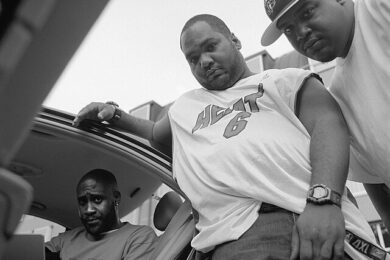

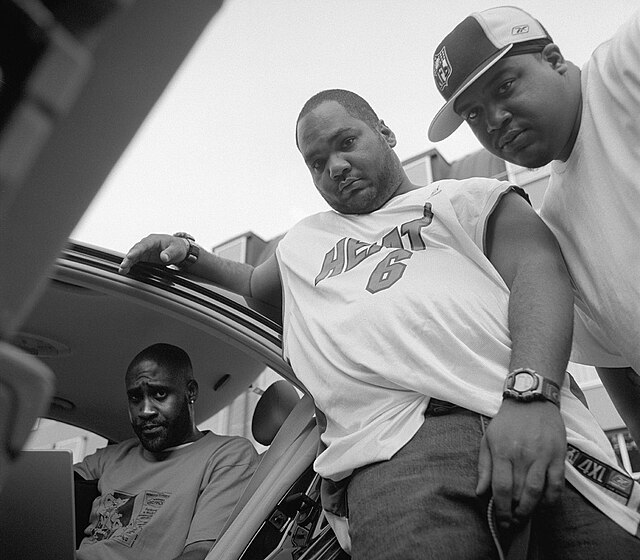
Although Posdnuos, Trugoy, and Maseo found each other while living on Long Island, none of them, including DJ Prince Paul, were born there. Their families, like many, migrated from New York City’s boroughs in the 1970s and 1980s. Kelvin Mercer was born in the Bronx, while David Jolicoeur and Vincent Mason, Jr., were born in Brooklyn. Maseo was the last of the group to move to Long Island, in 1984, and he explained why his new surroundings were the perfect place for cultural experimentation. “Long Island was a bit more multicultural. Black, White, and Hispanics lived amongst each other instead of across town. On Long Island, there was a mix of everything as one community. They had grass, trees, houses, NBC, ABC, WBLS radio, and then we eventually picked up Kiss FM,” Maseo told Wax Poetics in 2013.
While the future members of De La Soul did not come of age in New York City’s five boroughs, they all admit the Long Island community nurtured their artistry. Posdnuos explained to journalist Brian Coleman, “In LI you had your own four walls that weren’t attached to anyone else’s four walls. There wasn’t the city congestion.” Dave concurred, “Hip-hop was something we had the opportunity to digest from afar. If we had all grown up for all our years in the Bronx, De La Soul definitely wouldn’t have been the same.”
Paul Huston was born in 1967 in Queens, but his family migrated to Amityville in the early 1970s. Exposed to a burgeoning hip-hop culture at an early age, he developed into a DJ prodigy. Huston was the first member of the group to get into hip-hop (or rap), even before the culture had a name. In an interview with Ethan Brown for The Source magazine, Paul recalled, “I was going to block parties and backyard parties in Long Island and in Brooklyn. . . . That’s how I got exposed to different styles. I would sit in front of the DJ from the time I rode my bike to the block party until they loaded the equipment back up.”
Over time, Paul learned the most popular records DJs spun and eventually started DJing once he reached the fifth grade. He worked with fellow Long Island rapper Biz Markie in eighth grade and joined the rap group Stetsasonic as the DJ and youngest member in 1984. Maseo says he saw Paul at a party he attended within the first month of arriving on Long Island. But another two years passed before they encountered each other as artists.
De La Soul was not the only rap act to draw inspiration from growing up on Long Island. Public Enemy, Rakim, and Biz Markie illustrated how rappers’ musical styles reflected their suburban experiences. These artists developed distinct rap styles, sounds, and outlooks. Rakim introduced a new rap style with slower verbal delivery and more complex rhyme schemes. Biz Markie might have appeared goofy, but he could do it all – beatbox, rap, sing, and entertain. Of course, Public Enemy, like De La Soul, brought a new sound to hip-hop – one that was more urgent, noisy, and intense. Developing a hip-hop scene on what became known as “Strong Island” complicates early hip-hop’s urban history. Rap was not just limited to the dilapidated landscape of the South Bronx, nor the projects in Queens. The ascent of Strong Island also reminds us of the complicated racial history of suburbia. Of course, Long Island was home to Levittown, the suburb developed by William Levitt’s company, Levitt & Sons, which mandated residents abide by racial covenants excluding African Americans and Jewish people. Yet, Long Island boasted its share of predominately Black suburbs and neighbourhoods. For example, Rakim grew up in mostly Black Wyandanch. Posdnuos and Trugoy grew up in East Massapequa.
“This is where it all starts, yo,” Luck, Posdnuos’s brother, said about Amityville High School. Hip-hop entered the schools as more Black and Brown youth took to the genre in the 1970s and 1980s.
Thus, like many young people, hip-hop artists, fans, and critics often found their community and honed their talents in high school in the 1980s. Future Native Tongues brethren Q-Tip and Ali Shaheed Muhammad of A Tribe Called Quest and Afrika Baby Bam and Mike Gee of the Jungle Brothers met at Murry Bergtraum High School; Busta Rhymes attended George Westinghouse Career and Technical Education High School, the same school as The Notorious B.I.G.; and Posdnuos, Maseo, and Trugoy connected while attending Amityville High.
Posdnuos, Trugoy, and Maseo took the art form seriously early on. Posdnuos claimed the creative environment encouraged him to engage with hip-hop culture. He told LL Cool J, “Everyone in the neighbourhood, whether you was trying to breakdance, you were involved in this culture that was evolving that would become hip-hop.” Posdnuos then explained, “Just like-minded individuals start, like, boosting the creativity to a level like, ‘Yo, I can do this. I can do this for a job.’ ”
Referenced artists
Prince Paul
Death Was Not The End: Gravediggaz’ 6 Feet Deep Revisited
Posdnuos and Trugoy began their artistic relationship in 1985 when they joined a rap group called Easy Street. Like scores of music bands forming in and around New York City at the time, the outfit did not last. Trugoy said the other members took music less seriously than he and Posdnuos. “Pos and I really clicked personally. . . . So we broke with Easy Street and got down with Charlie Rock, who was a good friend of mine. We didn’t have a name – we were starting to put music and concepts together.” Maseo then joined the group at the behest of Rock. The new group needed a name. Charlie Rock left the group, and Posdnuos floated calling themselves “The Threesome” since they were left with three members. Trugoy and Maseo shot that down. Years later, Posdnuos would recount the origins of the group’s name, which translates to “From the Soul,” in a radio interview. “I feel like we do everything from our heart and soul. Why don’t we call ourselves From the Soul?” However, Trugoy refined it. “Why don’t we say De La Soul?”
Living in a D.A.I.S.Y. Age by Austin McCoy is published by John Murray Press