

For the four kids of John and Alice Coltrane, it seemed like any other morning at home. Three years prior – still mourning the passing of their father – they had packed up and moved with their mother to California. And by 1975, they were firmly settled into life on the West Coast in the suburbs of Woodland Hills in the San Fernando Valley. Michelle was a full-blown teenager, John Jr. turned eleven, Ravi was ten, and Oran was now eight years old. Alice’s kids were quickly growing up and becoming more independent, able to take care of themselves. “I had reached a point where most of my duties as a householder were fulfilled,” she said. “It gave me the time to want to see, to want to strive, to want to devote quality time, because you know, the work of a woman is so full. I mean it’s sometimes twenty-four hours. So once that was reduced, I had additional time that I could apply to the path, and that’s what I’ve been doing.”
Turiya, as their mother had taken to calling herself, a Sanskrit name referencing the fourth state of consciousness in Hindu thought, began to devote even more of her time to her spiritual practice, meditating into the wee hours daily. Her practice of sannyas — the ascetic practice of renouncing the material aspects of life, of detaching from identification of the body and self — intensified. “It started with taking the sannyas, that was a total mystical experience,” she said. “It was God’s deliverance of his anointed mercy on me.”
As documented many decades on in her book of holy writings, Divine Revelations, Turiya described how this miraculous transformation out in the suburbs of Los Angeles came about one night in summer of 1975: “I received my initiation following meditation. I had a revelation about what would take place. I would be initiated through Divine Grace.” She had been told to wear a white dress, and when that divine day came, a vibrant new color emerged: “I remember that Lord Ram poured the color into the white clothing worn for initiation. The orange hue that He created came down from above, softly and ethereally. It was truly magnificent to witness the Lord materializing color into the clothing so completely that a heavenly light began to radiate and flow into the periphery shining with the color of a summer’s evening sunset. It was a divine honor and blessed privilege.”
Along with the new saffron color of her garments, she heard the Lord “call me Turiyasangitananda, which means the bliss of God’s divine music.” Along with her new name, the feminine honorific of Swamini was also bestowed. Her work and mission were revealed to her, as well as the directive to start her own ashram in California. Alice Coltrane was now Swamini Turiyasangitananda. A grand proclamation, she left a note on the fridge announcing her new name to her kids, who fell out laughing when they saw their mom’s new name.
“We were challenged trying to pronounce a word with so many letters and eventually John Jr., Ravi, Oranyan, and I — and even my mother broke down laughing with our attempts to say it right,” Michelle recalled. “What did we know? We were teenagers, energetic and running around. We did not yet know the depth of our mother’s journey ahead.”
Nor did most of the jazz world or record-listening public. Soon after her move to California, Coltrane was released from her contract with Impulse Records. After seven studio albums for the label often referred to as “The House That Trane Built,” after her late husband, John Coltrane, Alice Coltrane had no deal. In the interim years, she had made a studio album with guitarist Carlos Santana and guested on The Elements, a thrilling slice of spiritual jazz recorded with her old Detroit jazz pal, Joe Henderson.
That same year, Warner Brothers Records came calling, though Turiya herself was hesitant to sign. “I got a call from a record company offering me a contract, I did not want to take it because the Lord had pointed me in the direction of spiritual activity, which would involve everything — initiations, service and whatnot,” she said. “And then it was disclosed to me that I could do both spiritual and musical work. So for five years I executed that contract.”
An earthly contract and spiritual compact were sealed that year. In Divine Revelations, Turiyasangitananda detailed a dialogue between her and Lord Sri Rama deep in her meditation: “Several persons in this country (USA) are inquiring amongst themselves as to ‘how does an American black, Christian lady become an East Indian swamini?’” To which the Divine Lord replied: “It matters not whether public inquiry and opinion are favorable or unfavorable; one’s country and nationality are of no underlying criterion. If one has dedicated his life in devotion to God, he can be selected to become a candidate for initiation into the renounced order of sannyas.”
In August, work began on her first album of new material in over three years. Recording at Burbank Studios, some twenty-nine players were assembled for the sessions. Ed Michel served as producer, Baker Bigsby was engineer, and Murray Adler was first violinist / concertmaster. “I generally preferred to record everybody at once, because the music was elastic and soloists responded to the whole environment,” Michel said. “This was contrary to what was preferred when recording pop projects.” Ed Michel himself even pitched in and played wind chimes. For Bigsby, he was always impressed by Turiya’s demeanor in the studio. “Even though her brain was wandering around in the ether and heavens or whatever, her feet were planted firmly on the ground,” he said. “So she’s a real practical mother. She seemed to be really a practical down-to-earth person.”
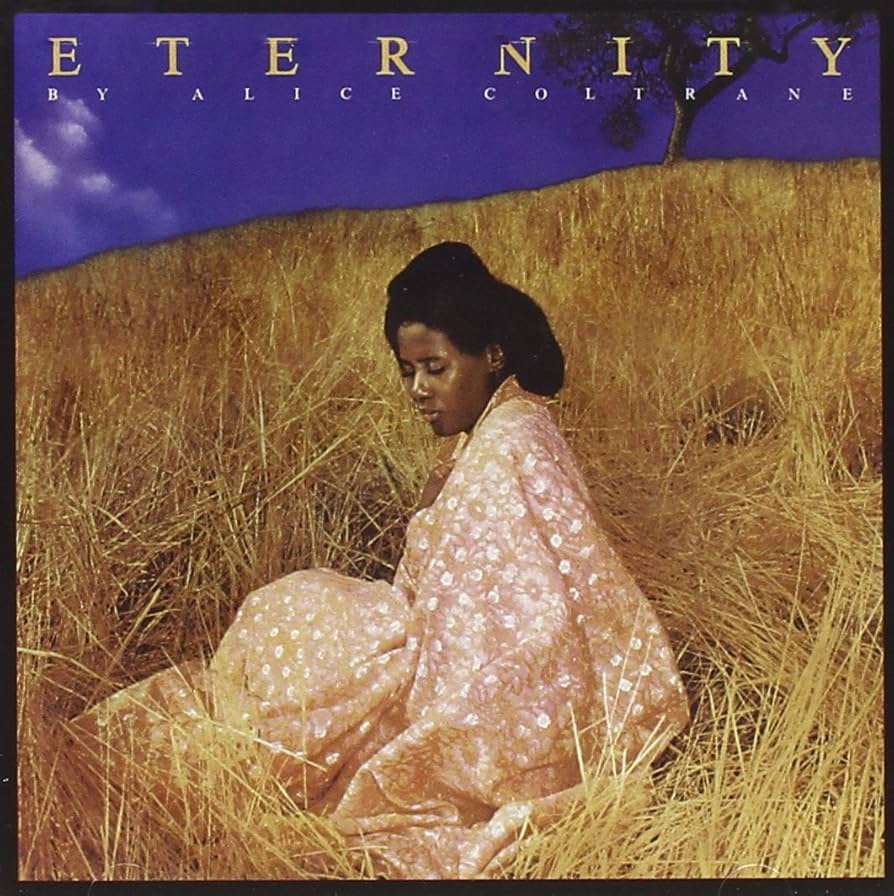
Eternity, her Warner Brothers debut, is both more polished and more eclectic than her prior albums. On the mid-August recordings of ‘Spiritual Eternal’ and ‘Spring Rounds’, there’s something decidedly Californian about her use of strings and orchestrations, which are cinematic in their sweep, able to be Technicolor-bright as a Hollywood soundtrack, the bracing dissonance of her later Impulse albums mostly buffed away. While her last Impulse recording, Lord Of Lords, featured a vertiginous read on Igor Stravinsky’s The Firebird Suite, this time Turiya repurposes Stravinsky again, this time with a piece from The Rite Of Spring, delivered in a more calm, stately manner. ‘Wisdom Eye’ presents Turiya’s mature harp style in the solo spotlight for the first — and only — time in a studio environment, creating a serene three-minute stream.
On the album’s centrepiece, ‘Om Supreme’, she debuted an all-too-rare rare turn on Fender Rhodes and featured her first chorale arrangement. It was also the first piece to feature vocals since her days in Detroit playing with vocal pop group, the Premiers. But in featuring only organ and voice, it also reflected the kinds of chanting she was already leading at her newly- established Vedantic Center. The melody has its roots in the bhajans, with her providing a new vocal line on top, memorializing how the Supreme Lord instructed her to move to the west: “When I called you to California / you knew I would meet you in California.” Ed Michel brought in professional singers for the session, yet their polished delivery and clear enunciation stands in stark contrast to her future choir pieces. What it lacks in raw energy and the ecstatic feel of gospel music (as well as her later work with bhajans), it makes up for in its curious amalgam of Anglican and Indian vocals: there’s a blissed-out feel to the back half of the piece as the six vocalists chant in Sanskrit.
Eternity’s other bold move is ‘Los Caballos’. Out in the rugged landscapes of Woodland Hills, Michelle Coltrane had become taken with horseback riding and took up dressage. “She bought a ranch house with a barn and the guy that worked with Trigger, Hollywood people were out this way,” Michelle Coltrane said. “It was close but not too far away. Boys would be on BMXs and girls would meet in fields on their horses.” At one point, the family owned multiple horses: Chico, Bart, Loose, Joker, Peppers, Leo, and Camelot Diamond Coltrane. Her mother became enchanted by the elegant magnificence of these beasts, their strength, intelligence, and beauty.
Turiya was also fascinated by the rhythms of their hooves on the ground, creating a song that replicates “its walk, trot, jog, on up through the extended cantor, and hand-gallop.” Her Wurlitzer is set to whinny on the song, mixing growling low-end jabs with high-frequency runs as bright as a meteor shower. Santana percussionist Armando Peraza added clopping congas to the backbeat, while Carlos Santana himself guested on timbales (called “A Friend” on the album credits). There’s a definite Latin feel, but as is her wont, the rhythm speeds up and slows down throughout, a spicy Latin rubato. The mid-1970s might have been when jazz began to dabble in disco beats, but ‘Los Caballos’ — like its titular subject— gallops down the path less traveled. And at the very bottom of the record cover, in small print, she signed off as Turiyasangitananda, the first time her full new spiritual name appeared on one of her albums.
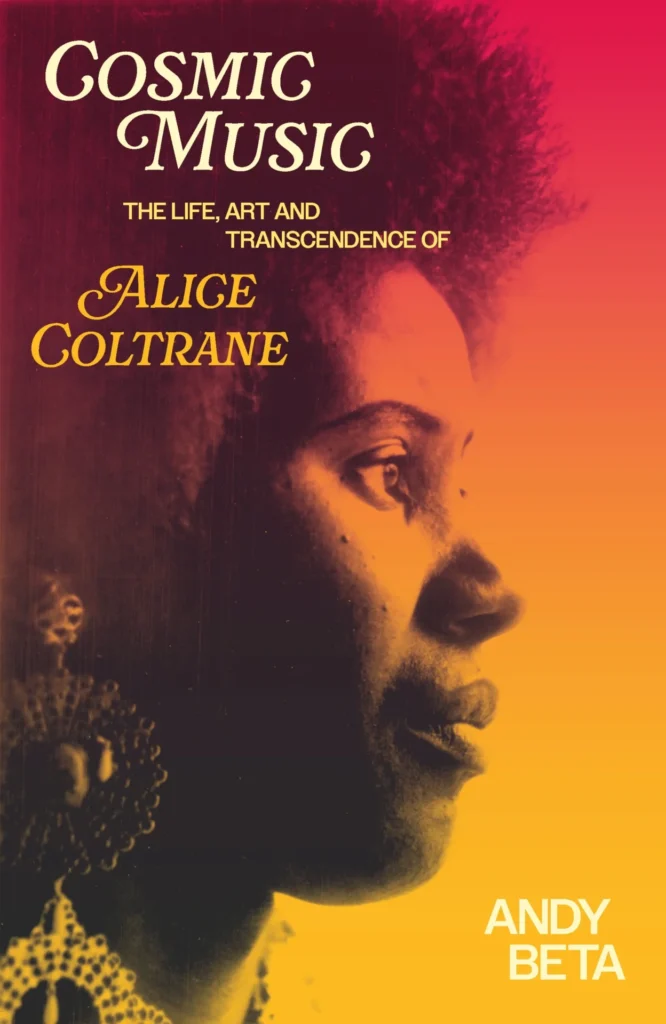
When she wasn’t in the studio, Turiya was often flying from LA to San Francisco, where she had established her first iteration of the Vedantic Center at the One Mind Temple, originally started by Franzo and Marina King (and later to be re-christened the St. John Coltrane Church), teaching chapters of the Bhagavad Gita and her own unpublished work, a slim 53-page testimonial of her spiritual transformation, Monument Eternal.
A nineteen-year-old attendee at the Temple named Carl Hickson had been coming around for a few months in 1973, helping out as needed. “I was very happy to find a vegetarian place that made really good food and was playing the music of John Coltrane in the background,” he said. Soon, he was helping them to serve others in the community. Hickson grew up in a small upstate New York town, but felt “a really deep fire to understand what’s real” that drew him out west. Hickson didn’t have a steady job or a place to call home, spending his time between church crash pads and the One Mind Temple.
One night, Hickson was clearing away the last of the dishes at the communal tables when the music that had been playing in the background suddenly zoomed into the foreground of his mind, overwhelming him completely. “Now, as if for the very first time, I heard it,” he testified. “ The celestial sound gently embraced me then it shook me to the core! It was otherworldly. Ethereal. Cosmic. I placed the stack of dishes on the floor. As if pulled by a tractor beam I walked over to the stereo and picked up the album jacket. With my eyes glued to the cover I slowly sat down on the wood floor in a clumsy cross legged position. Pulsating celestial music flowed from the speakers. Staccato organ music danced between the sound of violin strings like children joyfully crossing a stream- jumping from one rock to another.” He was floored by Alice’s rendition of ‘Hare Krishna’ off of Universal Consciousness and in that instant, “deep in my heart, I knew, she knew! This being had attained to transcendental levels of consciousness. She had been to the mountain top.” Hickson began coming to these readings and informal sessions at One Mind Temple, along with another recent convert, Carol Adams.
In Adams’s book, Portrait Of Devotion: The Spiritual Life Of Alice Coltrane Swami Turiyasangitananda, she recalled Turiya’s gentle grace toward all she encountered. “She greeted the higher, divine Self of each person she met,” she wrote, likening her to Mother Teresa and St. Francis of Assisi. “She expressed that her intent as she met each person was to receive them as the Lord receives them. Instead of seeing human flaws and character defects, these holy beings perceive the spark of divinity.”
Hickson saw in Turiya’s example an empathy to the progressive social movements of the day, an intersectional meeting between the Black Liberation Movement and the Women’s Liberation Movement (not to mention freedom from the oppressive, regressive patriarchy of Western religions). “In meditation she was told to ‘shatter’ two of the prevailing myths of our time,” Hickson said. “The first, ‘Black people could not be leaders, teachers, and gurus.’ The second, ‘Women could not be leaders, teachers and gurus.’ And shatter them she did!”
At the end of the year, Hickson was given the spiritual name Purusha and Adams was given the name Shankari. Hickson recalled the anticipation of the day before initiation. “I meditated with Swamini during the early morning hours of December 20th, one day before our initiation. The light in the meditation room was dimmed and had a soft orange hue. The scent of sandalwood incense lingered in the air […] during this first meditation, it felt like being enveloped by a soft, rose coloured cloud — like being in a lucid dream. I couldn’t see Swamini but I could sense her presence.”
Swamini Turiyasangitananda welcomed 1976 in South India, but was back in the United States by the end of the month, as she went out to Burbank to record a duet with former Ornette Coleman bassist and recent collaborator, Charlie Haden. When Haden first extended the invitation, Turiya demurred, saying she was no longer performing on harp, but Haden finally convinced her to join him on a piece written especially for her, “For Turiya.” As Haden remembered: “I thought I had ascended into heaven, the way she played it. It was so magnificent.”
In late February, she performed at the Beacon Theatre in New York as part of Warner Brothers’ big rollout package of their roster, conquering the Big Apple under the banner “California Soul.” A reporter in Toronto detailed the ironic sight of Alice Coltrane during this major label press cycle. They spotted Coltrane draped in a sheer saffron robe, seated unperturbed amid the ambient lavishness of the Cole Porter Suite at the Waldorf Astoria, stating: “‘All my work, my music, is really just an extension of myself ’ . . . [while] oblivious to the dozens of record company executives running around the hotel’s halls worrying about her. She might just as well have been meditating in the lower foothills of the Himalayas for all she seemed aware or cared about the activity around her.” The piece went on to describe Eternity as “a luxurious album full of lush textures and shifting harmonies…You can feel her quiet hand at work everywhere.”
The weekend-long event featured the likes of the Staple Singers, Ashford and Simpson, Dionne Warwick, Graham Central Station, First Choice, Leroy Hutson, and the Impressions, the label’s pop side, paired to their light and airy jazz roster: David Sanborn, Al Jarreau, Pat Martino, Miroslav Vitous, and guitarist George Benson. Benson was on the precipice of releasing Breezin’, a triple-platinum smash that would forever affect the expectations of the rest of the WB jazz roster. Onstage at the Beacon, her music stood apart from everyone else on the bill: “The most informal music of — and in many ways the most honest— was provided by Alice Coltrane’s quartet,” the New York Times reported. “Mrs. Coltrane and her musicians exuded a quiet strength that was conspicuously absent from the rest of the program.”

In the wake of George Benson’s Breezin’, Warner Brothers was no doubt hoping for something that could sell, yet the quiet strength of her presence — what Ed Michel called her “will of tungsten” — would neither be hurried nor bent. As he recalled: “What I remember is waiting for her to come up with a title, with the record company screaming at me to get an answer (‘It’s holding up the damn release!’), while she patiently waited for her meditation process to give her the answer.”
Eternity came out and Coltrane performed a few concerts in support of the album. Down Beat’s three-star review compared her to her late husband (“She certainly has never demonstrated the capacity for organic creativity that John did”), questioned “her insistence that everything be permeated with cosmic significance,” and concluded: “It’s all very smooth, but it’s also rather emotionless, devoid of warmth.” Another review concluded: “She will remain a minor-league avant-garde jazz figure, because she exercises without consistency or reason.”
Outside of such critical indifference, Swamini began to experience mounting tensions at the One Mind Temple. It soon came to a head sometime in 1976. Reverend King “was having a harder and harder time accepting instruction from Swamini,” Hickson said. Not because of her teachings or insight, but for something more primary: because Turiya was a woman. “[He] was bumping into a fierce enemy — himself.” During one lesson that Turiyasangitananda was giving, she suddenly found herself being accosted by an onslaught of hostile questions from her hosts, the King family. “It wasn’t the questions themselves that was so startling, but the sarcasm and dissatisfied energy behind them,” Hickson said. “I was stunned.”
As was Turiya, who quickly took her leave and made her way out of the temple, never to return. But as she was at the front gate, Hickson walked up to her, went to his knees, “and bowed with my forehead touching her feet. I stayed there awhile. Swamini bent over and with her arms encouraged me to stand up. I was at peace. As I stepped back, Shankari stepped forward and knelt at Swamini’s feet as well.” Turiya had her first two students. And they soon moved into the neighbouring house in Woodland Hills, living next door to the Coltrane family and studying intently with Swamini Turiyasangitananda.