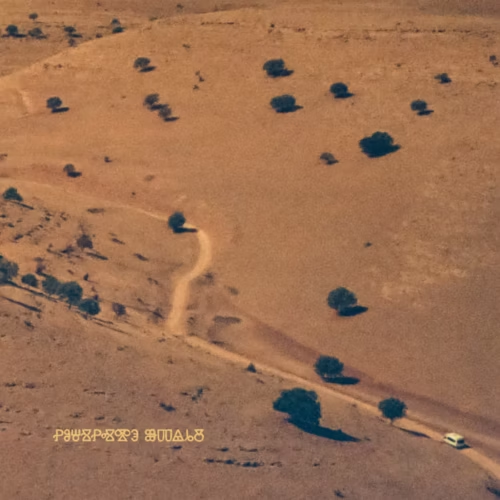

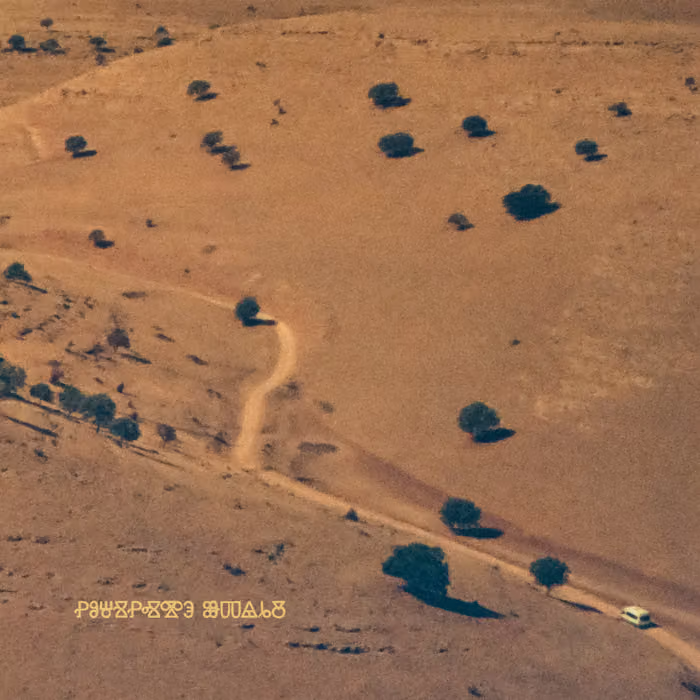
The music of Polish guitarist Raphael Rogiński and Slovenian multi-instrumentalist Iztok Koren finds its fullest expression as a practice of attentive, high-resolution listening. In a world of overstimulation, Nocturnal Consolations operates through a logic of reduction. Intensification emerges at the point of sharpening. Every gesture, every vibration of a string, every resonant surface exists in suspension. Meanings arise only through the relations between sounds.
The idiom developed by Rogiński reaches an almost crystalline form here, best exemplified in ‘The Spirit Is Becoming a Desert’. His playing has long oscillated between reconstruction and erosion, drawing on traditions (Jewish nigunim, Middle Eastern music, and broadly understood Eastern European folk) while systematically undermining their stability. Melody unfolds through drift and microtonal shifts, undergoing subtle deformations. It is a language devoid of exaltation, distrustful of virtuosity, where tension arises from restraint and precision.
Koren, in turn, transforms the space in which this playing unfolds. He works with a wide and compelling array of instruments, from gimbri to prepared strings and percussive objects. Frictions and vibrations render the sound strikingly physical. The Slovenian multi-instrumentalist introduces a textural and ecological dimension into Rogiński’s music. Their collaboration is based on the coexistence of two sonic trajectories that intersect and diverge, forming a system of dynamic relations.
This music is best understood as a process in which folk undergoes its own decontextualization and dispersion. Microtonal tunings, instrumental preparations and the subtle use of effects generate a sound environment in which silence assumes a structural role. The artists invite the listener to move in a space without a clear centre.
Nocturnal Consolations situates itself within the broader landscape of Central and Eastern European music, where tradition increasingly functions as a field of negotiations. Rogiński has long remained one of the key figures of this scene, and his duo with Koren allows his language to reach a particular clarity. The music remains at once disciplined and open, yet paradoxically rooted and mobile. Meanwhile, the Byzantine palette of timbres evokes the borderlands of Europe and Asia, directing the gaze even further east.
The absence of clear climaxes, the slow pace of change and the consistent avoidance of spectacle demand a mode of listening more akin to engaging with field recordings than with a conventional studio album. Ultimately, Nocturnal Consolations is a space to inhabit. Rather than offering ready-made meanings, Rogiński and Koren test their capacity to construct them. The album is made of sounds that contain the essence of all times.