
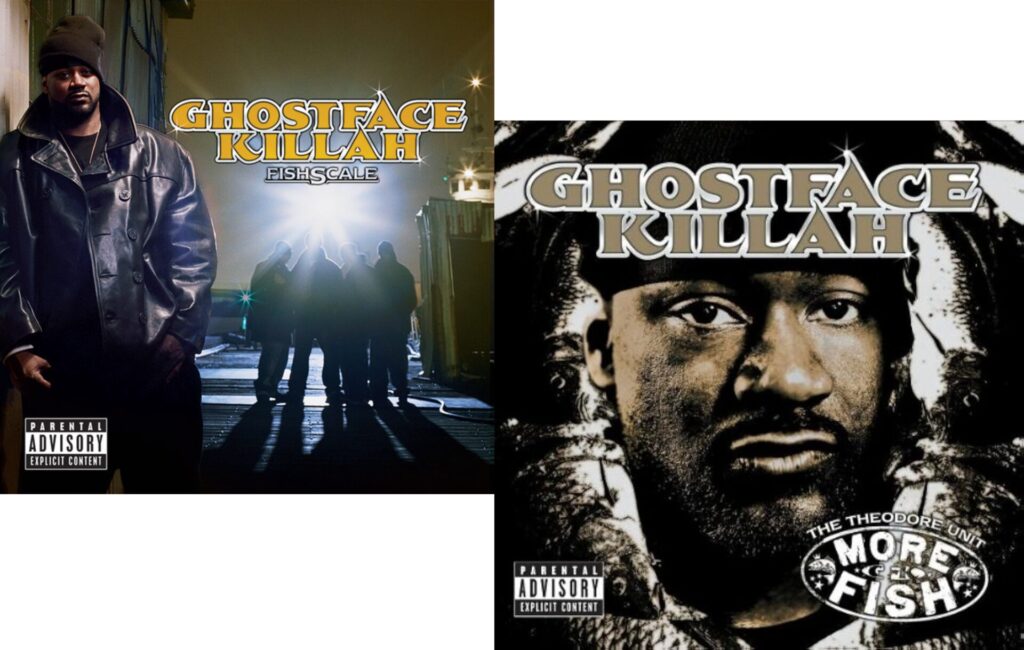
As attentive readers of this august journal will know, the remit and parameters for the occasional Three Album Run series are exacting, the bar set so high it can see for miles. The records that define a whole genre? That’s tough. But it has to be: the artists who’ve made three crackers in a row have already earned their place in the canon, so writing about a particularly storied arc in their catalogue is obvious to the point of laziness. Ghostface didn’t make three records that encapsulated his genre, but, starting in April 2004, he embarked on the kind of studio hot streak that is worthy of the kind of acclaim we routinely accord to Dylan in the mid-60s, Stevie in the mid-70s or Public Enemy from 88 to 91. The Anniversary series has already looked at the first of the three LPs he released over that marvellous 18 months – The Pretty Toney Album – so the task remaining is to listen again to the two records he released in 2006, and which cemented his place not just as first-among-equals in the Wu-Tang Clan but one of the greatest to ever do it, in any genre.
Hyperbole? Maybe. But Pretty Toney, Fishscale and More Fish are remarkable records. Perfect they are not; over-laden with salty skits that were never funny enough to sustain their length, never mind repeated listens, each record at least pulls back from the mid-90s hip hop bloat tendency – the widespread theory that you should always fill that CD up to its 72-minute brim – but still force-feeds too much stodge to their audiences. And while it may be possible to argue that some of the most difficult-to-stomach lyrics are in-character confrontations of the hate and rage that fuels evil behaviour, that doesn’t diminish the potential a lot of this material has to cause pain.
But at the time, even allowing for all that, these records felt like a breath of fresh air. A bifurcated and often listless hip hop marketplace seemed to be populated by artists who were either turning in focus-grouped pabulum aimed at the pop charts or deliberately left-field fare that failed to do very much that was new. (An oversimplification, admittedly; and there are honourable exceptions. Think of this like a weather report: while there may be isolated areas of sunshine and blue skies, that doesn’t mean, overall, the conditions were not grey and gloomy.) Ghost’s records were outliers: unlikely to engage the casual rap listener but making no concessions to an often self-important and pious underground crowd, he just did what he had always done – followed his own determined and inscrutable internal logic to wherever that happened to lead him, making sure to tape all the results, and aiming to have it released in a vaguely professional manner. If that sounds like an easy mark to hit, nevertheless there were few who were then demonstrably bothering to try: and because of this, the records landed all the more forcefully with those who cottoned on to them at the time.
The take back then was that Fishscale, released 28 March, was the “proper” album and mid-December’s More Fish a kind of halfway house between a mixtape and a conventional solo record. Or, perhaps, given the number of verses given to members of Ghost’s side hustle, The Theodore Unit, maybe it was his (or Def Jam’s) stab at having a D-12/Devil’s Night type of offshoot extended-family hit. Partly this notion is reinforced by the moments on the latter where the beats are other people’s songs – rappers rhyming over other rappers’ instrumentals being a mixtape rite of passage back then. But that interpretation ignores that this is what Ghost had been doing on his own albums all the way through his career anyway – albeit that he would rap over old soul records, vocals and all, rather than other artists’ sample-based instrumentals – and also means we’re encouraged to gloss over the extent to which Ghost made those tracks his own, and engaged in a spirited and inventive dialogue with the earlier work.
The two prime examples of this on More Fish are ‘Ghost Is Back’ and ‘You Know I’m No Good’. On the former, Ghost takes the instrumental from Eric B & Rakim’s 1992 Juice theme song, ‘Know The Ledge’, and slathers his own brand of verbal dexterity all over it. But if Ra’s track was an elaborate finished piece – an end-to-end burner of a song, carefully constructed and referencing the plot of Ernest R. Dickerson’s film without necessarily replicating its story beat for beat – Ghost’s resembles a quick and dirty throw-up; words splattered onto the beat’s canvas, ideas jockeying for position, each one given a chance regardless of whether it would have survived the kind of ruthless editing that seems to characterise some of the high points on Fishscale (‘Shakey Dog’; ‘Dogs Of War’). It’s bracing even in its moments of objectionable excess and unrepentant ugliness (the second verse’s attack on a notional rival emcee devolves all too quickly into sickening misogyny; and for all the dexterity of the delivery and the thrill of the blizzard of internal rhymes in the lines at the end of the first verse, the dig at Ruben Studdard is cheap and unmerited). Yet what comes across isn’t a sense of, ‘Here’s Ghost trying something where not everything works and putting it on an album anyway’; instead, what you’re left with is a kind of emcee brag piece that stands almost alone in the annals of the type. It’s a declaration of supremacy that works because it challenges all comers to colour as far outside the lines as Ghost is willing to spray, and in which he implicitly declares victory because he knows – and it’s there in the way he raps, rather than what he actually writes; though it’s because of how extreme what he writes is that he is able to feel so certain – that nobody will even dare try.
The Winehouse collaboration / mash-up is another track where the approach is unprecedented and which works not despite its strangeness but because it pushes so far beyond where anyone else would ever think to go. The structure is straightforward: Ghost and Amy perform a duet, but it’s a surgical creation, their respective halves of the verses stitched together. There is no reason to suppose they ever spent time together in a studio, and Winehouse’s parts are clipped to the point where the song’s internal logic is put under severe strain. But their deliveries – both conveying an end-of-the-line sense of desperation, her through resigned lassitute and him via amped-up animation – mean that we can believe in it as a conversation, and we gain a sense of two people in a shared situation, rather than two individuals talking at accidentally aligned cross purposes. It is haunting and magnificent, singular and inimitable: it feels like a kind of alchemy.
If Fishscale feels more finished, more polished, more written, that’s not necessarily because it is. Much of this will have been coded into our thinking before we even heard it. Certainly, at this distance, it’s hard to hear any more logic, any more precision of thought, any greater degree of conventional compositional technique at play than is evident on More Fish when listening to ‘Underwater’, a track that received more than a bit of positive attention in the many enthusiastic reviews that were published around Fishscale‘s release. To perhaps oversimplify, what those reviewers seemed to love was Ghostface’s uninhibited and unabashed sense of playfulness, and – by implication even if not always specifically acknowledged – the fact that he was willing to go as far down this apparently ridiculous tunnel as he did. (“Up ahead lies Noah’s Ark / But that’s waves aways / ‘Look up to the right, that’s one of our bangin’ spas’, she quoted / I took notice / SpongeBob in the Bentley Coupe, bangin’ the Isleys…”) He had already cornered the hip hop market in vulnerability – nobody else was doing it. Notwithstanding Jay-Z’s “sensitive thugs” who “all need[ed] hugs”, Ghost’s cry-pray-sing performances moved these ideas from the
speculative and considered to the intensely and directly felt. And on ‘Underwater’ he – if you’ll pardon the apparent tautology – reached the similarly rarified air of the most freely expressed imagination. If you can think it, why not rap it? His genius was both that he did not just do that, but that he wasn’t bothered at all about how that might have made him look. And because of that, of course, he looked like a genius.



Another thing both records did brilliantly is to cohere despite their extensive cast lists. Not just in front of the microphone – 13 guest vocalists on More Fish, fewer on Fishscale, but only if we go by the precise wording of the sleeve credits, which decrees that ‘9 Milli Bros’ features just one other artist, Wu-Tang Clan – but behind the boards, too. Again, for the era, both records are noteworthy in constituting stylistically and sonically consistent wholes despite the music being the work of a frankly preposterous number of different people. There are 17 named producers credited on Fishscale, 15 on More Fish – among them some huge names: Madlib, MF Doom, Pete Rock, J Dilla. This was very much how major-label rap albums got made back then, patchwork assemblies of beats solicited from anyone who might help cover the different regional and sub-genre bases that notionally constituted the potential market, with the intention of expanding the reach of the artist beyond their core audience. But all too often it resulted in albums that sounded like compilations, with the recipient of the beatmakers’ latest offerings audibly struggling to bring their world and that of the producer together. Here, Ghost, his A&R team, and his posse of executive producers (including then label head Jay-Z) ensured that the process worked the right way round. The music is always aligned with Ghost’s ideas, and the tracks are in service of his creative vision, rather than acting (whether deliberately or by accident) to redirect it.
Those big names delivered some of the two records’ most dizzying highs. The tremendous should’ve-been-a-hit ‘Be Easy’ is fuelled by the kind of combination of inspired crate-digging, counterintuitive looping (the Sylvers’ ‘Stay Away From Me’ is unmistakable, but has a completely different rhythm) and inventive technical tweaks that make it a standout even in Pete Rock’s career, though his similarly transformative use of Sly Stone’s ‘Family Affair’ in ‘Dogs Of War’ is little less sensational. Dilla’s Luther Ingram sample – cut, chopped, speeded up to unnerving effect – is expanded from its Donuts ideation (‘One For Ghost’) to become the bleak, desolating ‘Whip You With A Strap’. Madlib lit upon a track by Hamburg prog band Novalis and built the formidable ‘Block Rock’ with it; Doom drank his own ‘Dragon’s Blood’ and transformed it into ‘Guns N’ Razors’. But there is fine work from the less heralded producers, too, particularly British emcee Lewis Parker, whose ‘Shakey Dog’ kicked off Fishscale, supplying Ghost with the undercarriage that supported one of his greatest, sharpest, most precisely observed and cinematic crime stories; and ‘Outta Town Shit’ on More Fish is based around an inspired and augmented overhaul of a tune from a 1976 library LP by Londoner Alan Tew. Throughout, the vibe is sample-based, golden-age-adjacent, hard-edged drums that snap and snarl, but melodically quirky and individual. Whether everything here was written for Ghostface, pretty much everything across the two LPs sounds like it could have been.