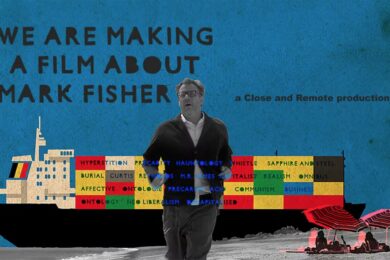

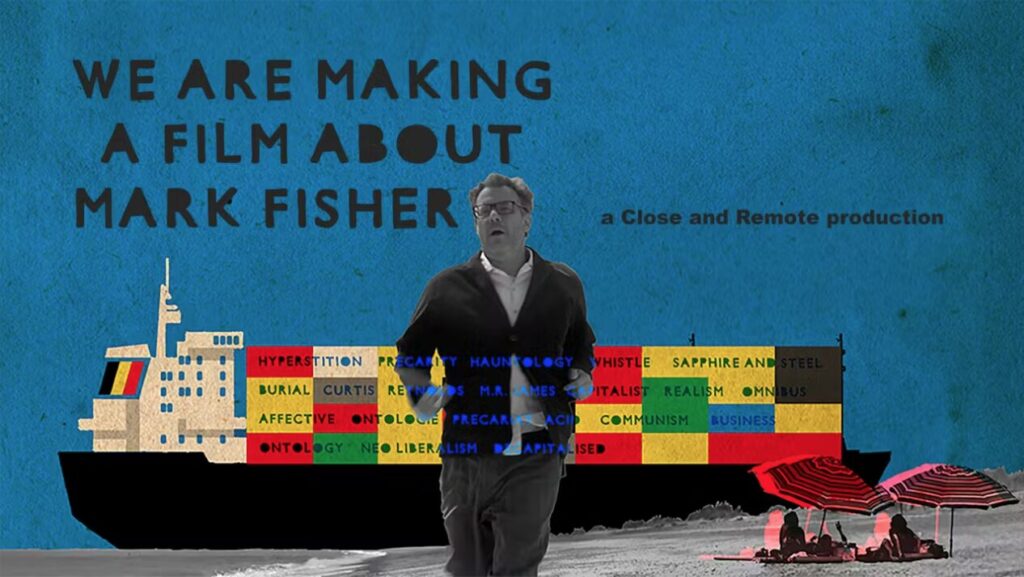
We are making a film about Mark Fisher. That much is true. The idea came about in October 2024 while we were sitting on a park bench in the south Essex commuter town of Rochford. I had been talking to the artist and filmmaker Simon Poulter about the parkland that surrounded us, which was created using money provided by Section 106 funds from a developer. During our visit, a succession of dog walkers adhered to an allotted path running alongside an abundant, all but untouched stretch of grass; all of them were moving towards or away from a 24-hour car park. The park, wedged between a depleted ancient woodland and the A roads of Essex, offers easy access to London Southend airport, which suggests that it is the kind of place, that might have inspired Mark Fisher to make a point about privatisation’s diminishment of the public realm.
As Poulter and I talked about capitalism’s effect on place, I said someone really should make a film about the late writer, theorist and critic. About how the effervescence of his prose and online persona reflected the playful, explorative discourse of the internet in the 2000s. About how he was one of the sharpest political and cultural thinkers in the years after the millennium. About his sensitivity and his sense of intellectual duty, his class consciousness and his kindness.
I first came across Mark Fisher’s writing when I was an English undergraduate at an offshoot campus of Falmouth College of Arts, based in an old convent building up a hill in nearby Penryn, a long bus ride from town. I had just read Simon Reynolds’ book that followed the feverish intellectualism of post punk, Rip It Up And Start Again, and was a compulsive reader of his Blissblog at the campus computer room as we didn’t have smartphones nor internet in our shared house (imagine).
Reynolds had a sparring partner called Fisher who ran the K-punk blog. Having never heard of him before was part of the thrill of the early internet – the ease with which one could come across voices that had no prior vetting in print media. I still sometimes wonder if K-punk was actually the best cultural magazine in the UK between 2003 and 2015, despite Fisher being its sole operator. In his writing on everything from Burial to The Hunger Games, M.R. James to Moloko, he always connected emotionally with his subject, but was also at pains to explore why it mattered in the context of the world at large.
For example, while his peerless writing on The Fall’s early 80s heyday was canonical K-punk, his 2014 retrospective of The Jam is written in the context of four years of the Conservative / Lib Dem coalition led by David Cameron – a man who professed himself a fan, particularly of the song ‘The Eton Rifles’ (which of course referenced his alma mater). “What did the young David Cameron hear when ‘The Eton Rifles’ played?” wrote Fisher. “He says ‘protest’, but what did he imagine the song was protesting against, if not himself? Yet the whole concept of ‘protest’ is inadequate to grasp what is at stake in ‘The Eton Rifles’. For isn’t the song – inspired by Weller’s hearing of Eton schoolboys jeering Right To Work marchers – about the failure, the impasses, of protest? The song stages an antagonism in which there is no neutral big Other to which one could direct protest, there are only partisans in a class struggle. The undernourished, ragtag marchers, facing inevitable defeat at the hands of a well-trained elite protected by the magical insignia of class power: ‘all that rugby puts hairs on your chest / what chance have you got against a tie and a crest?’”
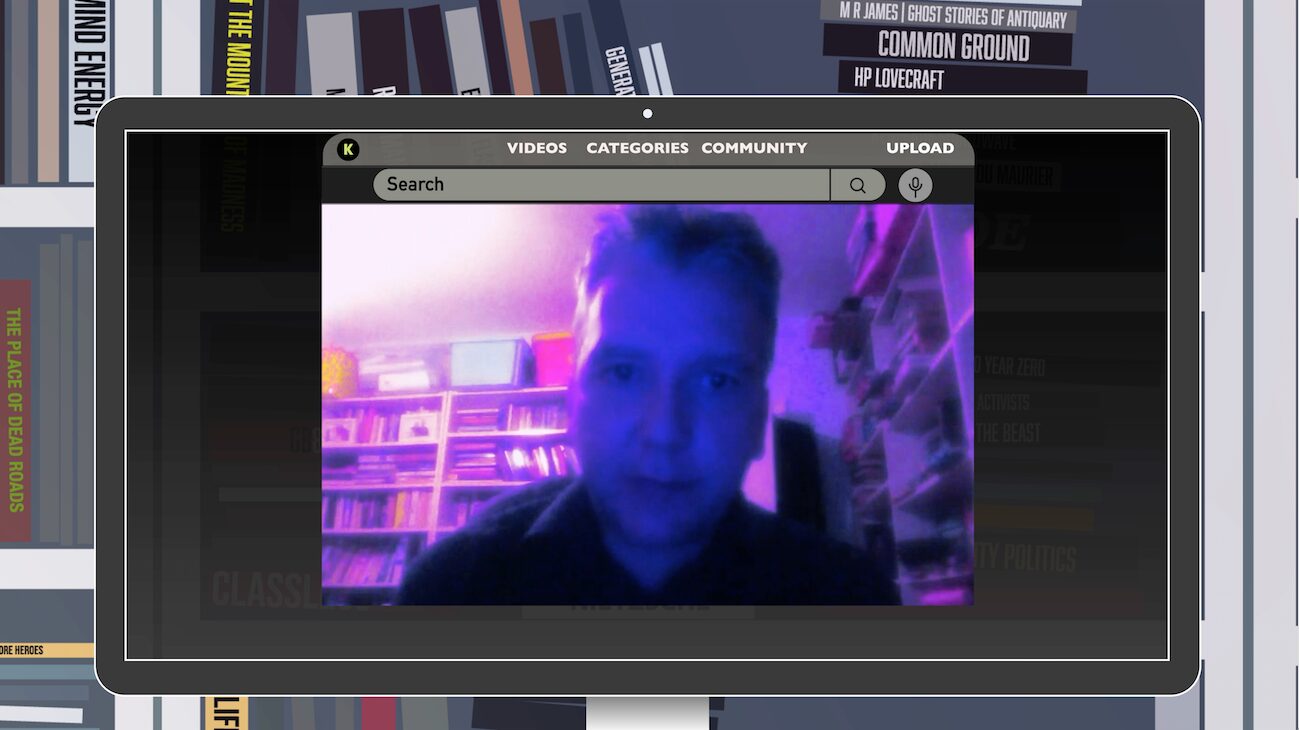
Fisher would always take great care to set out why culture – in this case The Jam, a band loved by masses and masses of people, but often overlooked by serious critics – mattered, and where it sat within the structure of society. Connection was key. He was never a solo figure scaling the heights, on the kind of macho solo mission many male writers fall into. Instead, he created a network thanks to K-punk’s online presence, and the forum he helped set up with fellow Wire magazine writer Matthew Ingram AKA Woebot, Dissensus. He was at the fulcrum of a new kind of discourse about the UK, alongside voices also finding space online, from fellow bloggers such as now established writers of the British left Owen Hatherley and Richard Seymour to associates including Steve Goodman, aka Hyperdub label boss and dubstep artist Kode9.
His writing was fearless, scathing of the double-crossing nature of capitalism during an era when neoliberal promises were still generally believed. He was having none of it, and in this he had a particular affinity with the writer and artist Laura Grace Ford, whose collection of Xeroxed Savage Messiah zines depict an East London that Fisher recognised. As a theorist and lecturer, his writing connected with people’s lives under capitalism in a way that felt rare. He was often a confident and funny speaker, free-riffing across topics, always with a trace of working class anxiety fizzing within his delivery. He would pace around the stage, darting from point to point as if rushing to catch each of his many thoughts before they could escape.
Along with the writer Tariq Goddard, Fisher set up Zer0 Books, and wrote its blistering mission statement full of characteristic scorn for what he could see had happened in the years since neoliberalism: “Contemporary culture has eliminated both the concept of the public and the figure of the intellectual […] a cretinous anti-intellectualism presides, cheer-led by expensively educated hacks in the pay of multinational corporations who reassure their bored readers that there is no need to rouse themselves from their interpassive stupor.” Plus ça change.
Fisher wrote what became Zer0’s most successful book by far, Capitalist Realism, in 2009. The book set out how neoliberalism had created an unconscious state in which there was (to borrow Margaret Thatcher’s phrase) “no alternative” to capitalism, no matter how dire the societal consequences. It warned of a creeping authoritarianism should we not change course (spoiler: we didn’t), and entered into dialogue with ideas that were just coming into being about the effect of technology on student mental health, for example, or the insidious, eroding nature of precarity on the body politic.
Capitalist Realism was an underground publishing miracle. Fisher was apparently hoping to sell a few hundred copies, maybe even into the thousands if he was lucky. According to Goddard who went on to found Repeater Books with Fisher after Zer0, it has sold 250,000 copies in English alone (and a quarter as much again in translation), an incredible achievement. In addition to providing a pathway for neoliberal critique, he popularised the concept of hauntology in music and film with Ghosts Of My Life (2014), and was one of the key modern theorisers of the strangeness of East Anglia in The Weird And The Eerie (2017). He also made sound work based on his walks around Suffolk from his home in Felixstowe with Justin Barton, and also found his own ideas shared in other people’s music before too long, particularly Burial, whose nocturnal “after the rave” sound characterised our feeling of mid-noughties drift (and who shared a particular love with Fisher of M.R. James’s ghost story, ‘Oh, Whistle, And I’ll Come To You, My Lad’).
In bypassing the traditional editorial gatekeepers to enjoy publishing success with a book soaked in theory, Fisher was ahead of his time. He was also a hard sell to editors. His fame is on two tracks: a big deal in the world at large, but not thought of as an established thinker in the more traditional institutions of legacy media. Fisher has a growing presence on TikTok, via people such as critical theory influencer Louisa Toxvaerd Munch, and is also featured on Lorde’s Instagram stories after she packed both Capitalist Realism and Ghosts Of My Life to read on her world tour. In 2018 Laurie Anderson declared herself a devotee of Capitalist Realism. In 2023 El Pais, the most circulated daily newspaper in Spain, was moved to commission a feature about the unlikely endurance of Capitalist Realism, asking: “What did this son of a cleaner and an engineer from Leicester do that meant the internet would keep sharing poetic still lifes with his books, memes of his quotes?”
I always thought the people who perceived a kind of miserablism in Fisher’s writing got it wrong. The negativity in his sentences had a practical element. His writing was often full of complaint offset by gleeful just-invented portmanteau and flights of fancy. Negation was not just allowed, but advised, as it was constructive to point out what was wrong, because he cared about changing it. This is what we have to do to get out of this mess. Talk about this stuff and think what to do next. This manic drive would sometimes lead to wrong turns. He made punts for new cultural allies that didn’t always work. The worst was his celebration and defence of Russell Brand, who for a time was the most famous leftwing celebrity in the UK – Brand was even asked to read the audiobook of Capitalist Realism. Years before he was accused of rape and sexual assault, Brand’s negative traits such as misogyny and reactionary, haphazard politics were missed or ignored by Fisher, who by this time was desperate to build a post-capitalist mediascape. Perhaps this misstep showed a kind of bravery to throw everything at the problem, seek allies, and move on if they don’t work out.
His fearlessness and lack of association with a particular editorial line meant he could call bullshit immediately, most effectively when it came to the Tory / Lib Dem coalition government from 2010. His K-punk essay in October of that year highlighted that the Cameron government launched the Tory austerity programme in 2010 – where the poorest 10% of the population saw a 38% decrease in net income over five years – with the slogan “We’re all in this together”. “The slogan may turn out to be a phrase that comes to haunt the Tories in the way that ‘Labour isn’t working’ dogged Labour for a generation,” wrote Fisher. “History is starting again, which means that nothing is fixed and there are no guarantees. Right wing victory is only inevitable if we think that it is.”
Fisher saw hope in Labour, and joined the party in the years leading up to Jeremy Corbyn’s election. His analysis of the problem with the party – that neoliberal managerialism is an electoral dead end – is now almost two decades old, and is still not heeded by decision makers who seem to have a higher tolerance of associations with child sex traffickers than they do with workers’ rights. “[Ed Miliband]’s awkwardness stems as much from this lack of any vision as from any personal quirks,” he wrote of the then Labour leader. “There is nothing animating the transparently choreographed moves: tack to the right on immigration, a little to the left on taxation etc. The ambition – to be the slightly lesser evil – is painfully clear to all, and can inspire no-one.” He may have been writing in 2015 about the deficiencies of Miliband, but it could just as easily be about Keir Starmer in 2026. And yet, while Fisher’s analysis of this country’s wreckage under neoliberalism feels prescient, I’m not sure how prescient it was: although ideas of the future preoccupied him, he was not in the business of predicting it, per se. More, he was in the business of seeing what was happening and writing it down in scathing, joyous prose (a radical action if every I saw one), cajoling the present in order to encourage a collective will to, using a phrase he said to me during our 2012 conversation, “invent the future”.
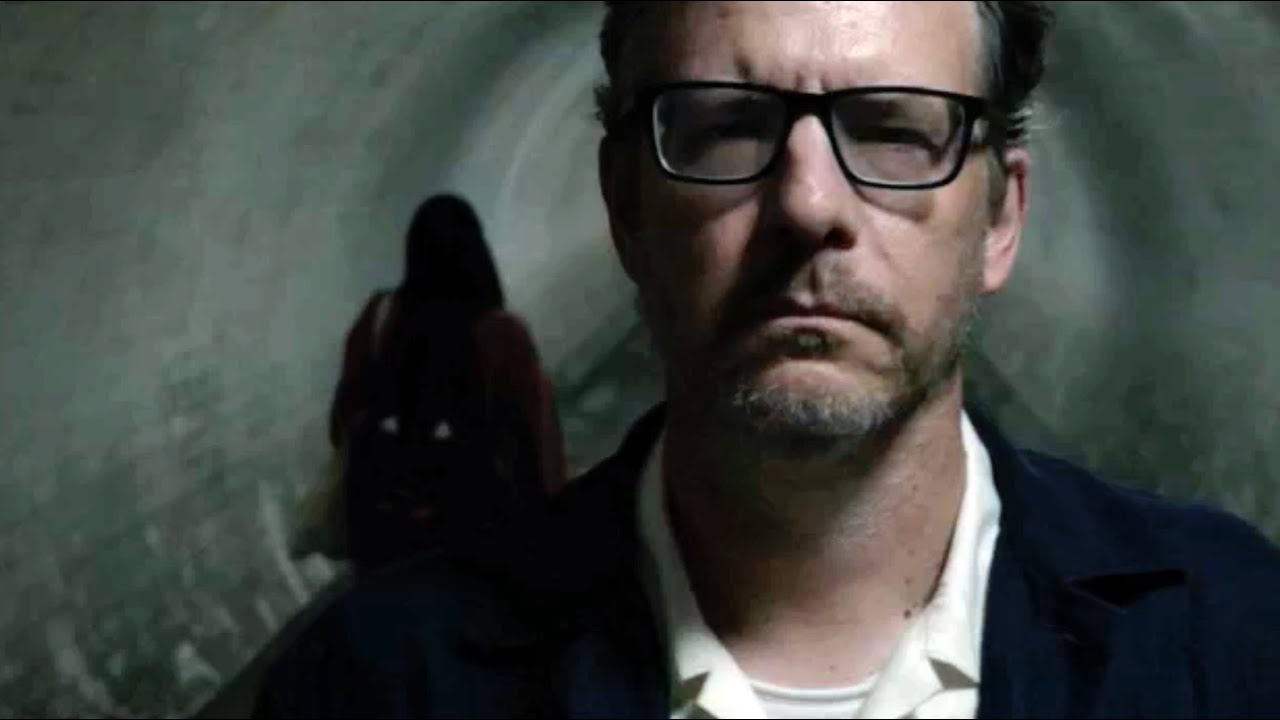
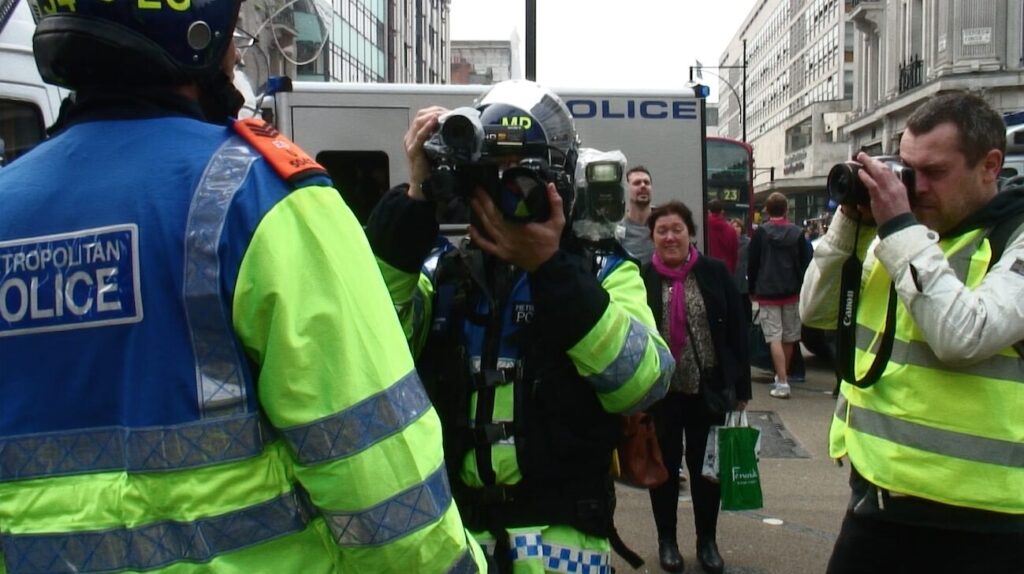
And so we made the film about Mark Fisher: a 70-minute feature by Poulter and his collaborator Sophie Mellor, who utilised video of Fisher, plus a new work which utilised more than 15 years’ of protest footage they created together – an experimental patchwork of interventions in London’s main thoroughfares from the student protests in the early 2010s to the far-right raise the flag march in the autumn of 2025. Poulter phoned me the day after our conversation in the park to say he was setting up an Instagram page to process research and communications for the film we were making about Mark Fisher. The film would be a collective, “decapitalised” (i.e. not made with funding) effort inspired by the spirit of those early blogging days. The resulting film “is not a documentary” says Poulter. “It’s an experiment in solidarity, using Fisher’s work as a compass.” It was decided that the film should be an exploration of some of Mark’s ideas through interviews but also a meta-fictional narrative that stars the writer Justin Hopper (AKA Old Weird Albion) playing the character of Parkins from ‘Oh, Whistle, And I’ll Come to You, My Lad’ (including sequences in homage to the haunting 1960s BBC adaptation that Fisher so loved).
“One purpose of the film is to inspire a sense of solidarity and to combat hopelessness as Fisher’s writing often did. It reminds us that the future is not something we inherit, it’s something we can have agency over,” Sophie Mellor says: “The film ends with the line ‘We are making a film about Mark Fisher, and now that you are watching, so are you’. The idea is that the film continues in the room it is shown, that it is a starting point for discussion of Fisher’s ideas and concepts, in the now.” The film has so far screened in venues all over Europe including a former Soviet radio station in Berlin, a former TK Maxx shop in Middlesbrough, an Italian tour, Central Saint Martins college, two sold out shows at an anarchist squat in Austria, a former school in Leytonstone, and spaces in Manhattan, Coventry, Ankara, Bristol, Cornwall and beyond. Poulter has observed that at screenings a key group responding to the film are age 20 to 34. “They are looking for a way forward in Fisher’s work.”
Fisher admired the Guardian journalist and British political historian Andy Beckett, who appears in the film. Beckett makes the point that Fisher started off as part of Nick Land’s accelerationist experiment at Warwick University, the Cybernetic Culture Research Unit, but what marked his work from the 2000s on is a distrust of the pernicious creep of tech. Fisher articulated in real time his realisation that the internet, which made him, was not some free ride into infinite possibility. Much of his work betrays a worry about what the potentialities of this technology, allied with capitalist realist political projects, could mean for all of us.
Referenced artists
The Jam
Music Has The Right To Children: Reframing Mark Fisher’s Hauntology
The Fall
Reissue of the Week: The Unutterable by The Fall

Kode9
Not A Void But A Plenum: Kode9 & Shannen SP Discuss Ø Project
Laura Grace Ford
Afraid Of The Dark: Horror At Somerset House
Woebot
Well I Never: Matthew Ingram Interviewed
Around the time I first came across Fisher’s work in that computer room, we were all joining MySpace, its lack of trigger-happy algorithms leading us to believe that social media was a societal good. What his work was committed to, I now realise, was a search for culture that promoted human agency and resisted hackneyed, nostalgic groupthink, which was becoming a more difficult task in the 2010s. In Ghosts Of My Life, he wrote that the internet had turned us all into Howard Hughes “living in one hotel room for 15 years, endlessly rewatching Ice Station Zebra”, as “the intensity and precariousness of late capitalist work culture leaves people in a state where they are simultaneously exhausted and overstimulated” meaning “culture becomes de-eroticised”.
Fisher killed himself in early 2017. There is a moment in the film in which Beckett speculates whether he might have felt despair in 2016 at the double shock of Farage’s Brexit, then Trump, both projects that to a degree that seem powered by the vindictive “deal-with-it” logic of the very online shit poster. It’s a logic similar to that which he outlined in his 2013 essay ‘Exiting The Vampire Castle’, in which he decried the lack of solidarity of online leftwing discourse that prized call-out culture. The resulting backlash was so fierce, Fisher stopped using social media. The online world that had thrust him in front of so many had turned out to be a dead end.
I often feel this uncanny sense that we live in a world wholly described by Mark Fisher, in terms of some of his bleakest predictions. The dominance of capitalist realism as an ideology begat the rise of the realest capitalist, the US president Donald Trump, a racist idiot and thuggish convicted sex offender who uses his time in public service to unleash violence around the world. But rather than feeling beyond despair at the trajectory of things since the days of K-punk, the energy that has surrounded the making of this film has given me hope that a collective desire for a fresh politics to avert disaster still exists. It has reminded those of us who helped to make the film, and hopefully the thousands who have seen it, that we have to make a new kind of future, simply because there is no other choice. The sun will rise regardless. However hopeless things may sometimes seem, we need to seek allyship at all costs to show, as Mark Fisher did, we are not taking it any more.
We Are Making a Film About Mark Fisher is touring the UK and Italy. There is a screening at Rio, Dalston, London, Saturday 28 March at 3pm