
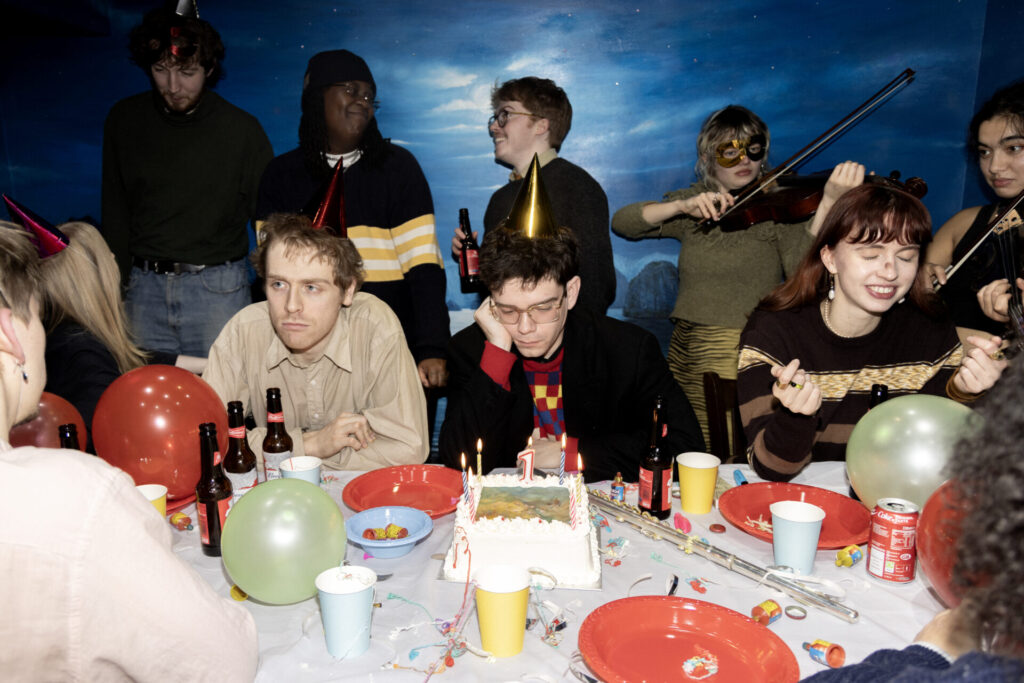
In August 2023 Cameron Picton was touring China with Black Midi, the band he’d co-founded with his schoolfriends just six years earlier. Their mind-bending fusions of math rock and prog had made them a globe-trotting, Mercury-nominated, frequently imitated success story, but behind the scenes, things were starting to fall apart. “We just started touring too much,” is all Picton will tell tQ. “It wasn’t the most pleasant experience in the world at the very end.” This would be their last tour before going on an indefinite hiatus. After a night of beers and Chinese street food, including the risky choice of a “big-ass crayfish boil,” Picton got food poisoning and fell into a state of delirium, scribbling down words. One of the phrases that emerged was ‘My New Band Believe’.
Picton’s debut album under this moniker is a triumph. It channels Black Midi’s surging, maximalist spirit into an acoustic setting – aided by friends in London’s folk and avant-garde scenes – but it is also an altogether more emotional, impressionistic record. Tapping themes ranging from romance to unfulfilled desires, his songs burst with heated dialogue spoken by loosely drawn characters. The arrangements dart breathlessly between lush strings, finger-plucked folk and free improvisation. “I was frustrated with the landscape of singer-songwriter music,” he says. “One of the few real ambitions for this record was to try and make another case for how it could be.”
The project emerged from a period of uncertainty about how Picton might fit into the music world beyond Black Midi. Uninterested in either pursuing a traditional solo career or starting another conventional band, “I discarded any idea I’d considered for Black Midi or brought to the band, and started writing fresh with a blank slate.” He began booking short-notice gigs using various aliases and setups, principally at The Windmill in Brixton, and “using the shows as an excuse to write songs.” This exploratory period culminated in a 2024 tour supporting Black Country, New Road under the name Camera Picture, and a self-released mixtape labelled 44m50s that collaged minimal pop, field recordings and ambient electronics. One of its sketched ideas is a larval version of ‘Target Practice’, now the playfully threatening opener of My New Band Believe’s self-titled debut album. “Don’t cry,” Picton croons. “You deserve this.”

Reconnecting with musician friends in London, he also revisited some early passions. “Bert Jansch, John Renbourn, the 60s folk revival,” Picton says, “that’s stuff I’d been interested in since I was a teenager before starting Black Midi.” After considering making a collaborative record with experimental folk group caroline, Picton began “thinking about a new way of how a band could operate.” My New Band Believe is the result, less of a solo venture than an informally organised studio project. It’s helmed by Picton, but its cast of players spans singer-songwriter Kiran Leonard, veteran percussionist Steve Noble and most of caroline.
I ask Picton whether, in the same way Black Midi emerged from London’s mid 2010s post punk boom, My New Band Believe’s folk leanings reflect a new trend in his home city. Between the much-talked-about events organised by Broadside Hacks and groups like Shovel Dance Collective, there is a lot of new energy in the capital surrounding both traditional folk music and strange, experimental interpretations of it. “As a result of where I am physically in the world, that’s going to bleed into it,” Picton says of his music, but “I don’t see myself as connected to the folk revival-revival-revival that’s happening.” More than traditional folksong, “I’m interested in pop music and the song form. There’s just as much influence from pop music, and the electronic music I really like.”
Pop music in Picton’s hands is filled with sharp left turns, however. The nearly nine minute long ‘Heart Of Darkness’ jumps between dry fingerpicked guitar and yearning soul. “My idea was for it to be a transatlantic song,” Picton says. “To have these sections of folk guitar referencing music I like from England, then referencing music I like from America. John Renbourn and Otis Redding, flipping between the two.” That kind of ‘flipping’ persists throughout the album, even when Picton is doing something straightforward, like the verse-and-chorus structure of ‘Target Practice’ in which the repeated sections use different arrangements and even recording spaces. “The first chorus is physically recorded in a different room,” Picton says. “It’s a phone recording in my friend’s bedroom. And then for the next one you’re back in the studio, in an E.L.O. song with strings and stuff.”
Just as the songs’ arrangements move between different settings or ideas of themselves, so do Picton’s lyrics. “I was trying to do this thing of presenting a recited conversation, where two opposing things are happening at the same time across a lot of the songs,” he says. “Being the only singer on the record means you can play a lot with your delivery, and how obvious you want to make the perspective shifts.” The lyrics jump between yearning, taunting, questioning and instructing. “I wish you would kiss me, before it’s all too late,” he croons on ‘In The Blink Of An Eye’, “but if you’re going to kick me babe, at least let me pick the place.” It can be disorientating, intensified by Picton’s style of very loosely drawing his characters – it’s often unclear whether a lyric is from the same speaker as before. Picton claims he is “not trying to tap into a character, but just trying to tap into an emotion or feeling” by giving his speakers a dreamlike, unstable quality. “I think that’s much more interesting, to have these inconsistencies. People changing their minds, and being erratic.”
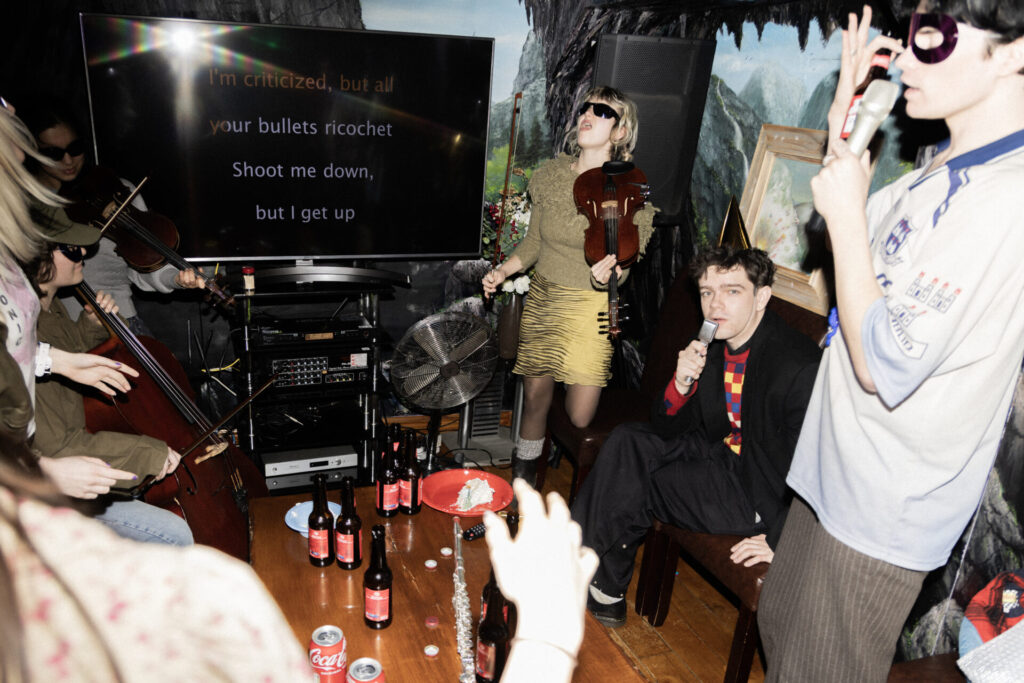
This mix of perspectives is most interesting when Picton explores romance, which didn’t get much of an obvious look-in in Black Midi. My New Band Believe’s candid songs about intimacy range from the tender domestic scene in ‘Love Story’ – “pick up some onions, I’m making dinner” – to the quietly agitated story of a fling in ‘One Night’, half-whispering “you are not the man I took you for.” But for Picton, “a similar thing is happening” in both of these seemingly different scenarios. Moreover, he considers ‘One Night’ a companion to the far more upbeat standalone single ‘Numerology’, which was released with the announcement of the album but not actually included on it. For Picton, the surge of desire in ‘Numerology’ – “I need your face tonight” – is “like the ‘before’, considering both positive and negative fantasies about what might happen. They’re presenting these things that could go wrong, but could be amazing.”
Picton’s scattershot lyrics hits several other big themes in My New Band Believe. ‘Opposite Teacher’ centres on ideas of mentorship or parenthood. “Will I follow in your footsteps?”he sings over plucked guitar in his delicate falsetto, then – subtly firming up his delivery to switch character – “you barely know what life is. Blink and you’ll miss it.”Picton claims, “I’m not thinking of personal experiences” in these songs, but “my personal experience will come into it, because these are quite universal things in a lot of cases.”
Another example is the sprawling, theatrical ‘Actress’, which focuses on chasing ambitions. “The last line is my friend’s real diary entry from when she was 13,” Picton says. “It was 4am, we were chatting, and she went, ‘look at this funny ass thing I wrote when I was a kid.’” The line was “so go on, get up, become a famous actress, because that’s what got you through this.” This unfurled into a writhing exploration of aspiration – “no shooting star will steal my flame” Picton sings – and how it can be accompanied by lying, self-destruction, and eventual disappointment, swelling to a dramatic peak then evaporating in a flurry of free-improvised guitar. “It’s a trait you can see in everyone you know,” Picton says. “Getting to a point of getting what you’ve wanted your whole life, and then actually being like, ‘nah’.”
I ask Picton how coming to success early – he left secondary school as an internationally-touring musician – might have shaped his own attitudes towards ambition, as he carves out this new chapter. “After finishing Black Midi, I didn’t want to just do an album campaign or tour for financial gain,” he says. “If I was going to come back to doing music professionally, I wanted to make sure it was something I was happy to pursue, even if it didn’t make money.”
The fact he has gotten to a place of being “very satisfied” with his new music, which is so different from his previous work, may reframe how he thinks about Black Midi. “I think lots of people would look back on music they made when they were 19 with a sense of embarrassment,” Picton says. For him though, “there’s not a single Black Midi record I would listen to and feel anything less than proud.”


Something else which may have changed Picton’s feelings about his old band is the recent, tragic passing of Matt Kwasniewski-Kelvin. The founding guitarist in Black Midi, Kwasniewski-Kelvin left the band in 2021 citing mental health difficulties, and died this January. “It’s an emotional thing to talk about Matt, but I spent a lot of time looking back at old photos of us,” Picton says. “A lot of the photos I have are like ‘ah, that’s a fun memory,’ but from periods I remember being relatively dark. It’s a good lesson for me now, where sometimes you will look back on periods where you were quite happy, but there’s a sad thing underneath it. But also, there’s moments of lightness in things that are not so fun.”
Looking ahead, the future of My New Band Believe is an open proposition. “It could be anything, and that’s exciting,” Picton says. “It could be a proper band that all signs a deal together. It could be what this is, where I’m the dictator of the record. Or it could be something where I’m not even singing, playing or writing the songs.” For Picton, just as the project came from a period of confused exploration as a chapter of his life closed, “I’ve gotten the most satisfaction from things by having as little a plan as possible,” he says. “Winging it is the most exciting thing.”
The self-titled debut album by My New Band Believe is released on 10 April via Rough Trade