

This year, in our garden, we leaned hard into winter interest. Across the sixteen or so beds and borders in our small, suburban plot of land in Metro Detroit there are great, golden-brown bunches of bloodletting sawtoothed grass taller than me; dense knee-high rip curls of spent aster – under which a three-legged neighbourhood tabby cat overwintered; shocks of wheat and feathered grasses (less dangerous than their sawtoothed brethren). There are patterns and rhythms to all of this. The way stalks overlay stalks, the spirals of twined bundles made stubbornly strong to withstand cutting winter winds.
I am making room for spring in the east-facing bed that runs alongside the very large shed or very small barn that sits in the southeast corner of our yard. The bed is perhaps three feet deep and about eighteen feet long. In season, it contains luminous orange Mexican sunflowers that stretch taller than the shed, to maybe fourteen or sixteen feet. Woody and tough, their stems held nutty brown seedheads aloft nearly all winter – until shearing sixty-mile-per-hour gusts bent them at the knees. With yellow Niwaki secateurs in my foolishly ungloved right hand, I am making patterns and rhythms of my own, with my limbs and the stems, working in time to the music in my headphones. Bill Orcutt’s four interlocking, chiming guitars loop rhythmically as I decisively cut each stem at the base, pull it free with my left hand, and sort of lob the whole thing into an orderly pile behind me.
There is a kind of fixed-gear, cyclical perpetuity to Music In Continuous Motion that makes it particularly well suited to this kind of work. On a fixed-gear bike, you pedal to get going, but once you’re going, the pedals never stop. So, you keep pedalling because, well, the pedals are already going, which only makes them move faster. So, you pedal faster, and on and on until you work against the pedals or jump off the bike. Method of creation notwithstanding, this is how Orcutt’s new batch of compositions sounds and feels. As if by starting to play, his playing perpetuated playing, and could have done so ad infinitum, unless actively stopped. Couple this with a bright guitar tone that suits the sun and a briskness that suits the March bluster, and you’ve got an album that suits a moving body out in the world.
Music In Continuous Motion is Orcutt’s latest collection of solo studio works for four guitars – just guitars – following the aptly titled Music For Four Guitars, released back in 2021. Both albums share a considered brevity, but Music In Continuous Motion is noticeably looser and more alive than its predecessor, which can feel somewhat mathematical and mechanised by comparison. But Orcutt’s trajectory is not so simply parsed. He’s a tricky fella. And his through-lines are often obscured by his prolificacy. In between the former and latter “four guitars” records, there have been something like fifteen releases of live and studio recordings, ranging from solo acoustic albums to ensemble jams to plunderphonic mash-ups made using his signature Cracked software. And he’s seemingly happy to let ideas or concepts lie for a while, until he chooses to pick up whichever thread again.
In this case, the thread runs through Four Guitars Live by the Bill Orcutt Guitar Quartet, recorded live in 2023. Woolier, noodlier, and more psychedelic than Music In Continuous Motion, it nevertheless seems a counterweight to Music For Four Guitars, with the two records creating a difference that, written to be performed, Music In Continuous Motion splits. The result of this is the strongest LP in a trio of great ones. But in a way, that’s neither here nor there. The most important thing is how effortless, how inevitable, how effortlessly enjoyable Orcutt’s latest is. It plays out like a terrific rock record and shares a similar timelessness.
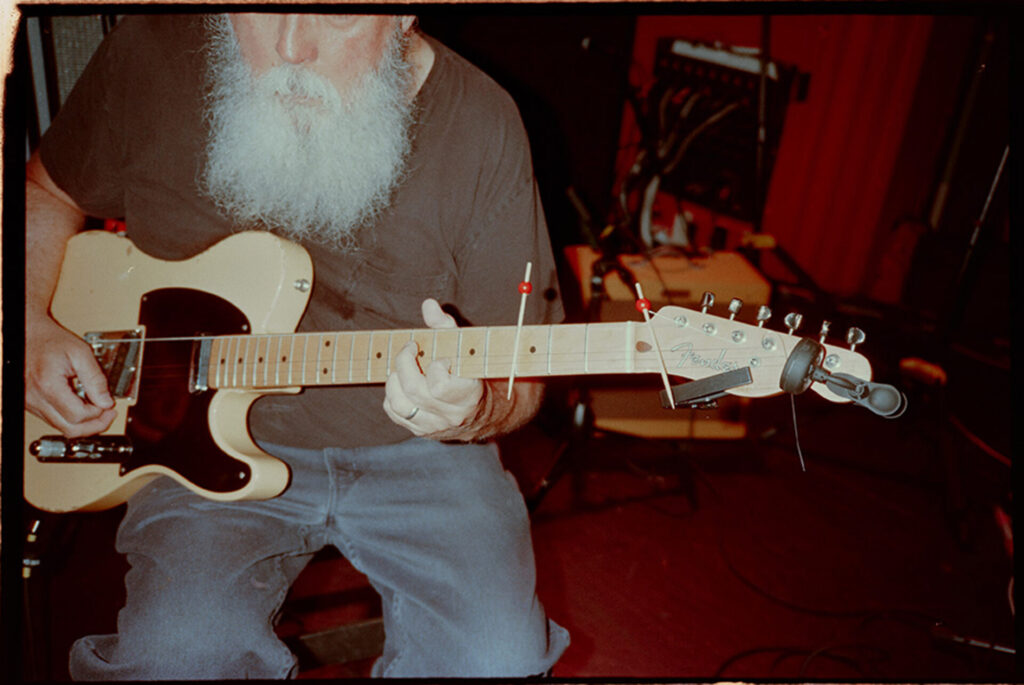
If I’m emphatic here, it’s because for too long I laboured under the misapprehension that listening to Orcutt was work. He seemed a bearded music guy’s ideal bearded guy, making out-there beard-stroking music. To be fair, at the time of his reemergence in 2009, I had veered away from what I perceived to be overtly brainy, experimental stuff toward the lowest of lo-fi garage rock – real brilliant knucklehead shit – toward community and accessibility in all senses of the word, for both music-maker and listener. I was on a reverse snob tip at thirty, and I was a clueless fourteen when Harry Pussy started doing their thing. So, it wasn’t until well after the pandemic that I first dipped into Orcutt’s catalogue. I finally listened and to be honest, I heard everything that I was looking for in ‘09, albeit more abstracted and clever in a different way to the stuff I was actually listening to back then. And it was properly digestible. I listened and I heard that Orcutt’s guitar can and often does contain practically the whole modern history of guitar music within it.
If that reads as absurdly hyperbolic, deal with it. Because it’s true. Not only that, I think that’s at least partly the intent and the point. I mean, it’s kinda in the text. Orcutt named his second record for Editions Mego, released in 2013 and full of mutoid standards beautifully played like a gutbucket gremlin, A History Of Every One. Orcutt’s inclusion of the past in his playing is a re-interrogation and a reassessment, radical and revisionist. And I think that even when he’s not overtly doing this, he’s doing it. Even when it’s not technically the point of whatever record he’s making. Basically, I think he’s doing this whenever he picks up his guitar. Even if just to say, There are still things to be mined here. Even on Music In Continuous Motion, which seems to mostly exist in the past four-and-a-half decades – in the No Wave and post-everything zone – and can condense the whole of post- and math-rock into like two-and-half minutes, and sounds mostly concerned with the joy of playing this stuff, Orcutt takes time to connect the dots between jammy classic rock and the reject-everything NYC of the No New York era. Sure, as a brainwave, as a notion, that’s not even remotely novel, but how many can make the case so succinctly and with such verve, without sounding derivative, without saying a word? When four guitars make you forget there’s no bass nor drums, when ‘Barely There’ invokes ‘Rumble’ and then turns it on its head into something so unbelievably sweet and generous and gentle, before the album’s closing tune explodes into pointillist stars? That’s undiluted magic.
But it’s magic made from the past. And the tedious among you might argue that, while his playing is always inventive and imaginative, Orcutt isn’t doing anything particularly new, or – gasp – experimental here or indeed throughout the bulk of his oeuvre. Barring a surly “Who cares?”, my reply might be: Is the horticulturist who cross-breeds a new varietal from pre-existing plants not experimenting? Is that varietal not new?
By now, I’ve turned my attention to my pile of sunflower stalks. I am returning them to the bed from which they’ve just been removed, laying them in a criss-cross pattern, creating a new, tight lattice from old material that will protect the soil from late frost and provide nutrients for this season’s growth. I am wondering whether Orcutt is the lattice of stalks or the new growth the stalks will nourish. Is it possible he’s both? I don’t know that it much matters. No matter what, something’s going to bloom.