

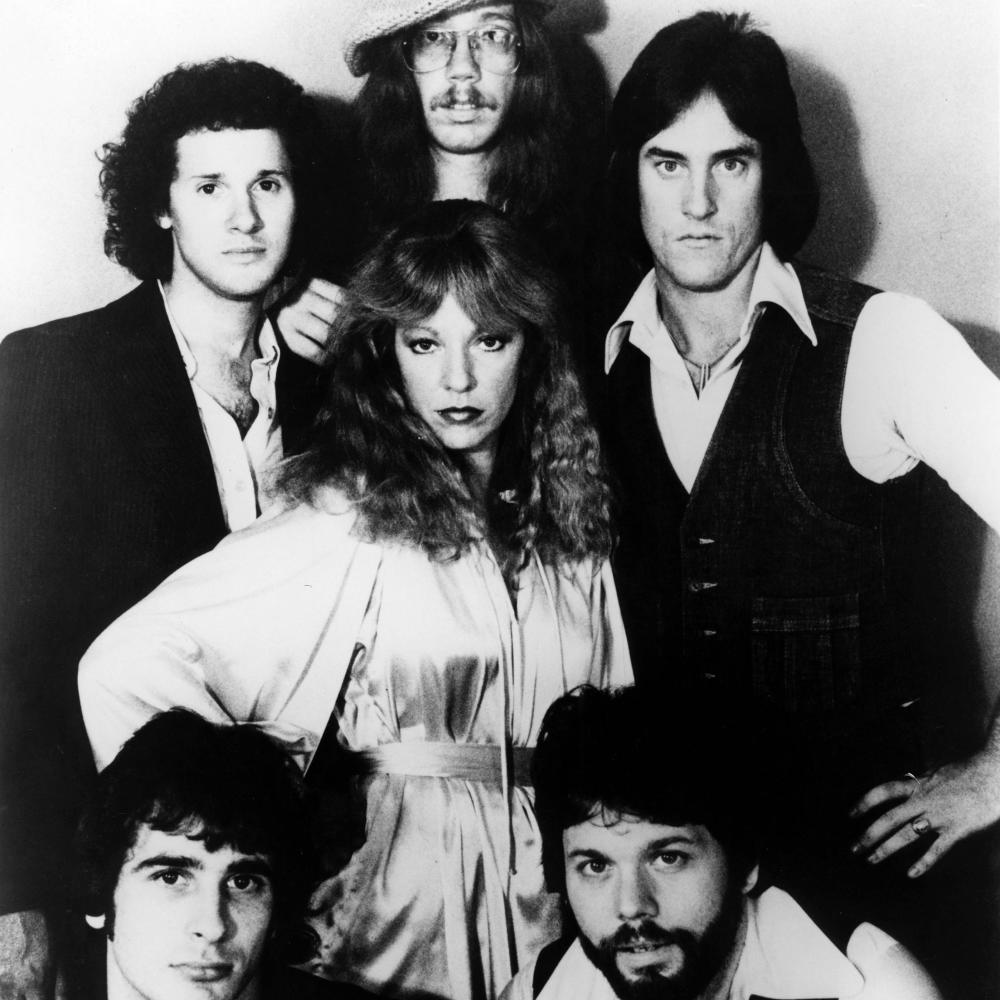
Manhattan was a mess in the mid 70s. The middle classes had upped sticks to the suburbs, leaving the city centre to fester as Mayor Beame led New York to the brink of bankruptcy. In the thick of a fiscal crisis, unemployment rates were up while the Dow Jones was way down, but certain industries – especially the music business – thrived beyond the city’s rat infested sidewalks
Godfrey Diamond had secured a job as a studio engineer at Mediasound, housed in a converted midtown church. His baptism of fire occurred in 1972 when his mentor Tony Bongiovi had to duck out to deal with a family crisis, leaving the fresh-faced assistant to helm a horns session for Kool & The Gang. Over the next couple of years, Godfrey would work on mixdowns for the likes of Crown Heights Affair, Genevieve Waite and Ben E. King, but while he had an ear for silky soul, the young engineer was a rocker at heart.

Godfrey had come of age watching his big brother Gregg’s hard-boogie band Five Dollar Shoes. Although legally too young to be allowed in, he later recalled lugging their gear into Max’s Kansas City, and hanging out at rehearsals where the singer would ask the teenager for his thoughts on their songs. “Off the top of my head,” he explained in an interview for Tape Op, “I would say ‘you could repeat that chorus or try a different intro.’” It was the spark of a production career to come.
Five Dollar Shoes recorded just one album in 1972 before breaking up, but their drummer Gregg Diamond was determined to make it in the business, ditching session work to focus on song writing. The career move would leave him destitute as he worked on a sultry piano groove for weeks and weeks until, one fateful day in 1974, his half brother Jack Doroshow came calling. Doroshow, better known as pioneering drag queen Flawless Sabrina, was producing a porn film which needed music.
Godfrey was between sessions at Mediasound when Gregg rang. “I was wrapping up microphone cables,” Godfrey recalled, “and [he] said ‘you know that song we came up with? Can you come over and play drums on it?’” Gregg had booked a few hours at the nearby Dick Charles Studio, so Godfrey spent his late lunch break laying the rhythm track for what was to become ‘More More More’. Gregg knew it was potentially bigger than a porn soundtrack, but they still had no vocalist, or any words for them to sing.
“So, we had this song hanging around for about a year,” Godfrey said in an interview for RBMA, “we tried different people on it, but we didn’t know what to do with it.” That is until another fateful phone call in 1975 when a woman who Gregg had briefly dated called him from Jamaica.
Andrea Truden had arrived in New York in the late 60s. Born in Nashville, she was an accomplished pianist who grew up dreaming of stardom, and had hosted a local TV show before she’d even finished high school. She left it all behind, however, after getting hitched at 19 and heading to Manhattan with her husband, who was there to finish his law studies. The marriage went awry, but Truden settled in Greenwich Village where she studied acting at Herbert Berghof Studio, and paid the rent with sporadic film extra work.
Her boyfriend at the time was an astrologer whose high school buddy, another struggling actor called Herb Streicher, would often drop by for dinner, sharing the trials of their chosen trade. Unlike Truden, Streicher had a sideline starring in porn under the name Harry Reems, and after the success of the infamous Deep Throat in 1972, Streicher urged Truden to get involved. “He asked me straight out if I’d like to come meet a producer,” Truden told The Rialto Report in 2011. The offer was to join Stricher in a film “which we’d make up as we went along.” The opportunity to improvise on screen appealed, even if it meant getting naked. “I said ‘yeah, as long as no one else is there other than the cameraman and the crew.’”
Truden made her debut under the pseudonym Rose Stevens in 1972’s Head Nurse, before trying out a succession of stage names including Sandra Lips and Inger Kissin, eventually settling on a truncation of her real name. Andrea True was born. By 1974 she’d notched up around 20 pornos, with a handful of extra jobs in mainstream movies including Syndney Pollack’s Oscar winning The Way We Were.
In 1975, she travelled to Jamaica for the premiere of one of these non-porn films. While the rest of the cast partied, Truden wound up bedridden in a motel with a bout of flu – a decidedly un-showbiz moment that set her on course for international stardom. The doctor who was called to Truden’s sick bed owned some lucrative local real estate, and hired her for an ad campaign that would keep her busy for the best part of the year. It was a far cry from the hasty turnaround of her porn productions, which were often shot and edited in a matter of days. The only problem, and one which surely no one could’ve foreseen, was the aluminium industry.
Some might assume that music is Jamaica’s biggest export, but since the 1950s, the island’s economy has been buoyed by its bauxite reserves which are mined for the production of aluminium. In 1975 it was the world’s second largest bauxite exporter. With millions of tonnes of the stuff shipping out across the world, Jamaica’s prime minister Michael Manly, a staunch socialist, imposed heavy taxes on the bauxite buyers. Angered and wary of Manly’s relationship with Fidel Castro, the U.S. withheld aid to the island until the government agreed to lower its bauxite taxes. Instead, Manly imposed a sanction on Jamaican dollars leaving the country. The result was that Truden was stuck on the island there with her earnings from the commercials.
Her plan had always been to funnel this money into music. Truden had been recording demos in New York for a while, sometimes with Gregg Diamond’s assistance, but nothing had caught the attention of the music business. Stranded in Jamaica with a wad of cash, she remembered the slinky disco instrumental Diamond had played her, and got straight on the phone to New York.
With the multitrack and tapes that were to become ‘More More More’ packed, both Diamond brothers boarded a plane to Kingston where Truden had hired Ken Khouri’s hallowed Federal Studio, a Jamaican institution responsible for key moments in the evolution of reggae including Ken Boothe’s 1974 international smash ‘Everything I Own’. It probably didn’t mean much to a couple of hard rockers, but Khouri gave them access to the cream of the Caribbean’s instrumentalists. Trinidadian Trumpeter James Smart and saxophonist Enrique Moore joined them fresh from a session with calypso legend Mighty Sparrow. All that was left now was the vocals – except they still had no lyrics.
The story went that Gregg headed off to the beach where he began penning the song with Truden’s porn career in mind – ”get the cameras rolling, get the action going” – but the singer disputed this, claiming he took all the credit for her lyrics. His brother can attest. In his RBMA interview, Godfrey reflected “I love my brother very much, but he wasn’t big with sharing credit.”
In the vocal booth, they soon realised Truden had far from a trained voice, and as she struggled through the recording sessions, the Gregg worried that they might never get off the island. Eventually they convinced her to try a relaxed, breezy and almost spoken approach, then layered it up and drenched it in reverb until they were satisfied. The session was over, Truden’s money was all spent, and the song was in the can. It was surely time to fly home and shop this song around.
Not quite. The next hurdle was what Truden described as Gregg’s “terrible drug problem”. In just a few days, Gregg had run up a sizable tab with a local dealer, and with their whole recording budget now spent, the only option was to license the song to Ken Khouri. He released his own mix of ‘More More More’ on the Federal label in Jamaica, months before they’d even signed a deal for it in New York. While you might hope this alternative mix came simmering in tape-echo with an obligatory disco-dub version, it’s sadly a fairly muddy mixdown which had little impact on local airwaves or dancehalls.
The initial response in New York was equally lukewarm. Every label they approached declined until Art Kass, infamous for holding out til he was an artist’s only hope, signed it to his Buddha label. Kass then hired Tom Moulton to fix the mix. He’d recently blended the b-side of Gloria Gaynor’s Never Can Say Goodbye album, mixing five tracks into one continuous sonic odyssey, and everyone wanted a piece of that Moulton magic.
Moulton was now the go-to guy for an extended dancefloor bomb, and in his capable hands, ‘More More More’ morphed into a lush discophonic sensation. When quizzed about his approach to the production, Moulton admitted on The Rialto Report that he didn’t catch the pornographic subtext of the song. “It was just so pretty, I thought she was talking about the music,” the remixer said, “I tried to make it so breathy and beautiful, and that’s what everyone loved about the song: that fucking hook!”
Acetates were cut on the cusp of Christmas 1975, and did the rounds of the New York discotheques before it finally got a commercial release the following February, reaching the upper echelons of the Hot 100 and topping the US dance chart. It hit UK shelves on March 12th 1976, slowly slinking its way up the top 40 until it peaked at number five in May. The chart that week was awash with disco, from Johnny Taylor’s ‘Disco Lady’ to Isaac Hayes’ ‘Disco Connection’. ABBA held the top spot with ‘Fernando’
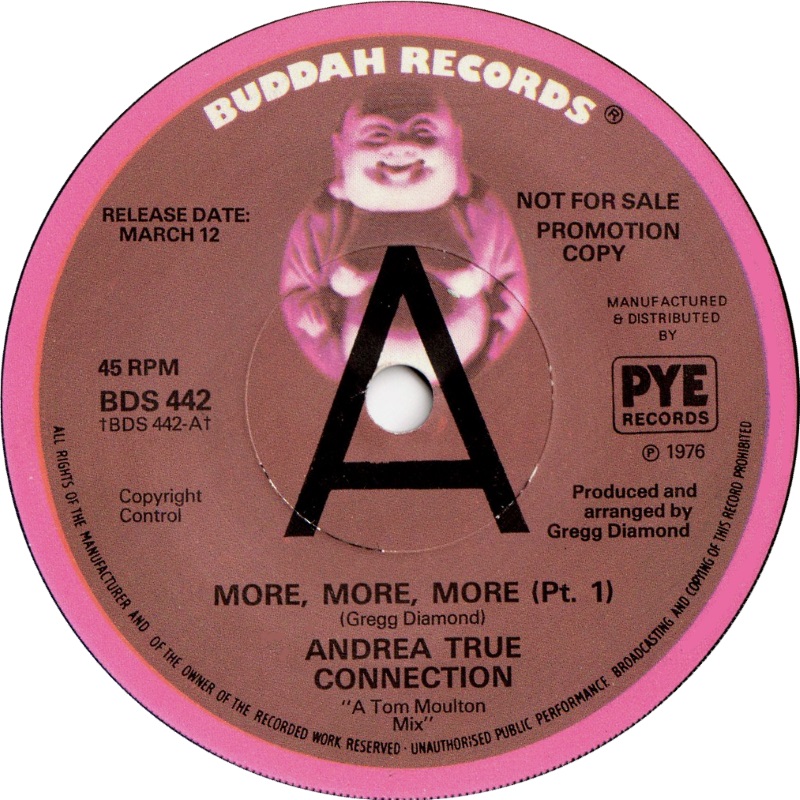
‘More More More’ was everywhere. The Andrea True Connection cobbled together a live set to take it on the road, with gigs making headlines before they’d even happened. In Texas, the Paris News reported that Six Flags amusement park were “red-faced” having learned that they’d “unknowingly booked a rock singer who doubles as an adult movie actress”. Another local paper announced “Porno Film Star Loses Singing Date” a couple of days later, but all press was good press, and Truden’s notoriety helped shift more units.
An album was rushed out before the summer with Moulton keeping the mix nice and pretty. It featured just four more songs, with double entendre titles like ‘Keep It Up Longer’ and ‘Fill Me Up’, the latter clocking in at an epic 10 minutes, in the vain of Donna Summer’s sprawling ‘Love To Love You Baby’ which dominated discos that year.
Gregg recorded one more single with Truden. ‘NY, You Got Me Dancing’ was another piano-heavy disco stomper, but lacked the raw immediacy of ‘More More More’, Two more albums followed, White Which in 1977 and War Machine in 1980, but after that Gregg and Truden went off the radar, with wild speculations about the latter’s whereabouts whispered amongst her old contemporaries. Was she in real estate in Florida, or working upstate as an astrologer? Some assumed she was living it up off the proceeds of her hit, but others agreed she was more likely broke, and living a quiet life somewhere off the beaten track.
Godfrey continued to produce, with credits on albums by everyone from Billy Squier to Princess Superstar, but his disco past remained a hushed secret, and he’d mostly put ‘More More More’ to bed until the release of Doug Liman’s Go in 1999. In the cinema, Godfrey’s friend turned to him and said “I recognise this song.” “Recognise it!?” Godfrey told RBMA, “That’s me playing!”
On a post-rave comedown, Marc Costanza from Canadian group Len wrote a warm and fuzzy rap around a loop of More More More’s breakdown. He had his bandmate and sister Sharon in mind because the pair had fallen out. The resulting ‘Steal My Sunshine’ would patch things up and go on to reach top 10s internationally. Sadly Gregg Diamond didn’t get to hear it. He died a few months prior from gastrointestinal bleeding. He’d just turned 49.
Truden was eventually tracked down to Woodstock, NY in 2011 where she was living a frugal but happy life. The candid interview she gave Ashley West for The Rialto Report would be her last; she died of heart failure a few months later at 68.
‘More More More’ lives on, of course. Having appeared in almost 30 films and TV shows through the years, it’s now synonymous with the disco excess of 70s New York, a splash of iridescent colour across the city’s drab, urine-stained streets, and it’s been covered by everyone from James Last to Rachel Stevens. whose version reached number three in the UK charts in 2004. Jamaica, meanwhile, currently holds steady at number eight in the top ten of global bauxite producing nations.