
In his novel The Third Realm, Norwegian author Karl Ove Knausgaard writes about a fictional black metal band called Domen. The band never records and only rarely plays live – in secret, in the middle of nowhere. They create a “cacophony of the most incredible noise”. Domen song ‘And Long Was I Dead’ opens with the line “I was the cockerel that crowed in the ground”. Elsewhere in the book, another black metal band is murdered in a ritualistic killing. A new, baleful star has risen in the sky above Norway and Satan appears to be abroad.
Knausgaard’s book, first published in 2022, is one example of a purveyor of the country’s high culture, one of the finest writers in the world, getting to grips with the legacy of Norwegian black metal. Also in 2022, the Munch museum in Oslo put on the exhibition Satyricon & Munch, where real-life black metallers Satyricon addressed what they saw as past failures to combine music and fine art to emphasise the emotional experience of both. The longing and heightened anxiety of Munch’s art worked beautifully with the foreboding, hour-long instrumental Satyricon wrote for the space, which one entered as if being swallowed by darkness. “I’m not here to be someone’s professional occult clown,” frontman Satyr told me about the project.
Over 30 years since it erupted, Norwegian black metal is demanding to be taken seriously, with some success. One of Munch’s artworks on display in the Satyricon exhibition, Blossom Of Pain, has an aggressive primitivism: jagged lines cutting across the canvas, a tar-like substance enveloping a human figure, with a black star sitting above him. It could be a sketch towards an album cover for Darkthrone.
Originally formed in 1986 under the name Black Death, Darkthrone stopped gigging in 1991 before playing a final one-off concert in Oslo in 1996. The opposite of Domen, they have existed solely as a recording band since, consisting of two members: Fenriz (real name Gylve Fenris Nagell) and Nocturno Culto (Ted Arvid Skjellum).
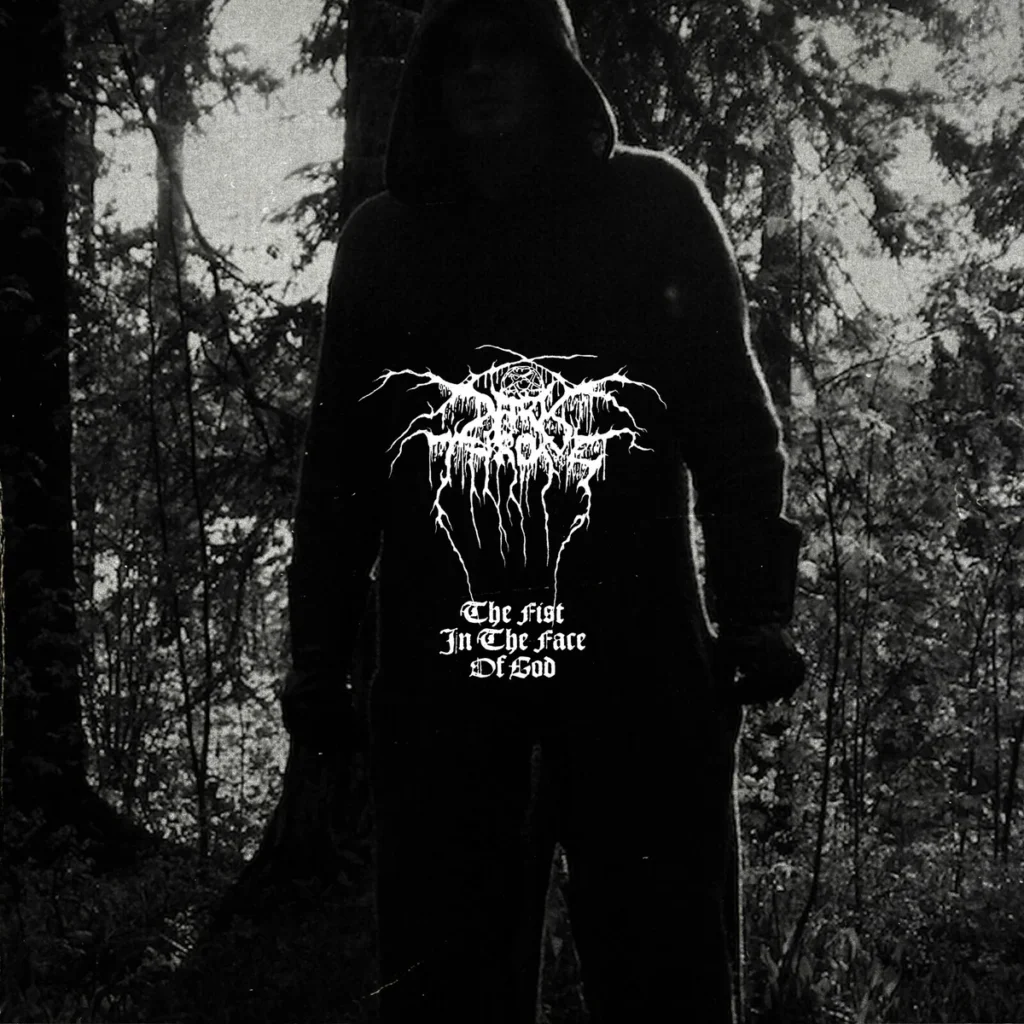
Darkthrone’s new nine-album retrospective vinyl boxset, The Fist In The Face Of God, sidesteps their first (death metal) album, 1991’s Soulside Journey, and plunges straight into A Blaze In The Northern Sky (1992). Blaze is the first of their “unholy trinity” of raw/“necro” black metal albums, completed by Under A Funeral Moon (1993) and Transilvanian Hunger (1994). The musical and visual aesthetics of these albums – adorned with grainy photographs of corpse-painted ghouls as still as the dead or shrieking into the night – defined the second wave of black metal. In 2020, a first edition of A Blaze In The Northern Sky was put on display in the National Library of Norway. As is evident in Knausgaard’s Morning Star sequence of novels, the album has seeped – consciously and unconsciously – into Norway’s cultural memory.
But I’d be careful to celebrate this recognition and apparent acceptance. Black metal is music of the Adversary, or ‘Striving For A Piece Of Lucifer’ to borrow a song title from Darkthrone’s 2003 album Hate Them. Darkthrone’s music is avowedly lo-fi and vicious (and sometimes, glacially beautiful). And it’s not all blast beats and tremolo-picked guitars recorded like wasps in a tin can. There are surprises: acoustic guitars merge into the stormy surrounds of ‘The Shadows Of The Horns’ from Blaze; there’s a scything two-note fuzz-bass break in ‘Summer Of The Diabolical Holocaust’ on Under A Funeral Moon which could be early Melvins; and hardened punk manifests in the frequent switch to the D-beat on ‘Inn I De Dype Skogens Fabn’ (‘Into The Deep Forest’) from the same album. Throughout these nine records, Darkthrone slow things down to a deathly trudge as much as they speed them up to hell-hammering intensity. In the early nineties, Bradford’s Peaceville Records, the band’s original label releasing this boxset, represented a heavy music Doggerland connecting Northern English punk and doom to its Scandinavian black metal brethren.
1994’s Transilvanian Hunger was a response to what Fenriz has described as a “bleak” turn of events in 1993, when Burzum founder Varg Vikernes murdered Mayhem’s Euronymous. In the affable commentaries he’s provided for previous reissues of their classic albums, Fenriz is open about Burzum as musical inspiration for Transilvanian Hunger. Vikernes contributed lyrics to four of its tracks. Fenriz remembers a very productive day at his day job when the opening riff to the title track and idea for its straightahead, relentless tempo “fell into my lap”. He used the same drum beat throughout every song, like a shard of ice running through the heart of the album. Transilvanian Hunger was sequenced with eight seconds of silence between each track in defiance of the seamless flow of Slayer classic Reign In Blood. Fenriz filled up his four track recording device with the two guitars, bass and drums he performed. Darkthrone resorted to a professional studio to record Nocturno Culto’s still-phenomenal chthonic screams. They were compelled to enshittify the vocal production to bring it down to the level of the other instruments.
Darkthrone wasn’t immune to the bad vibes and worse prejudices swarming around the black metal scene. They put out a pre-emptive strike of a statement for Transilvanian Hunger, declaring that anyone who criticised it should be chastised for their “obviously Jewish behaviour”. They later claimed they used “Jewish” as a slang-y Norwegian synonym for “idiotic”, an explanation which served them poorly. They have long since disowned this kind of posturing. The fallout led to the band and Peaceville parting ways. Darkthrone vowed to only write songs in Norwegian from then onwards (they didn’t) and switched to Satyr’s label Moonfog Productions for the following decade. The title of 1995’s Panzerfaust also didn’t help, though they insisted in its liner notes that anyone accusing them of being Nazis should “lick Mother Mary’s asshole in eternity”. Panzerfaust is the band’s most abysmal-sounding recording. Some of its songs are a continuation of the pacey Transilvanian Hunger, with drumwork as an ode to Quorthorn’s performance on Bathory’s 1987 Under The Sign Of The Black Mark. Fenriz has pointed out that black metal’s nineties second wave had as much to do with its first wave in the 80s (and Celtic Frost worship), as its own musical innovations.
As Darkthrone approached the millennium they found themselves revered by their peers (excellent 1998 compilation Darkthrone Holy Darkthrone featured covers by Immortal, Enslaved, Thorns and Emperor – handpicked by Darkthrone) but also outstripped in commercial terms by the symphonic end of the genre. Compatriots Dimmu Borgir achieved enough cut-through during the nu-metal era that they were included in the lineup for Ozzfest in 2004. But Darkthrone were unwavering in their commitment to all things necro. Though the final track on their 2004 Sardonic Wrath album, which ends this collection, perhaps signified a change in their thinking: ‘Rawness Obsolete’. After that, Darkthrone took a firmly crust-punk direction on 2006’s The Cult Is Alive before their eventual return to heavy metal on 2013’s outstanding The Underground Resistance, and its 13-minute tribute to their blasphemous career, ‘Leave No Cross Unturned’. The band’s subsequent output to this day functions as a meta-commentary on heavy metal itself.
It’s almost impossible to separate 90s Norwegian black metal from the controversies surrounding its progenitors. But following the tentative embrace of the genre’s homeland, the time has come to reappraise Darkthrone’s superb body of work on its own terms. The name of this collection is derived from a lyric on the imperious ‘To Walk The Infernal Fields’: “With my art I am the fist/In the face of God”. Art is the key word here. Darkthrone’s art is the resistant force; the negative entity. If black metal is the devil’s fuel, as they have claimed, we should treat it with caution, care, and not a little reverence. The pagan winter isn’t over yet.
The Fist In The Face Of God boxset by Darkthrone is released today via Peaceville