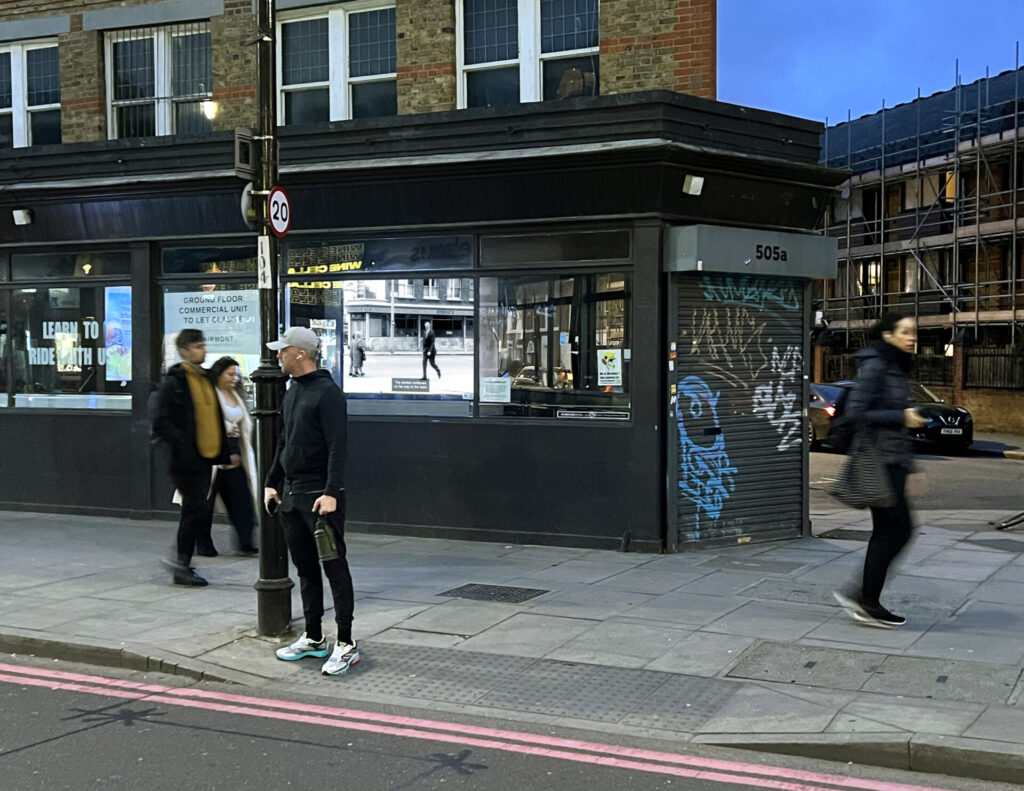

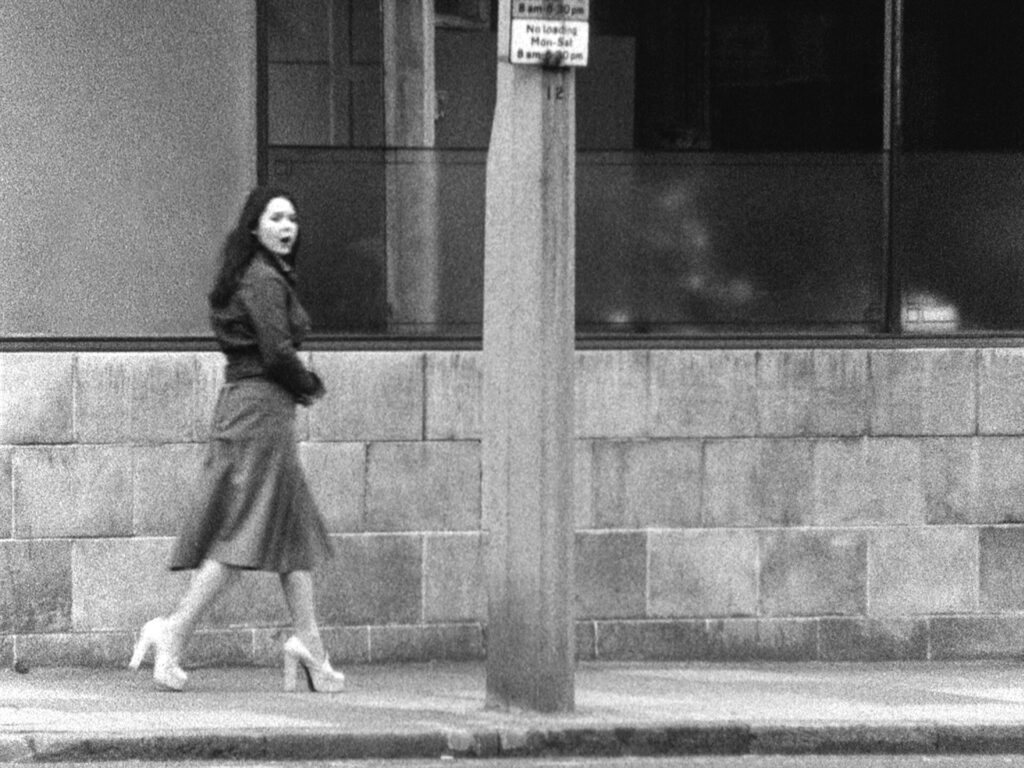
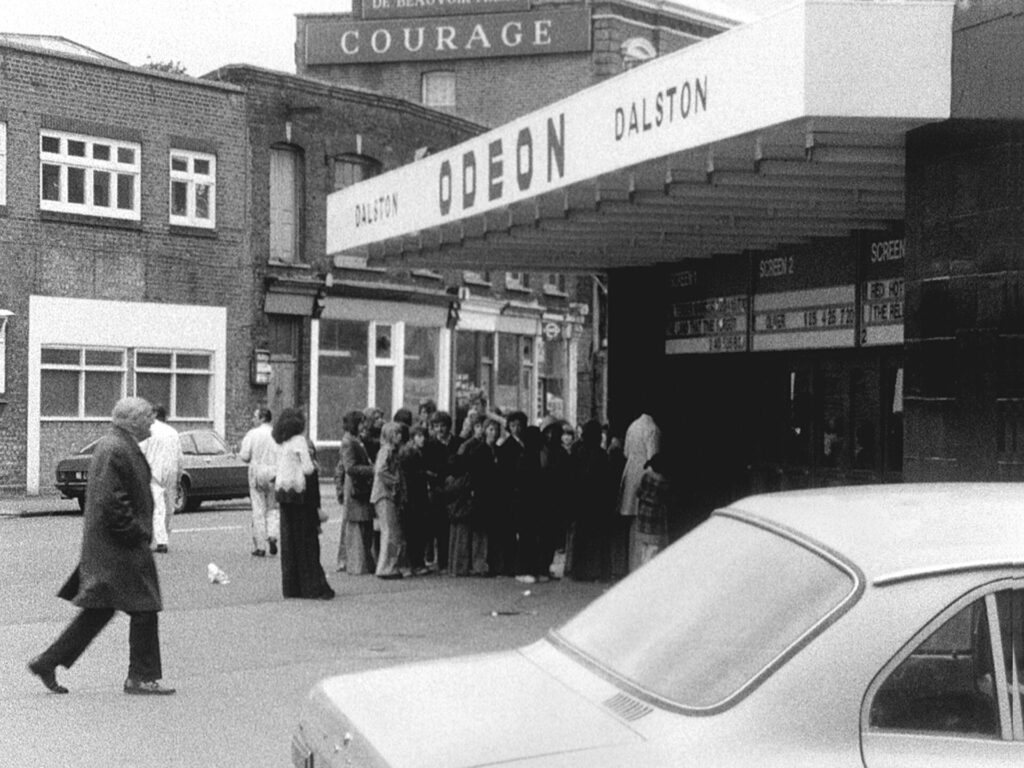
The motorbike shop at the corner of Stamford Street and Kingsland Road in Dalston might not look like much, but it is as much a part of cinema history as Battleship Potemkin’s Odessa steps or The Third Man’s ferris wheel – it was here, 50 years ago, that John Smith shot The Girl Chewing Gum, a classic of experimental film. The black and white short shows a mundane street scene, people walking back and forth, going about their daily lives. It all has the feel of a documentary, until a voice starts barking directions at the pedestrians as if they are extras. The directions, such as “hold that trailer there!”, are at first plausible, but then the voice commands a clock to turn and two pigeons to fly across “…before the girl chewing gum comes across from the left” which she dutifully does. Yet even as the narration becomes more and more absurd, our minds still cling to the yarns the voice is spinning.
Unlike the other great film locations, the site doesn’t vibrate with its history. I’ve walked past countless times with no flicker of recognition. The main façade of Steele’s, the glass merchants, gave way to a series of motorbike shops. The Odeon Cinema with its throngs of teenagers was demolished to build flats. The clock was removed and a third storey added to the building. The shop is currently empty awaiting imminent refurbishment. Smith has previously joked that he has a history of filming structures that are subsequently demolished (the black tower, his own home) as if his camera can channel destructive forces.
Smith was born in Walthamstow in 1952. He refers to a questionable AI generated description which stated that he “grew up in a vibrant working class area.” “It was working class but wasn’t very vibrant” he quips. “I was happy to get out of there.” Smith made a series of formal or “structural” films while at North East London Polytechnic before starting an MA at Royal College of Art where his films, like Associations (1974), started to play with language and film conventions. He has made over 60 films in his 50-plus- year career and is one of the most celebrated experimental filmmakers in the world, receiving the Jarman Prize in 2013. Artist Corneilia Parker remarked “His genius is in taking found material, the most banal situation, the slightest little cue, and imbuing it with a fiction that makes it potent.” He has lived and worked in East London all of his career.
I’ve come to this hallowed ground to watch Smith and curator/artist Stanley Schtinter install the film in the window of the empty building to mark the big anniversary. As I arrive, Stanley gestures to a side entrance – we have to go up a flight of stairs and down a flimsy temporary staircase to enter the ground floor showroom. Smith waves hello cheerfully but is engrossed in checking the picture settings on the enormous flat screen TV. Now in his early 70s, Smith still has a leading-man face (a bit Mathew Modine like), spikey white hair and perpetual glint in his eye, as if he’s just thought of an inappropriate joke.
The three of us carefully lift the TV into the window ledge. It’s an implausibly sunny, springlike February day in London, which is unfortunate because the sun is catching years of grime on the window, obscuring the film. We get to work with window cleaner and microfibre cloths. It occurs to me that I’m cleaning glass in a former glass merchants with a man who made a film about glass making (Slow Glass 1988). Smith likes coincidences – in fact he seems to leave a trail of them wherever he goes.
After the install, we grab a coffee in nearby Café Oto. “They have some nice new graffiti in the gent’s” Smith beams, drying his hands on his trousers “it says, ‘WHEN JAZZ IS FREE, EVERYONE PAYS.’” Smith is a congenital punster, often punctuating his films with wordplay or even making it the driving force. His film Waste Land (1stages the T.S. Eliot’s poem in a pub toilet (T.S Eliot backwards is nearly “toilet”).
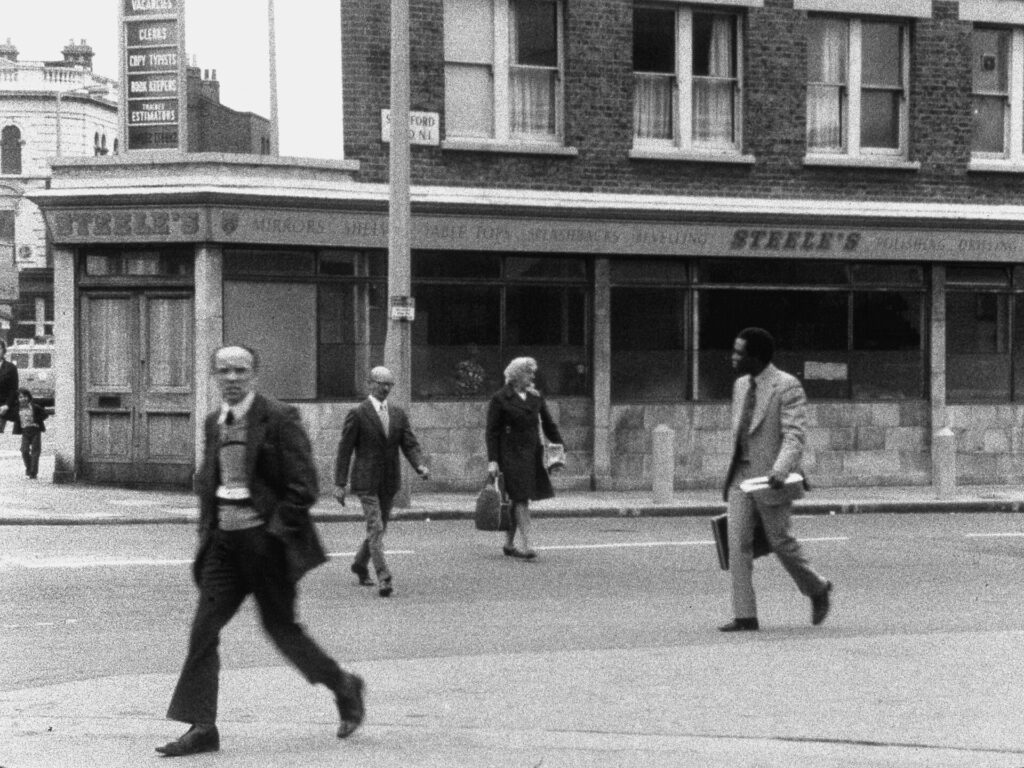
Smith is treated like a local here in Dalston. He has lived in the area since the early 2000s, as he coincidentally also did back when he made The Girl Chewing Gum. When he had the idea for The Girl Chewing Gum, he rented the equipment from the RCA and waited for a bright sunny day, but as the deadline of his loan approached, he was forced to settle for a typical overcast one. At the time, one needed a permit to set up a tripod in a public place. He did not get permission and had secretly hoped that the film would end with the police dragging him away. A few people in the film acknowledge the camera but apparently no one stopped to ask what he was doing. Does he find the camera empowering? “No, definitely not. I was nervous.” The length of the first shot was exactly the length of the reel he had purchased, 11 minutes – all he could afford at the time.
I always assumed that the burglar alarm pealing in the background was a later addition to ground the narrator’s fabulation about the “bank robber” fingering his gun, but Smith confirms it was really ringing that day. The “directors” stereotyping of different characters may also invoke the “sus laws” of the 1970s. I ask what his other favourite accidents were. He used to beat himself up about a jerky zoom early in the film but then had the genius idea to direct the clock to “move jerkily towards me.” He was also delighted that a gaggle of teenagers gathered around the cinema entrance just as he started filming.
Does he see his process as improvisation? We often think of improvisation as something that happens in the heat of the moment, but Smith improvises slowly, meticulously in the editing suite, not with musicians or even actors but inanimate objects, buildings, pigeons and clocks, riffing within self-imposed constraints. Thinking a little he says, “it’s a bit of both.” Often single shot films like Hotel Diaries which seem improvised are meticulously planned; others which seem planned are anything but.
Smith’s films are all about questioning the authority of the moving image, the way we are inclined to blindly trust what we see and hear. This makes his work increasingly relevant in an age defined by deep fakes, disinformation and generative AI slop. But Smith’s ideas extend further. Even in the late 20th century, when journalistic institutions and political discourse were apparently healthy, we’ve had good reason to doubt the camera’s unblinking gaze.
In 1991, an amateur photographer captured the horrific scene of four police officers beating an unarmed black man called Rodney King. Amazingly, the jury found two police officers not guilty. A police video expert had played back the video to the jury frame by frame and labelling each of King’s gestures as “escalation” or “de-escalation.” Hands raised in self-defence became karate chops coiled in waiting. As Smith points out, the same thing happened recently with video footage of Alex Pretti, who was killed by ICE agents in Minneapolis. Was his gun about to be drawn? Or was it his phone? Words shape what we see, even causing us to disbelieve our own eyes and intuitions.
This hinges on the fact that images can be ambiguous – that people screaming in ecstasy or in terror can look the same. “Like footage of young girls at Beatles concerts in 1963, it’s like they’re being murdered!” Smith says. But it’s not just words. In the Iraq War, I remember after the siege of Baghdad, seeing cable news footage of an enormous statue of Saddam Hussein being wrenched down by a tow truck, a suggestive noose of steel cable around its neck, watched a crowd of revellers brandishing American flags and cheering. But the next day, someone showed a picture from a wider angle, suggesting that the crowd was much smaller and probably stage managed. Our mind fills in the blanks of what is beyond the frame, imagining a square full of people.
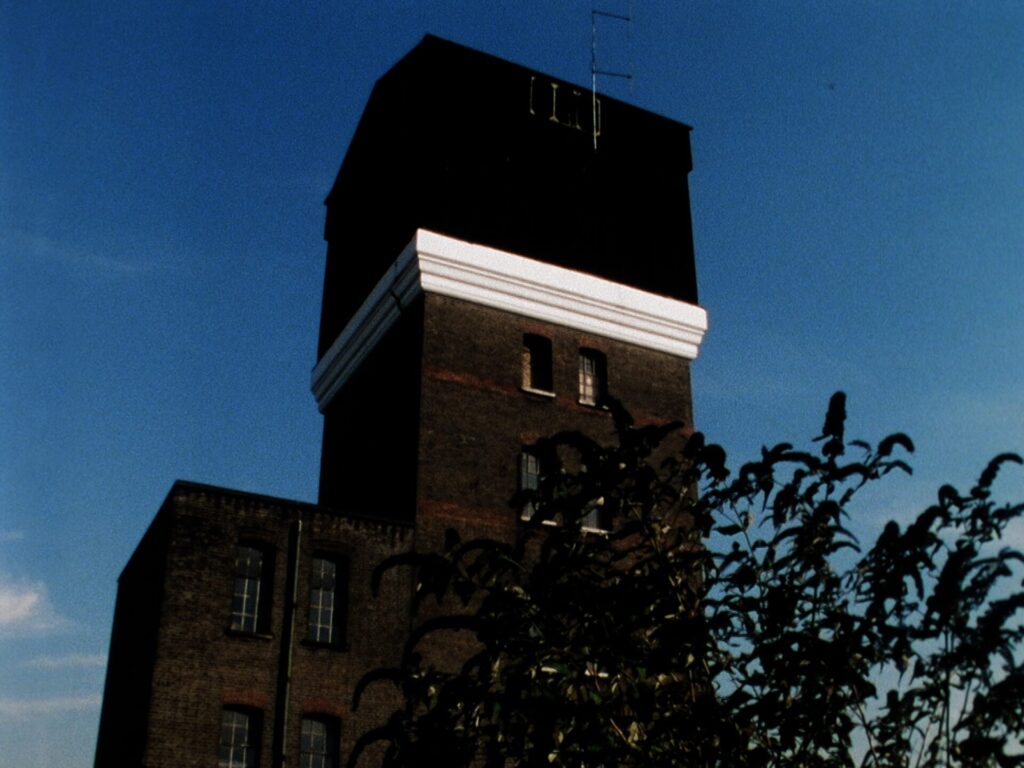
In The Black Tower, perhaps Smith’s most beloved work, his narrator describes how a strange brick building with a matt black structure on top has been following him around London. It has loomed over terraced housing or peeked out from behind playground equipment, even stalking him through the countryside. Audiences still ask Smith how he managed to find all these towers or superimpose them on the film. But there was a tower (a water tower on hospital grounds that he could see from his window) and he simply photographed it from every possible angle, carefully cropping the frames to appear like different locations.
Over the years, Smith’s films have been shown on national television. Like Barbara Kruger’s anti-ads appearing in real billboard spaces he had taken over the very medium he was subverting. I ask if anyone ever reported seeing The Black Tower, late at night on Channel 4 while stoned. “Of course” he says. He relished the opportunity, not as some power mad propagandist but because it was a rare chance to get feedback. The Black Tower got its share of call ins, “I’ve watched this upside down and sideways, but I still can’t make head or tail of it.” The complainers were also concerned because his film goes completely black at points (leaving our imagination to run wild). In the 80s, the BBC broadcasting dead air was a harbinger of nuclear war.
Aside from the big Girl Chewing Gum anniversary, Smith has been involved in several retrospectives in recent years, including 50 films for 50 years of filmmaking at the ICA and Close-Up in 2022. I ask if it’s strange to be bookended, given that he’s very much still alive and a working artist “I’ve always showed old films with my new ones and my voice is often in them or sometimes I visually appear in some of them, so I’m very aware of my own mortality,” he says laughing.
His latest film Being John Smith charts his life and career, with all the usual red herrings: he explains some of his found school photos were upscaled (or maybe a bit more) with AI. Smith has no qualms about using the latest technology in his obfuscation tactics. Being John Smith is full of coincidences, mostly having to do with his incredibly pedestrian name. It is also full of celebrity encounters: he nearly has a run in with Paul McCartney, talks about having Jarvis Cocker as a student at Central St. Martins and in a brief addendum to the film, shares an elevator ride with Tom Hiddleston, who it turns out shares the same nickname as Smith at school: “Pid.” Smith never engages the other Pid but wishes he had asked him “…if he also felt like the world only existed in his imagination.”
When I ask him about this line, Smith replies “I’d be quite happy if I dropped dead tomorrow and that’s the last line of a film. It’s a really important part of my daily life.” This might sound like the mindset of the megalomaniac, for whom the world is a playground and people mere playthings, but really it speaks to the power of our minds to fill in the blanks, to bring order to the chaos of the world. It also speaks to the power of film to impose meanings on the buildings, phones, pint glasses, suitcase stands and pigeons which populate our lives; to turn mere coincidences into fleeting truths.
A tower becomes a villain. A girl chewing gum becomes a movie star. A London corner becomes a film set. And then it’s gone.
Further Notable Works by John Smith
Om (1986)
In Om (1986), we see what appears to be a Buddhist monk, wreathed in incense having his head shaved, but the robe is revealed to be a barber’s cloth and underneath is a Fred Perry-clad skinhead, the incense just a cigarette. The “om” sound, and our own preconceptions, complete the illusion. Smith’s hallmark is that he always draws our attention to the film conventions which anchor our interpretation of the film, normally just as we’ve started to settle in. When the ‘monk’ says “tiddly pommm” we know something is up. Is there an ideal length, I ask, for an audience to get comfortable before he pulls the rug out? Smith sits back in his chair “it depends on the film but I’m thinking of keeping the viewer on their toes, you know but without being alienating, that’s the thing, getting that balance right.” Humour, especially of the absurd and self-deprecating kind, he contends, is also key to keeping the audience on side.
Slow Glass (1991)
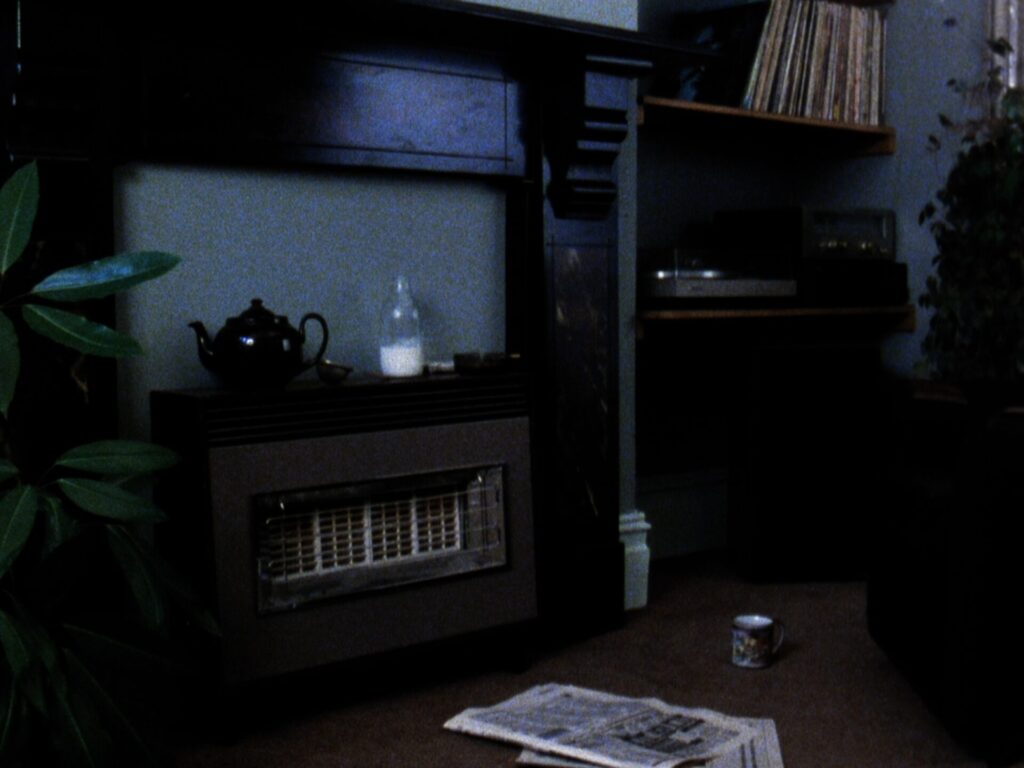
After Dalston, Smith moved to Leytonstone, where rent was cheap because the houses were about to be demolished to build the M11. He became part of a thriving community of similarly frugal artists. His film Slow Glass documented the changes affecting the area through clever before and after shots of rooms, houses. Apparently, he would look for “For Sale” signs and ring pubs to see when they were being refurbished, then arrange to take two shots from exactly the same camera position, a technique he perfected for the Black Tower. To observe change, you need a fixed point.
Blight (1996)
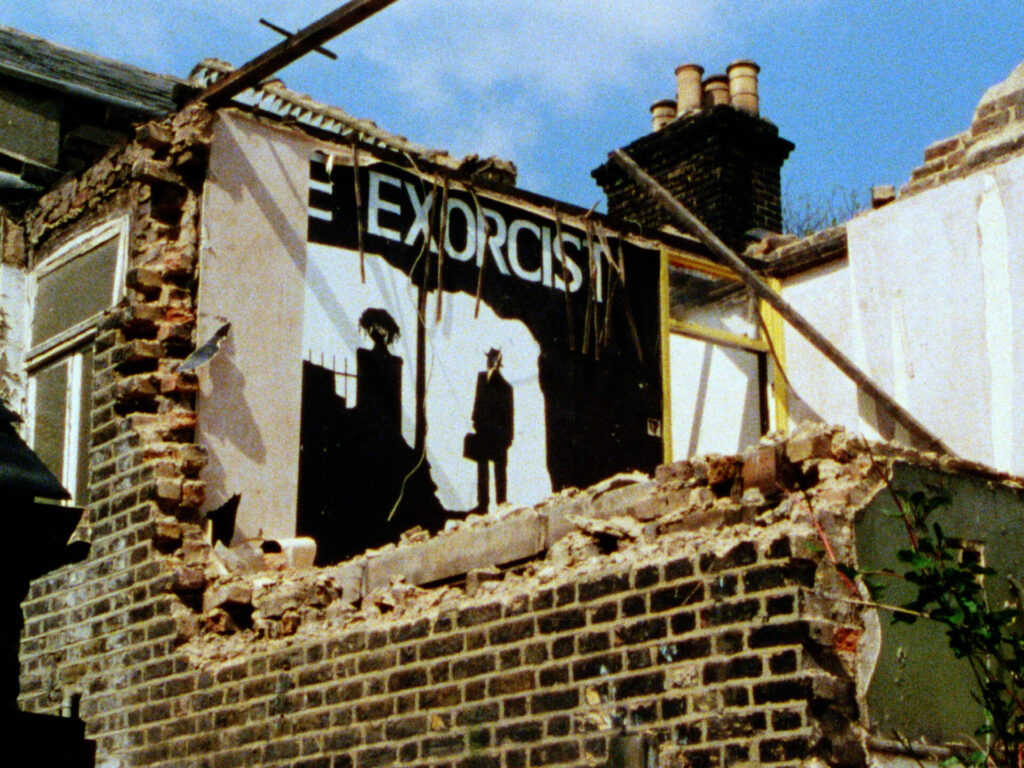
I ask about the role of music in his manipulation tactics. Smith rarely uses conventional soundtracks with the exception of the found mix tapes in Lost Sounds and the rousing score by composer Jocelyn Pook for the film Blight, which documents the demolition of the Leytonstone houses. “Well, I’m very apprehensive about the use of music because it’s emotionally so powerful,” he says. Pook’s score with its swelling strings is certainly that. “What I really hate about music in film is when it’s used kind of insidiously or subliminally – like to set the tone of a scene or something like that,” Smith continues, “whereas with Blight, it’s absolutely overt. You’re completely aware you’re being emotionally manipulated. What could be shots of a construction site becomes a site of trauma, ghosts and impotent rage. “People seem to know it is an agitprop, road protest film, but that’s really just the music doing that.”
Frozen War (2001)
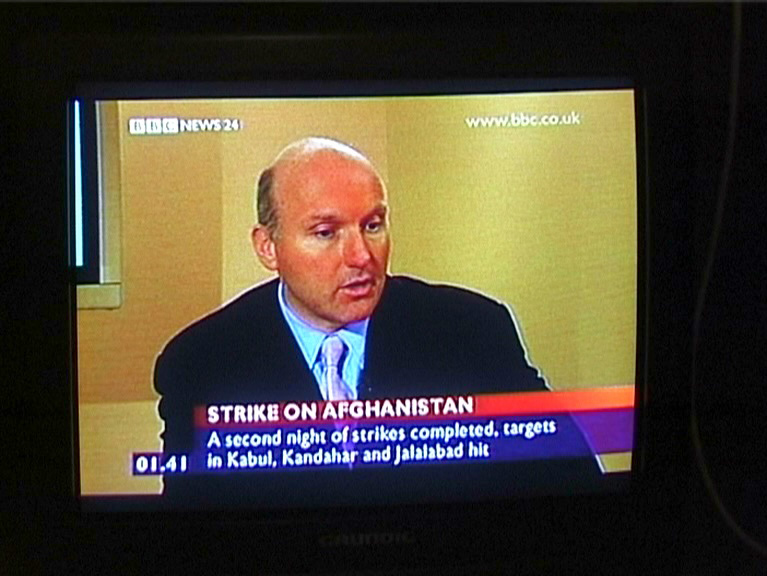
The first of Smith’s early 2000s series Hotel Diaries, Frozen War begins with the shot of a malfunctioning TV screen in a Cork Hotel Room – a news pundit frozen in contemplation. It was just as the US had started bombing Afghanistan as part of the War on Terror. From behind the camera, Smith speculates that perhaps WWIII has started and London has already been wiped off the map. The man contemplating what to say is now contemplating his own death. There is a paranoid streak to Smith’s work but not an unreasonable one. “How can we not question our grip on reality when there are so many awful things happening in the world,” he says. Perhaps the sanest thing we can be right now is a bit wary.
The Girl Chewing Gum will be on display until the 9 March 2026. An Anniversary Screening will be held at Close-up on 10 March. For tickets and more information, go here.