

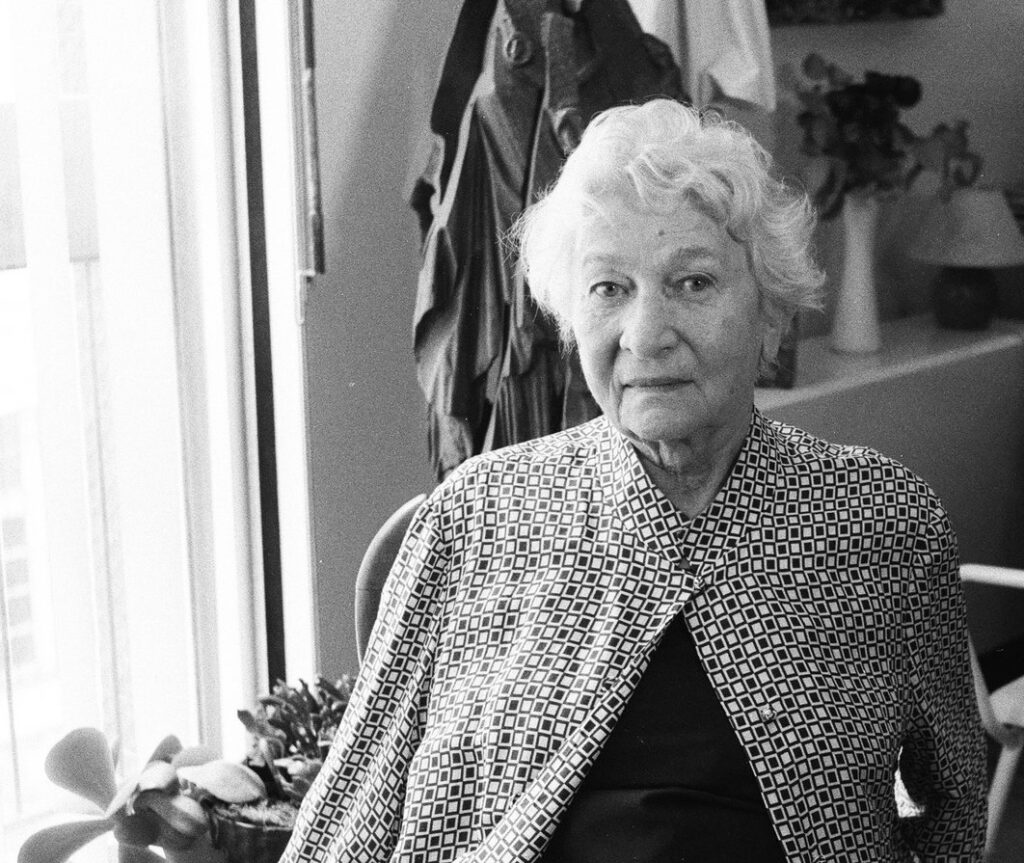
Only a handful of people aged over 25 could honestly say they grew up with the music of groundbreaking French composer Éliane Radigue. Her work was largely unreleased or unknown until this century, so the scale and warmth of the reaction to her death on Monday can’t be attributed to nostalgia, though it is what you’d expect on the passing of a long-loved artist. Instead, this widespread love for Radigue and the impact she has had on so many listeners and artists is a phenomenon that reflects the music she made: burning slowly and revealing itself those who took time to listen closely.
In terms of major releases, she first broke cover in the 1980s and 1990s with longform Buddhism-inspired works such as Les Chants de Milarepa, Jetsun Mila, and Trilogie de la Mort which, in their use of spoken word, sound like an act of devotion. Then music she had recorded all the way through the late 60s and 70s was released during the 2000s, and the extraordinary focus Radigue had maintained over the period of half a century became clear, revealing a sound world that few had previously had chance of hearing.
The story of those years making unheard sounds is worth remembering not just because of the barriers in her way, but also because what she recorded was the most extreme of all the music being made in her native France – and arguably the world – throughout the 1970s, at a time when being radical and countercultural was almost the norm. Radigue hit all the criteria you could imagine for an underground artist: uncompromising, no serious engagement with the music industry, producing work that infuriated the establishment, yet she received little in the way of validation or encouragement. Some of this was about her gender (Pierre Schaeffer once said “if she wants to come to the studio, she can put stamps on letters”), and what little recognition she received in the 1970s and 1980s came not from France but from the modern music élite of the USA, who encouraged her to create. “When I went to the United States, it was incredible to suddenly receive this moral support from American musicians,” she once said. Back in France, she almost never performed in public, saying that “for decades, I had no choice other than to fly solo.”
In her later years, Radigue owned her narrative, often telling researchers about her childhood fascination with the sound of aircraft (“Every airplane had his own personality”) and of hearing Schaeffer’s composition ‘L’Étude Aux Chemins De Fer’ on the radio at home in the early 1950s as a gateway into musique concrète. She would engineer a meeting with Schaeffer in 1955, shortly after that becoming a stagiaire (an unpaid intern) at his Studio d’Essai, learning the techniques of the Groupe de Recherche sur les Musiques Concrètes (GRMC).
A ten year break followed, spent mostly bringing up her children in the South of France, but with some experimentation at home, and sometimes travelling to the USA with her sculptor husband Arman where she met minimalist composers like John Cage, Steve Reich and Philip Glass. After separating from Arman, she spent a year back in Paris helping Pierre Henry in his studio, eventually drifting from his practice: where Henry wanted to isolate and use the attack of the sound, the remaining resonances interested Radigue, and this inspired her earliest solo work, including Jouet Electronique and Vice-Versa, which were created using just a microphone and tape recorder. These are longform pieces which gradually evolve, change created by her imperceptibly moving the microphone. Despite using techniques learned from them, this was already definitively not musique concrète as practiced by Pierres Henry and Schaeffer. Their approach was to record sounds from the real world, then control and manipulate them in the studio, whereas Radigue homed in on the sound – looked within it. She was a true experimental artist – for example on Usral (1969) recording ‘ultrasound’ outside of the human hearing range, playing it back at a much slower speed, and then using feedback techniques on it, recording the result to create loops. Equally radical, another of her final pre-synthesizer works, Opus 17 (1970) features a Chopin piano piece gradually decomposing, a twin of Alvin Lucier’s celebrated I Am Sitting In A Room (1969).
One of key moments in Radigue’s life was the discovery of the synthesiser, which meant she could focus even more precisely on the sounds she was exploring. She worked on ‘slow change music’ in 1970 in the studio at New York University School Of Arts, where she had become artist-in-residence, taking it in turns with Rhys Chatham and Laurie Spiegel to use a Buchla 100. Radigue was fascinated by the instrument, which could produce precisely the sort of sounds she was using in her feedback works, “a very simple vocabulary: pulse, beats, sustained tones. And then evolving from there inside”. Importantly, she found it much easier to do this with an analogue synth than with the equipment she had been using in France, and she loved the sound, which we hear on Chry-ptus (1971), her first synthesiser work. The sound is cleaner and deeper than before, but it’s only a small step in terms of method. Its length – over 20 minutes – starts to hint at the time-shifting effects her work could have on the listener’s cognition, the first piece of hers that can lead you to wonder how long you have been listening.
Through the 1970s, Radigue went on to use her own ARP 2500 synth to produce a series of long-form drone pieces, designed to be played at low volume, each with two things in common. First, there’s an absolute precision in the very few components of each piece, a surgical focus on different elements so that we seem to hear each one at a molecular level. Second, sound gradually evolves in such a way that, no matter how static it feels, there is a constant shift from one element to another, creating new sounds in the spaces in between. A typical piece was based on the output of five oscillators, all set to the same basic frequency. Each ‘voice’ could be adjusted – using potentiometers, controlling around thirty different parameters, all capable of changing the sound gradually – and played through the ARP’s filters. She recorded the resultant sounds on to tape, then came back and listened afresh after a month or two for editing and mixing, which is when the actual composition happened: she used crossfaders to mix sounds in and out, joining segments with a view to creating a whole that changed so slowly that the listener is not likely to hear the changes taking places.
Her work from 2010 onwards – her third phase, working with musicians on a series of pieces called Occam – is brilliant, fascinating and well-documented. When musicians talk about working with her, they always describe how they honed techniques that enabled them to maintain notes for far longer than they had ever tried before. It’s essentially about control, as in her final years Éliane Radigue pulled more and more people into her own deeply disciplined approach. And, while it’s tempting to highlight the unique aspects of each piece, and of each phase of her work, all of Radigue’s work feels like it is, as she asserted, part of a continuity.
Referenced artists
Pierre Schaeffer
A Guide To Listening Better: Spectres Of The GRM

Philip Glass
Slipped Discs: Record Sleeves By Contemporary Artists
Steve Reich
Time After Time: Athanasios Argianas’ Hollowed Water Playlist
Rhys Chatham
Music Of The Spheres: Rhys Chatham’s Favourite Albums
Laurie Spiegel
Laurie Spiegel
It’s an astounding body of work to leave behind; thrilling, hypnotic and uncompromising.