
Much has been written about the Transatlantic fallout of punk rock, with every crevice of the era meticulously scanned in the hope of a lost classic. Whilst Circle X’s fractious run, two albums and two EPs, over a span of seventeen years, might not signify complete unknown status to seasoned crate-diggers, their minimal place in the history books belies their brilliance.
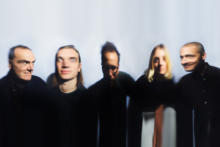
Formed in 1978, in Louisville, Kentucky – by brothers Rik and David Letendre, alongside Tony Pinotti and Bruce Witsiepe – Circle X emerged from the ashes of the city’s very first punk bands No Fun and The I-Holes, surfing the shockwaves created by punk rock. The band swiftly relocated. First to New York, then Dijon, and back to New York again, all the time evolving and mutating at breakneck pace.
The move away from the soon-to-be thriving Downtown NYC no wave scene to France was an odd career choice for a band like Circle X, but it defined their early years. There was very little in the way of like-minded contemporaries in France, and this pushed them into a space where their maverick ideas were allowed to ferment and effervesce in isolation. Their debut self-titled EP, recorded in Paris, captures the band in the mid-point of this evolutionary period, and whilst it has its frayed, brilliant moments, it will be of little surprise to anyone that it did not break the European market like manager Bernard Zekri thought it could.
The nine months in France, however, were far from wasted time. Algerian-born Zekri exposed the group to the music of the Syrian composer Farid al Atrash and the Egyptian megastar Umm Kulthum, which would be transformational, and the time they had to experiment with tape loops and percussion were revelatory. All of this meant that by the time Circle X returned to New York in the Spring of 1980, they were ready. Of course, the cream of the post punk crop were characterised by a future-facing DNA. A foresight that allowed them to release music that sounded way ahead of the times. Be that the grizzled futurism of the early Human League and Fad Gadget records, the angular, silver grooves of Wire and PiL, or Mark E. Smith’s lysergic pre-cog hypno rock. Notably, This Heat – probably Circle X’s closest sonic relative – envisioned a scorched Earth; a disintegration of language and culture, for the only future that seemed possible from the confines of their Cold Storage studio was one of utter destruction of what had come before.
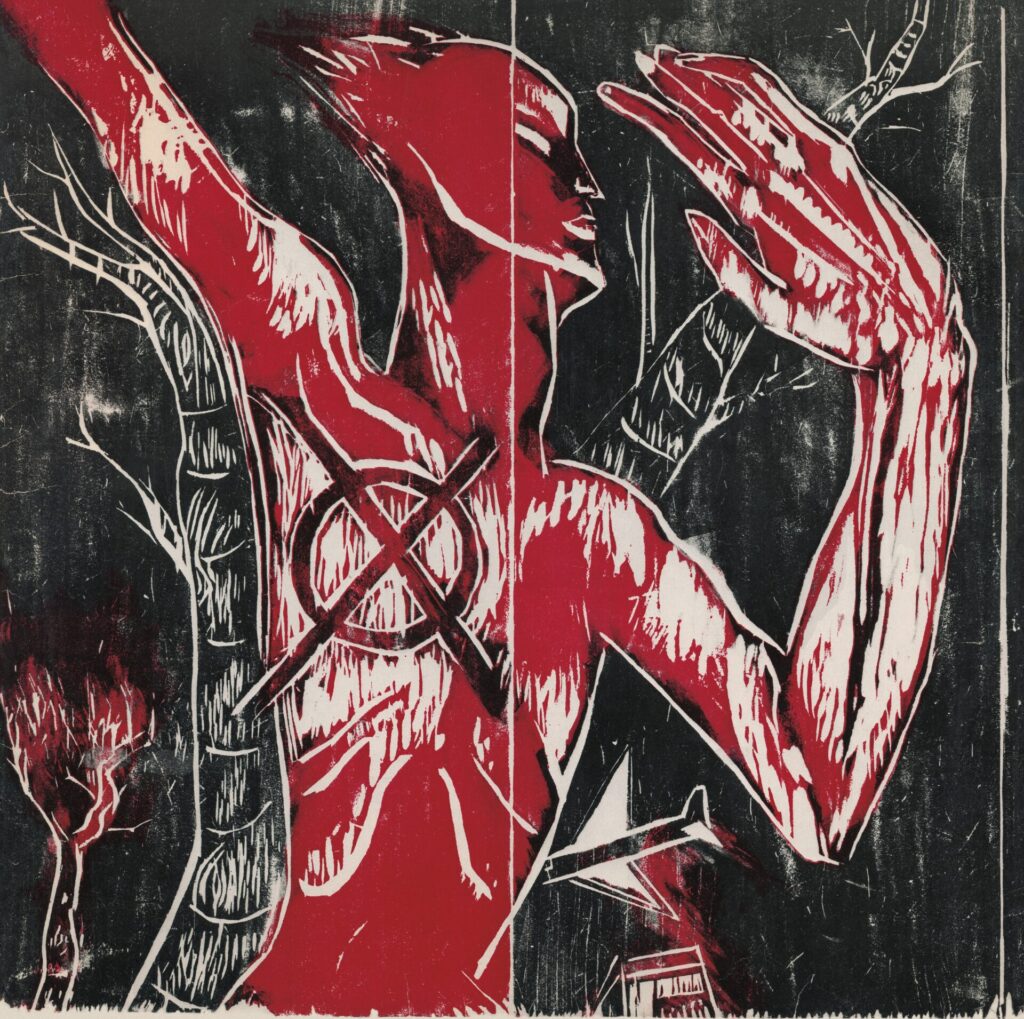
Circle X, however, used their debut to look far back, to a muggy, writhing comedy written in the bubbles of the primordial stew. Prehistory was recorded in New York’s Skyline Studios the year after they returned to America, and it is their masterpiece. A completely singular record that is rightfully getting reissue treatment by Drag City, 43 years after its initial release.
Post punk yes, but also an early post rock, post-everything-else release. Spidery riffs akin to Pajo’s Slint work phase in and out, and a Dada approach to percussion as collaged texture allowed Circle X to evoke a more feral, realised devolution than the one hinted at by Motherbaugh and co. a few years earlier. It is unsurprising that a lot of Circle X’s material was reissued for the first time in the 90s by David Grubbs’ Blue Chopsticks imprint, as this deconstructed skronk would act as a scrawled blueprint for Grubbs’ own visionary Gastr Del Sol work with Jim O’Rourke.
Opener ‘Current’ demonstrates this beautifully in microcosm. A fever dream world constructed around a rumbling bassline and rolling layers of drum and guitar, it invites you into the band’s cryptic, acrid world perfectly. David LeTendre’s polyrhythmic drums are the star of the show, and they are supplemented by a manner of clicking, clacking loops of scattershot percussion. He also adds additional guitars, disembodied and discordant, whilst Witsiepe’s vocals are gnawing and atonal transmissions from far away.
Throughout, guitars are deployed in fascinating ways that would become commonplace in later experimental rock but sound revolutionary for 1983. Rik Letendre and Witsiepe work in tandem, making scraping, clanging, industrial sounds that fade in and out of focus. They are close to their best on ‘Beyond Standard’, where a head spinning call and response of discordant, flayed riffs propel the sound into swampy, psychedelic territory, but throughout the work is an ingenious prototype of the shape of rock to come.
Across ‘Prehistory’ vocal duties are shared, with each member’s disaffected voices meshing perfectly with the band’s buzzsaw soundscapes. Circle X’s lyrics often arrive in abstract, detached fragments, which alongside the scrambled dub rhythms, make Prehistory feel as if it is an arcane code ripe for cracking. It feels like an artefact, discovered, rather than created, a cave painting or a monolith transplanted onto wax; you get the feeling, though, amidst the abstractions, the haze and the chaos, that there is no Rosetta stone to crack this one.
The title track, a ballasted symphony in two parts, gives the greatest clue to the world in which Circle X exists. “History falls away, like teeth from bones,” barks Pinotti on ‘Part I’, as a patchwork Goliath of scratching guitars judder ever so slowly to life, before a hissing Rik Letendre wheezes: “I’m making my house in the ice age,” amidst the thuds and the dirge of ‘Part II’. Circle X are most at home envisioning a world before; not just a world before song structure and rhythms became very standardised, but a world before everything else.
Of course, this talk of time and history, is ironically fitting in the world Circle X. They are anomalously out-of-sync with their future-facing, synth-wielding contemporaries, yet this album is decked in innovation. ‘Culture Progress’ and ‘Prehistory Part II’ are sound collages, where evidence of the looping process, the makers’ marks, are left in, making them important post rock precursors to the likes of Tortoise, whilst their percussive tape experiments ensure that their work has aged just as well as that of the This Heat albums. There is a touch of the art brut about Circle X – Jean Dubuffet rather than Eddie Argos – in the way that both the guitars and drums are often played in such a way that they have been unlearned, but fortunately this never becomes hokey or staid.



The group spent the 80s largely working on other projects (although Rik Letendre has said vast quantities of unreleased material exist), and Circle X would not follow up Prehistory until 1993, and disbanded in 1995 following Bruce Witsiepe’s death from complications relating to HIV. Whilst this reissue of Prehistory is not the first, it should go some way to establishing a lost history of punk, post punk, and post rock in which Circle X take a deserved place at the forefront.