

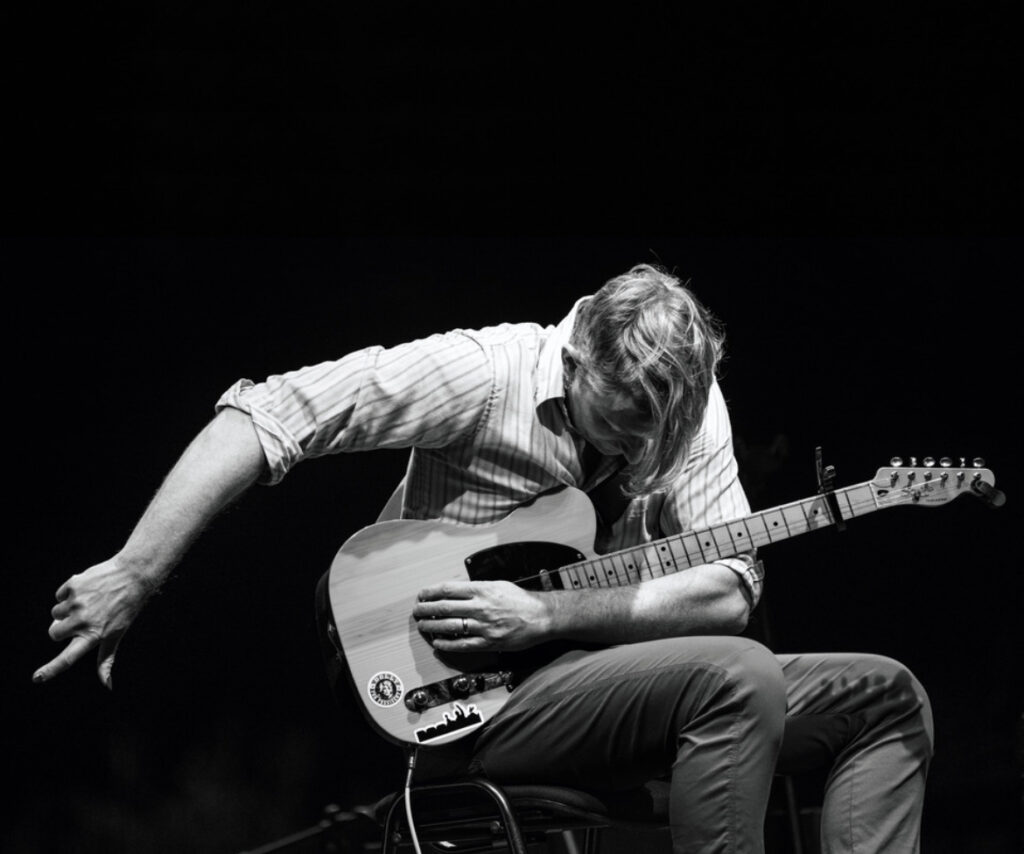
Just when you think you know everything there is to know about the guitar, here comes Shane Parish to show that you are mistaken. This can be heard on both acoustic and electric instruments; in brilliant recordings made with the Bill Orcutt Quartet and Ahleuchatistas; playing his own music and interpreting shanties and songs by Kraftwerk, Aphex Twin, and Autechre, as exemplified by his latest album, Autechre Guitar, released by Palilalia Records this week.
Since his first serious band, the Union Prayer Book, the guitar for him has been less a vehicle for virtuosity than a tool for exploration. Parish was not interested in mastering a style so much as inhabiting a world. Music became, as he describes it, a “parallel universe” – a place to disappear into, separate from everyday life. His autodidactic approach would later become a defining strength. He discovers a lot through trial and error and develops a deeply embodied understanding of the instrument. That experience now informs his teaching as much as his playing. He likens it to the idea of the “wounded healer”: someone whose authority comes not from institutional legitimacy but from hard-earned understanding.
This resistance to dogma also shaped his early band work, most notably with Ahleuchatistas. Emerging from a love of both punk and prog, Parish’s goal was not genre fusion for its own sake but tension – riffs appear briefly, sometimes only once, before the music veers elsewhere. The effect is destabilising by design: just as the listener settles in, the ground shifts. At the same time, Parish was making a living as a working musician in Asheville, North Carolina. He played in hotel lounges and at restaurants, at weddings and other events both public and private, often interpreting other people’s music. Whether folk songs or jazz standards, performance became a way of engaging more deeply as a listener. Interpretation, for Parish, became a shared experience: a form of communion between composer, performer, and listener.
That long period of constant motion – gigging, teaching, performing experimental music – came to a halt around 2014, when Parish’s daughter was born. For several months, his practice became radically minimal. When he emerged from that period, he began recording folk songs on acoustic guitar, applying his improvisational instincts to traditional material. These recordings would eventually become Undertaker Please Drive Slow, a record that marked a clear turning point. It was the moment when disparate threads – free improvisation, interpretation, teaching, listening – finally synthesized. He found a balance between improvisation and composition.
Crucially, this moment of internal clarity was mirrored by external affirmation. Parish sent some of these recordings to John Zorn, who knew his earlier work with Ahleuchatistas and wanted to release a record. Similar encouragement would later come from guitarist Bill Orcutt, who pushed Parish to collect and formalize the solo guitar arrangements, which led to Repertoire. That was the moment that showed these interpretations were not side projects but the work itself.
Parish experimented with alternate tunings, key changes, and voicings, gradually removing what couldn’t be played while preserving the illusion that everything was still there. Whether he’s arranging Ornette Coleman, Sibylle Baier, or electronic music, the process is iterative. He insists on the retention of the urge to express himself. In an era obsessed with speed, visibility, and mastery, Shane Parish stands as a reminder that synthesis takes time – and that sometimes, the most direct path to a voice is the one that refuses to be direct at all.
Ahleuchatistas – ‘The Machines Became Cognizant’ from On The Culture Industry (2003)
Shane Parish: The band name Ahleuchatistas is a mash-up: “Ah-Leu-Ch” comes from a Charlie Parker tune, and “-tistas” comes from the Zapatistas, the revolutionary movement in Mexico. The album title comes from an essay by Theodor Adorno, in which he discusses how culture is administered and shaped through capitalist mechanisms. That idea aligned with what we were trying to do musically – making something subversive not just in content, but in form. When I was a teenager, I had accumulated a pretty large collection of pedals and would jam endlessly. One day, I looked at all of them and thought, I needed to strip everything away and see what I could do with the guitar alone. Later, pedals crept back into my world. But for that period, keeping things completely clean was very intentional. “The Machines Became Cognizant” is a line from The Terminator, spoken by Arnold Schwarzenegger, describing the moment when Skynet becomes self-aware. That song – and really that whole project – was about 99% through-composed. There’s this fast, angular run early in the track, right after the intro. When you listen to it, it sounds completely chaotic – like random, unhinged guitar playing – and like I can barely play it. And honestly, that’s true: we were playing it so fast that I’m slightly behind the beat, just hanging on. It has that Zappa-like or early King Crimson, Larks’ Tongues in Aspic-era Robert Fripp energy – very tense, very angular. So even though every note is composed, it feels like total free-jazz chaos but the only improvised part is the ending.
Wendy Eisenberg & Shane Parish – ‘Fresh Bust’ from Nervous Systems (2019)
SP: Wendy was touring through Asheville, where I was living at the time, and we ended up playing a show together. We already knew each other online, we had mutual friends, and had both just published essays in Arcana, the series curated by John Zorn. We found out we both love Leo Brouwer, Thelonious Monk, and Willie Nelson, among other things. That common ground made the collaboration feel very natural from the start. The whole thing was completely spontaneous. Every track is a one-take improvisation, with no prior discussion, no plan, and no shared idea of what it would sound like beforehand. Instead of developing one idea for a long time, you move through different zones. In ‘Fresh Bust’, you can hear our harmonic and melodic sensibilities rubbing up against each other. I’m not really a wide-open atonal or fully chromatic player by nature – when I’m playing with someone very comfortable in that chromatic space, it wouldn’t make sense for me to stay strictly tonal. You can hear that negotiation happening in the music. It starts more tonally, then gradually shifts. There’s a lot of impressionistic colour blending – harmonies dissolving into each other rather than resolving in traditional ways. There’s a quality to it that reminds me – at least in spirit – of Cecil Taylor on guitar: in the percussive approach, the density, the tone clusters. There’s still a sense of melodicism in there, even though the music is often atonal. That tension is part of what makes it interesting to me.
‘Drop Z : Bell5@19/PS@Br(6-1)/PC1/CS@19(3-1)’ from Autodidact (2019)
SP: After spending so many years playing guitar in standard tuning, it became too easy for my conceptual brain to take over. Changing the tuning immediately disrupts that framework. The concept was simple: as the recording progressed, the instrument became more detuned and physically altered. The track titles are technical descriptions of the setup – no poetry, no metaphor. The first track is in standard tuning, with no preparations at all. By the time you reach this one, the strings are completely detuned; the instrument is heavily prepared. The last track on the album is where this idea goes furthest. “Drop Z” is obviously a joke: the lowest string is tuned down until it’s almost like a floppy rubber band. The rest of the title is a kind of shorthand describing the preparations and where they’re placed. For example: “Bell5@19” means a bell attached to the fifth string at the nineteenth fret; “PS@Br(6-1)” is a plastic strip placed across the bridge, spanning strings six to one; “PC1” is a paperclip on the first string at the first fret. On this track in particular, the result is very percussive. Playing just two notes in a groove can be completely engaging. That tension between control and discovery is really what the album is about. At that point, it really becomes another instrument entirely. It stops sounding like a guitar and starts functioning as a percussion instrument.
‘Haul Away, Joe’ from Way Haul Away: A Collection Of Fireside Songs (2020)
SP: My wife, Courtney, and I have a podcast called Is There An Echo In Here? which focuses on Echo & the Bunnymen. One episode is focused on Liverpool, which led us to sea shanties. I’d always enjoyed shanties on a surface level – the communal singing, the “yo-ho” quality, the rapturous energy. These songs were functional work songs – used to coordinate physical labor, such as hauling ropes or rowing. Once steamships came into use and less manual labor was needed, shanties lost their original function – they became more about nostalgia or preservation. Around that time, I owned a book called The Fireside Book Of Folk Songs, which I’d picked up at a second-hand store. After making Undertaker, Please Drive Slow, I found myself wondering what to do next, and thought, ‘Let’s do more folk songs.’ There are over a hundred songs in the book, and I ended up recording all of them. The process for ‘Haul Away, Joe’ lived right on the border between improvisation and composition. The question for me was, ‘Can I find that space where there are just enough anchor points to tell a story, while still following whatever impulses arise in the moment?’ That action-reaction relationship with the material is really what shaped the album.
‘Black Eyed Susan’ from Liverpool (2022)
SP: Liverpool was supposed to be an acoustic record. But it just never fully came together that way. At that point in my life, I was playing a lot more electric guitar. I was deep into the sonic world I’d been exploring with Ahleuchatistas – I had vocabulary built up using EBow, loopers, delays, octave pedals, distortion and volume swells, and I’d spent so much time with that palette that it felt very intuitive. ‘Black-Eyed Susan’ historically belongs to a subcategory of shanties known as “lover lost at sea” ballads. I first heard that song performed by the duo Anna & Elizabeth, and when I saw them play live, I literally cried. I thought, ‘What is this song?’ It completely floored me. My version was very much inspired by theirs, which is incredibly powerful. When my arrangement came together, it started very minimally – just me tapping and muting the strings, creating percussive clicks near the bridge. I used loops, arpeggiation, volume swells, and delay to create this pad-like atmosphere, then built a call-and-response structure with the melody. What really interests me is the melody itself – interpreting it, rephrasing it, ornamenting it. Once the drums come in, I’m essentially just returning to the melody again, finding new ways to voice it. The melody is so strong that it puts me into a trance. I keep reshaping it, subtly changing it, letting it breathe. That kind of variation holds my interest far more than soloing in a traditional sense.
Library Of Babel – ‘Winter’ from Sing To Me Of… (2020)
SP: This album is a collection of interpretations of Sacred Harp repertoire – music from the American South associated with shape-note singing. It’s a form of communal singing where different shapes represent pitches, making it easier for people who may not read traditional notation fluently. Before this record, we – I played with Emily Hunnicutt on cello and Frank Meadows on bass – had done a free-improvisation album together, which came out on Blue Tapes. After that, we thought, “Let’s explore this repertoire”, because we all genuinely loved this music. We recorded the album in a large wooden house somewhere in the Appalachian Mountains of North Carolina. What I do remember clearly is that it was this unique, almost surreal house out in the countryside. In my memory, it was shaped like an ear – or at least it felt that way acoustically. It was a very unusual, resonant space, and being there had a big impact on how the music unfolded. These songs are very concentrated melodically, and we didn’t feel the need to stretch them out. The idea was more about capturing a feeling, a moment, a shared atmosphere – rather than developing things at length. I tend to think of the record as a series of small windows into the same world. ‘Winter’ seems to hold something special for many people.
Bill Orcutt Guitar Quartet – ‘Out Of The Corner Of The Eye from Four Guitars Live (2024)
SP: We had crossed paths with Bill Orcutt a couple of times, and I noticed that he was buying my music on Bandcamp. One day, he sent me the recording of Four Guitars and asked me to transcribe the album. He’d seen online my arrangements and interpretations of other people’s music. When I listened to it, it was immediately clear: the music was very rhythmic, very structured, and very repetitive. Once the record took off, Bill asked me to help lead the live band. I had already played with Wendy, and Ava Mendoza had independently reached out to Bill, offering to play live. Everything just gained momentum: international touring, festivals, and the Tiny Desk concert. We knew we were going to record the show at Le Guess Who? and that would become the live album. At first, during my section of this piece, I played a more traditional lead solo – after Ava’s solo – over the vamp. But while we were on tour, in Austria, I was talking with the band in the green room and said, “I think I want to play an unaccompanied solo here.” Bill said, “Let’s do it tonight.” The very next day, we played the Le Guess Who? – what you’re hearing is literally the second night after we made that decision. In that solo, instead of playing lines over the motif, I decided to reinterpret and deconstruct the melody itself. I took the core idea and developed it into a purely solo guitar piece. So that moment on the record really captures something being born almost in real time – one day old, basically.
„Sycamore Trees” from Live at Cafe Oto (2024)
SP: It was the very next day after Four Guitars Live in Utrecht. We had two shows at the London Jazz Festival. To play Café OTO, we couldn’t do another quartet show there, so we decided to do an evening of solo performances. My set included a few folk ballads and the Angelo Badalamenti song ‘Sycamore Trees’ that Jimmy Scott performs in Twin Peaks: Fire Walk With Me. That turned out to be the most raucous and noisy part of my set. Sometimes, if you’re lucky, you discover a hidden room inside a song. It moved into an intense space that I hadn’t really premeditated. I think part of that was because I was very warmed up. Whenever I could, I’d review the songs in my hotel room, just keeping the melodies fresh in my head, knowing we had this solo show coming up. That way, when we arrived in London – my London debut, really – I could play naturally and stay connected to the material. The photo on the cover of Live at Café OTO comes from that solo section of ‘Out Of The Corner Of The Eye’, but it was taken later, at Jazz em Agosto in Lisbon. During that solo, I do this exaggerated, almost flamenco-like gesture: I run my hand all the way up the strings, past the bridge, then pull my hand back behind me and wiggle my fingers in the air. There’s a moment of silence, and the audience usually laughs – it becomes this slightly absurd, comedic moment.


‘Avril 14th’ from Repertoire (2024)
SP: One of my goals with Repertoire was to build something I could wield. I wanted to do that with the music I love, across different genres and composers. The melody of the Aphex Twin track is extremely simple. Just a few notes. It almost has a nursery-rhyme quality – that simplicity carries enormous emotional weight. This song means a lot to many people. It’s universal at this point – almost like a cultural meme. People are deeply affected by it, and I’m drawn to that beauty and emotional resonance. I also hear a strong connection to composers like Erik Satie – the harmonic palette, the rhythmic economy, the restraint. At the same time, there are very subtle technical challenges, especially rhythmic displacement in certain sections. And the final section is genuinely difficult. I started with a piano transcription. I knew I couldn’t play that consistently in a live setting. So, I made choices to make the piece playable: putting it in a guitar-friendly key, using drop-C tuning, and adjusting registers. The goal was to honor the emotional depth of the piece – even though it was a piano piece played by a machine, it feels profoundly human. It has a deep emotional and soulful impact. Usually, I don’t care much about mistakes – but with this song, I feel a kind of responsibility.
‘Slip’ from Autechre Guitar (2026)
Shane Parish: Around 2003, my partner Courtney introduced me to Autechre’s work. When I first heard ‘Slip’, I was completely struck by it. I figured out the melody on guitar, tabbed it out, and even performed it a few times with a friend, John Brinker, who used a laptop for sound design. Fast-forward 25 years – Courtney kept saying to me, “You have to do the Autechre album.” She’s deeply connected to the dance culture, and that pushed me further in. I went to Detroit for the Movement Festival, read Simon Reynolds’ Energy Flash, saw Richie Hawtin live and worked on covering music by Kraftwerk. I thought I should make a broader electronic music album; in the end, Autechre felt singular. Their music creates a complete world – one that’s emotionally rich but also intellectually dense and highly structured. In a way, this album feels like everything coming full circle – from that first moment of hearing ‘Slip’ 25 years ago, to finally having the tools, discipline, and clarity to realise the project fully. Coming back to it years later, I realised it’s an odd number of beats moving against a four-four pulse. That’s why it feels like it never quite repeats. The melody always feels like it’s slipping, literally slipping off the beat. ‘Slip’ has a lot of moving parts: the main melody runs almost continuously, while other lines appear and disappear. I gave it a simple, steady bass line, then let the themes appear one by one. ‘Slip’ is the one where I most clearly translated the piece into a guitar-centric language – something idiomatic, physical, and grounded in touch. And somehow, after all these years, that transformation made the song feel even more true to itself.