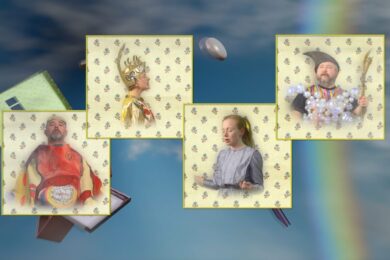

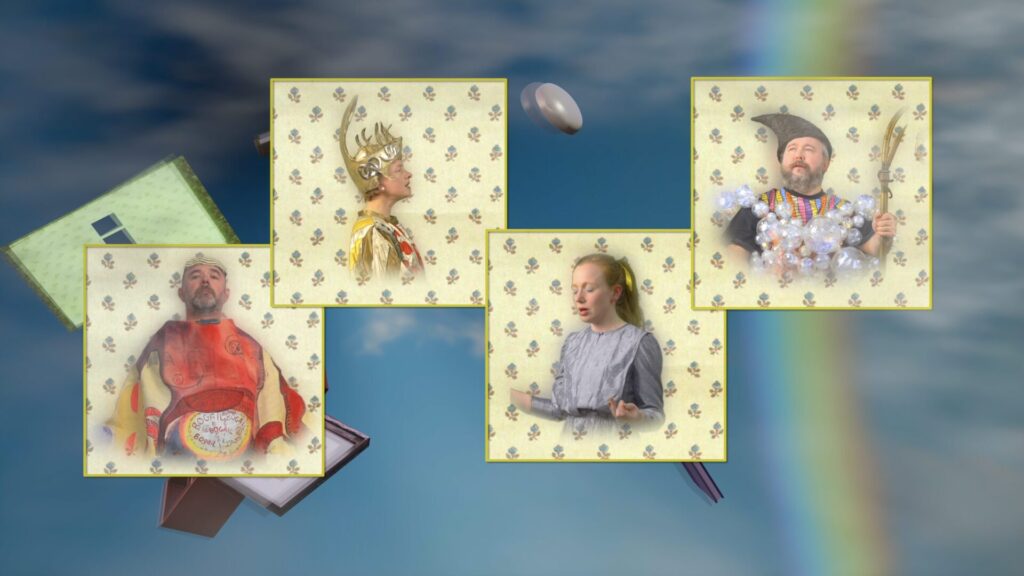
Hen Ogledd’s Discombobulated is in the radical mould of music that tackles the now. Unconcerned that references may go out of date, the timelessness of their sound comes in documenting the present, rather than in seeking to transcend (or ignore) it. Lyrically, Discombobulated celebrates dissent with all the force of the protest tradition in folk music; musically, the album glues together sounds and genres to evoke the chaos of today.
Hen Ogledd is the project of Dawn Bothwell, Rhodri Davies, Richard Dawson and Sally Pilkington. The first releases were just Dawson and Davies; since then, with the addition of Bothwell for 2016’s Bronze and then Pilkington on 2018’s Mogic, Hen Ogledd have grown both more complete and more porous. Complete, because the quartet clearly balance each other out: lyrics might be fraught while the music is calmer, or memorable hooks will find themselves squished within a slippery improvisation. Porous, because the musicians, family members and non-humans that contribute their sounds to Hen Ogledd expand with each record.
The multiple styles and masses of guest appearances on Discombobulated could have produced a scrambled blob, but instead the community around the core band members adds clarity and strength. Notably, there are several children featured here. It even opens with one: young ‘Nell’s Prologue’, a girl wondering at the mix of nature and human invention around her. It’s hard to get children’s vocals on an adult record without a cloying aftertaste, but Nell’s tale, accompanied by sounds that recall Angelo Badalamenti’s work for David Lynch, stays the right side of winsome.
‘Scales Will Fall’, which follows, feels like the album’s distilled manifesto. Dawn Bothwell’s words only take up the first half of this track, but what fire they breathe. She raps of the feudalism and hierarchies of greed that weigh down these islands, while celebrating those who challenge it – especially history’s insurgent women. Those at Greenham Common; the families of Durham miners, whose emotional tenacity and practical support enabled the striking men to sustain their protests during the 1980s; and the women of Armagh prison, who achieved an end to demeaning, compulsory strip-searches through their direct action. Weaved throughout are messages that uprising is coming again, as “youth lead the charge”. ‘Scales Will Fall’ completely changes the aftertaste of ‘Nell’s Prologue’, too; any lingering doubts that Nell may simply be there as a cute intro disappears, replaced by the image of the child as a rebel force, poised to protect common land and working-class rights.
There’s no hiding from the outside world in this record. Discombobulation is almost painfully insistent that you don’t stop your ears to the malign forces dividing nations across the globe. ‘Dead In A Post-Truth World’ is the best example of this. It recalls the direct instruction of The Beat’s 1980 song ‘Stand Down Margaret’; although Hen Ogledd stop short of naming their target, few British listeners will fail to guess the identity of the populist politician at its core. Yet, musically and vocally (and in contrast to ‘Scales Will Fall’), this song is placid. It evokes the folktronica of the first half of the 2000s: Tunng, The Memory Band, Four Tet’s Rounds.
As with much of the album, ‘Dead In A Post-Truth World’ alternates between English and Welsh. Elsewhere, Janne Westerlund (of Circle) expresses himself in Finnish. Regional accents are celebrated throughout. The effect is not only to highlight the diverse viewpoints of the band members and contributors. It also acts as an optimistic lodestar, a model for communities bumping along together at a time when contemporary politics seems ever more about carving us into smaller and smaller identity units.
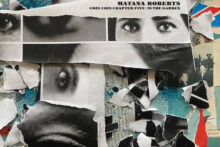
Two notable contributors to this album are Matana Roberts and Chris Watson. The presence of each is subtle, but both Roberts and Watson bring with them the gravity of their own work. Roberts, through their ongoing Coin Coin project, is creating a profound exploration of American history and narrative dislocation, while Watson’s field recordings have long given voice to everyday folk and everyday fauna. Their artistic wisdom folds into Hen Ogledd’s explorations of nature and human ritual.
Hen Ogledd have voiced discombobulation before: it was on their Mogic album, itself subtitled ‘a discombobulating pop prayer from The Old North’. Now they emphasise the disco in that word, too. ‘End Of The Rhythm’ is pulsating and groovy; a No Wave-ish celebration of dance and movement. Resistance follows when we abandon ourselves to dance, they say, kind of a free-your-ass-and-your-mind-will-follow philosophy. ‘Clear Pools’, in contrast, provides the album’s most musically tangled textures. Opening with a relentless drum solo, the rest of the near-twenty-minute runtime rebuilds from this opening passion, with its musical and natural elements slowly coalescing into healing energy. Bringing Discombobulated together is ‘Land Of The Dead’, written by Dawson and then translated into Welsh by Davies, who sings it along with his children. It forms a spare, pensive end to the album.
In ethos rather than sound, Discombobulated strangely resembles Public Enemy, notably Chuck D’s description of hip-hop as “Black America’s CNN”. It wasn’t only that Chuck D’s candid lyrics were truth bombs; his words were underscored by DJ Hank Shocklee’s sculptured sounds of the street. This same philosophy underpins what Hen Ogledd strive for here: revolutionary lyrical content embedded in irregular musical forms, where freshness carries more weight than perfection. In this, it also feels like the eighty albums Dawson and Pilkington created during lockdown (released under the name Bulbils) were a proving ground for Discombobulated’s urgency.

While the messiness of 2026 isn’t easy to depict, it’s even harder to find hope for change within its turmoil. Yet Discombobulated, despite its title, manages it. Ultimately, the album believes in the future. Although global and domestic traumas overlap one another, Hen Ogledd trust that humanity’s radicals will remain dogged, that its idealists will retain their visions, and that its musicians – in ways old and new – will be their megaphones.