
To parse the logic of Sex Mad, one must first inhabit the isolation of 1985 Victoria, British Columbia: a provincial capital where middle-class security doubled as a picturesque cemetery for the newly wed and nearly dead. Here, as the looming artifice of Expo 86 threatened to modernize the coast, the Pacific horizon acted as a literal dead-end and the Wright brothers’ basement as a laboratory. While the global hardcore scene was calcifying into a thudding caricature – The Exploited’s gurning pantomime merging with the metal-hocked bluster of the US crossover set – Rob and John Wright were busy deconstructing the very physics of the power trio.
When guitarist Andy Kerr completed the circuit, internal pressure reached a critical mass. The 1985 You Kill Me EP was the skeletal manifest, but album number two – tracked in the dying months of that same year at Keye Studios – was the industrial infrastructure itself. It arrived serrated and static-veined: punk rock stripped of its pageantry, now saturated with a terrifying, and terrifyingly derisive, muscular intelligence. The credits themselves functioned as a deadpan feint: a tactical erasure of Kerr’s identity – perversely credited as “No One Particular” – offset by the curated pomposity of drummer John Wright’s “evocative backups” (a vocal credit as silly as it was precise). This was the moment ‘jazzcore’, maybe the most wretched of portmanteaus, moved from a theoretical basement experiment to a volatile, brilliantly bastardised sound.
In an era of bloated, fret-wanking narcissism, Nomeansno began weaponising technicality into something purely utilitarian. Much like The Minutemen on Double Nickels On The Dime a year beforehand, the band reached this level of nigh-on offensive coordination. Aborting the ‘Loud-Fast-Rules’ pageant, the Wrights – raised on a diet of piano-teacher discipline and theatre-tech precision – traded subcultural uniforms for surgical aggression. Along with Kerr, they replaced punk’s standard bluster with a technicality landing like a biological mandate: high-culture rigour pulverised by blue-collar frustration. Rob, then a dishwasher at Royal Jubilee Hospital, was scrubbing industrial pans by day and reinventing the physics of the bass guitar by night. Forty years on, that frustration – all Häagen-Dazs-era Rollins and MacKaye – remains audible; the sound of a man finding his own necessity through a Precision bass and a Marshall 100-watt head.
Production – handled by the band and a young Craig Bougie – captures a bruising spatial proximity, all room-pressure and unvarnished friction. Unlike crossover peers like D.R.I. or Corrosion Of Conformity, who were drifting toward the gated-snare artifice of metal, Nomeansno tracked drums and bass live to preserve the swing. Kerr’s approach was equally recalcitrant: running a Fender Bassman through a P.A. speaker for a non-standard treble that sliced through the low-end. This technicality allowed them to navigate time signature shifts that would have seen beer bottles thrown at lesser bands; Nomeansno simply played faster so the bottles would miss. The result is a topography of paranoid friction as materially hostile, and un-eroded, as the day it was committed to reel.
The title track remains a perennial classic, anchored by John’s rare, manic lead vocal: a relentless assault that functions as an advanced lesson in cognitive and rhythmic battery. Kerr’s guitar – a raging rasp caught between D. Boon’s skeletal scratch and Bob Mould’s melodic incinerator – slices the mix with stroboscopic precision. Beneath it, Rob’s bass is a daunting, agile beast that sounds like someone owes it everything: a clanky, corrosive frequency that has come to collect the interest in marrow and refuses, point-blank, to negotiate.
Then there’s ‘Dad’. Kerr takes the lead, his voice a panicked sneer mirroring the granular horror of the family unit. To call it a domestic-abuse anthem feels a touch quaint; it’s a psychiatrist’s notebook set to a slam-pit pace, moving the punk needle away from the vague ‘system’ and toward the cluttered, private violence of the living room. The final line (“I’m seriously considering leaving home”) hits with skull-searing weight because it is so devastatingly matter-of-fact. The second of vacuum separating the track from ‘Obsessed’ acts as a beat of pure-cut, high-tension insanity. The latter remains the definitive instrumental soundtrack for a localized psychic break: a work of arachnid, chromatic groove where John’s keys and drums operate in a locked-groove unison with the bass and guitar like punk’s bizarro-world ‘YYZ’.
For those who thrive on the gear-grind of the sudden pivot, the record’s anatomical anchor is ‘Dead Bob’ (incidentally the moniker of John’s excellent current solo incarnation, with Nomeansno now retired). It arrives as an insolent, high-cadence hijacking of the meter: a controlled skid into Flipper-grade sludge that cannibalises a purposefully daft graft of ‘Sunshine Of Your Love’. In the hands of a lesser band, this would be a cheap wink; here, it’s a kind of art-school Motörhead, deconstructing a classic rock trope and forcing it through a triple-speed, math-punk meat-grinder. Much like Die Kreuzen’s ‘All White’ – a track that treats hardcore as a series of sharp, geometric fractures – ‘Dead Bob’ exists as a biological extension of its creators: a living artefact of a band whose dexterity resided well above the terrestrial norm.
The record’s second side – or ‘Slayde’, following the staccato wreckage of side one aka ‘Side Bob’ – is where the band’s subterranean impulses reach a state of calibrated compression. ‘Long Days’ is a triumph of taut, binary showboating. John Wright performs a kind of neurological sorcery, deploying precision rolls that elasticate the pocket; musicianship few could conceive, let alone execute with such fluid geometry. In this guitarless expanse, Rob descending bass motifs offer an early lesson in exacting mechanics, treating the six-string as a surplus luxury. When Rob’s gravel-flecked, almost operatic vocal drags itself to the finality of “I wasted them away”, it hits with the heavy-lidded conviction of a man who’s clocked too many hours in the Royal Jubilee scullery. The reality remains: music this flatly sovereign is the ultimate rebuttal to its own title. These were not wasted days, but the blueprinting of a language the rest of the world is still struggling to decipher.
‘Metronome’ follows as a masterwork of percussive malice, built around a definitive bass clank that hits like high-tension wire snapping against NHS-grade linoleum. By excising the guitar, Nomeansno achieve a stifling density that exposes the performative thud of standard-issue metal. Central is a suitably locked-in, spectacular drumming meter; John operates with a clockwork autonomy that feels like a physical law. As evidenced by 1991’s Live + Cuddly, for example, the track became a closed-circuit interrogation that tightened the screws on the audience, refusing the mercy of a steady 4/4 pulse until the very air in the room felt done in.
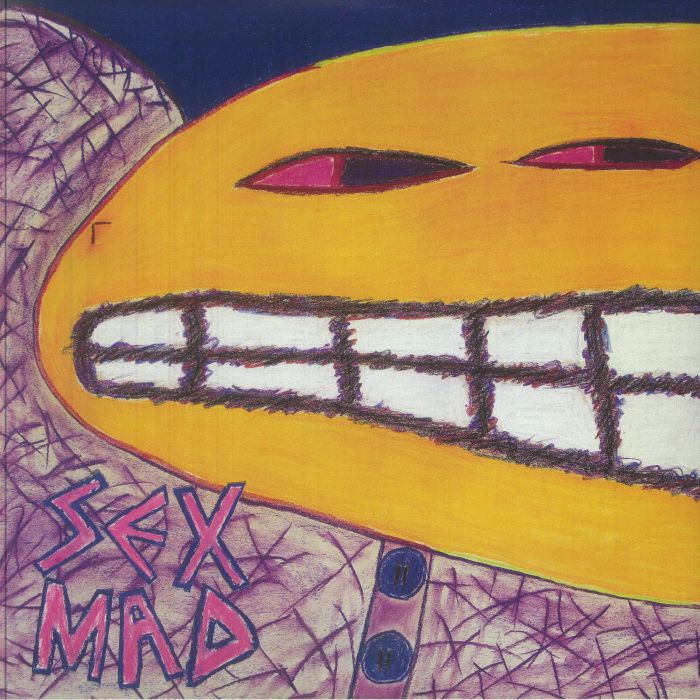
The album’s history is as schismatic as its arrangements. When Jello Biafra’s Alternative Tentacles licensed Sex Mad for the US and UK in 1987, the tracklist was shuffled and the cover art – Kerr’s visceral, abstract smear – was deemed too ‘unseen’ for polite retail: a censorship move that only served to cement their reputation for confrontational excellence. But it was on the stage where the myth truly hardened. While their own government largely looked the other way, the Dutch – bless their pragmatic, art-obsessed hearts – actually subsidised the band’s first European tour in 1986.
It was a stroke of bureaucratic genius that unleashed a calculated turbulence onto a world becoming increasingly neon and synthesised. If the neon artifice of Expo 86 was the coastal shop-front, then Nomeansno were the high-velocity friction generated in the warehouse behind it: a popular modernist weird that felt both absurd and painfully real. To the Europeans, Nomeansno offered a mangled, magnificent entity that treated stage volume as a living thing. Long before Primus turned the grotesque into a funk metal punchline, the Wrights and Kerr were filling rooms with a sound that was as much about the terrifying gaps between the notes as the impact of the hits.
Reissued by Alternative Tentacles to mark the 40th anniversary of its recording, Sex Mad remains a blitzing, logorrheic gospel. It’s the red-misted mania of Falling Down pressed to wax at five-times speed, inhaled by a high-voltage centrifugal fan and spat out as a rhythmic blunt-force instrument. Thank Christ that happened, against all the odds. This is a record forged from the ritual act of returning to the noise and re-inhabiting the body through vitriolic discipline. Not since the beamed-in provocations of early Devo had a band mapped the psychic rot of the suburbs with such forensic, scorched-earth focus.

Looking back from the far-edge of that dead-end, it’s a total clinic in pure bloody-mindedness: a seismic readout of three men from a sleepy island proving that you don’t need a sprawling metropolitan scene when you have a subterranean bunker and more chops and gristle than a butchers’ convention. Listening today, the record is the combustible blueprint for the widescreen, ballistic ferocity that would later culminate on Wrong; it is, more crucially, a technical mandate: a testament to the terminal, high-friction necessity of doing. The data does not lie.
Nomeansno’s Sex Mad is reissued by Alternative Tentacles today