

A classic album in the “post-album” age of streaming is hard to define and probably impossible to nail down. This is probably why Tim Footman regarded OK Computer as the last time an album counted as a bona fide classic – an album that reflected society and was widely discussed and celebrated in its long-form. A record that very much characterised a decade. Over a quarter of a century on, it feels like we have descended into a culture that tries to circumvent or avoid these collective moments – a culture in which we allow technology to flatten depth, reduce communal feeling and fragment shared cultural experiences – certainly in terms of music. In 2025, it was a TV show – the Netflix drama Adolescence – that seemed to have succeeded in creating a shared national experience of the kind that was more common in the era of broadcast media. Could an album have this effect now?
Two factors have combined to destroy the monster successes of the album’s imperial past. Firstly, unit sales only truly exist in the physical realm, a small fraction of the industry’s value. While the format can only generate a modest minority of industry revenues, record labels cannot afford to truly prioritise albums. The bigger problem, however, is the sheer weight of volume. Although no official number is tracked, the number of album releases has almost certainly increased year-on-year since streaming hit hypergrowth in 2015. By this measure, of course, the album is anything but dead. The problem is there are just too many for us to dwell on one long enough to make it a classic.
With stream counts nailed squarely onto individual songs (at least the first thirty seconds) and no reports of album consumption in existence, commercial metrics are all but redundant. A classic album might now simply be defined as one that is listened to a lot by many people, but we won’t know unless Spotify decides to tell us which albums made the grade. As we’ve seen, chart success is simply now the byproduct of a numbers game, with even a coveted No. 1 reduced to the status of a promotional badge.
In which case, a classic album must come down to the second measure – that of cultural impact. But this is a debate, of course. One person’s classic is another’s dud.
Only very occasionally do critical reviews, industry awards and actual consumption all line up to break an album into the wider cultural consciousness. In recent years, we might pick out Taylor Swift, Billie Eilish, Beyoncé or Kendrick Lamar as having success in this respect. It used to be that consulting a trusted media brand such as Pitchfork, Rolling Stone or the New York Times would guide us towards the best albums released in any given year. These lists would contain the same fifty records, but in a different order. But today, each list from each outlet varies massively. Each is a dizzying display of albums you have not heard by bands you do not know and will never have the time for. There really is just too much music.
Perhaps the personal perspective is more valid these days. With algorithms feeding us more highly personalised content and albums in such plentiful supply, the idea of agreeing on what makes an album stand out from the rest seems a pointless exercise. After all, music isn’t a competition. A more subtle evaluation would relate to how we personally enjoy the journey of an album and how it qualifies as something special to us. Albums that:
• take you on a listening journey through the scheduling of the songs from beginning to end, ebbing and flowing in energy across their duration;
• you would not consider listening to an individual song from, out of context from the others;
• improve with repeated listening, revealing new depths and hidden stories and sounds;
• you look forward to hearing again with excitement, but you will delay the experience until the right time and context comes around so that you can indeed focus on it;
• continually reveal the individual songs as something that rise above and become your favourite for a time, until another one takes over;
• transcend boredom, commanding you to play them over and over for years and years. If an all-time classic, you will play it through at least once a year and may return to it for repeated listens at some point in later life.
Through any of the above, we begin to form a relationship with albums in a way we cannot with songs, or with any other form of art for that matter. We think of them as friends, largely because we spend a lot of time with them and hear them frequently. As Travis Elborough writes in The Long-Player Goodbye:
“Who hasn’t thought of songs on a particular album as a set of companions, at some time or other? And LPs can be rather like friends. We fall out with them. We grow up and move on. We lose contact and find new ones. And then, years on, renew our acquaintance, only then remembering why we fell for them in the first place.”
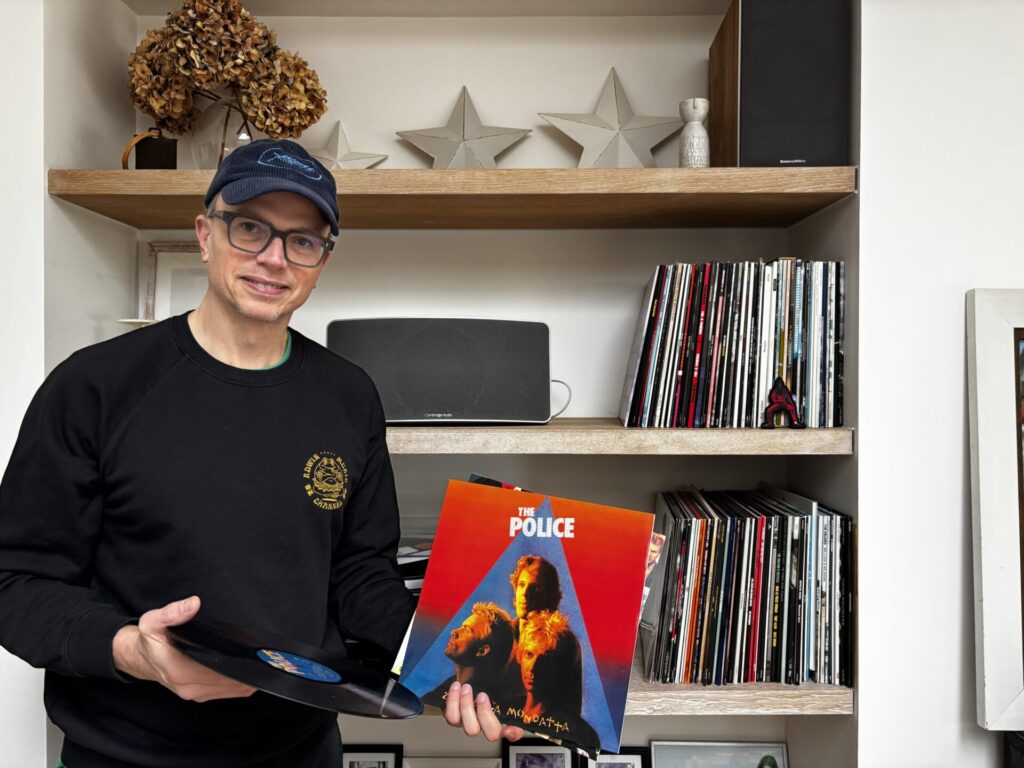
I certainly have this relationship with any number of albums, often from my formative years: Zenyatta Mondatta by The Police, Bad Reputation by Thin Lizzy, Skylarking by XTC, Scoundrel Days by A-ha. In the case of Zenyatta Mondatta, my original acquaintance was such a powerful experience that the bond “between us” is exactly that of an old friendship. I discovered the album on my doorstep, on a chilly winter’s night in 1980. I heard a knock on the door and a motorbike speeding away down the street. I went down the stairs, opened the door, stuck my head out and looked around. Nothing – just cold, still air and the sound of that motorbike speeding off into the distance, two or three streets away by now. Then I looked down, and there it was on the doorstep – an LP record. The sunset burst in the background and the band’s three headshots in that distinctive blue triangle, with The Police logo set at an angle and the words “Zenyatta Mondatta” in a vaguely ‘Eastern’-looking script. Egyptian, was that the effect? Exotic for sure. What did (does) ‘Zenyatta Mondatta’ even mean? It’s one of my favourite band album covers (which is what makes the Spotify canvas for ‘Don’t Stand So Close To Me’ so cool). I took it upstairs and put it on the turntable. I was excited to hear it. Up until that point, I hadn’t spent much time with albums. I was twelve years old. Albums were like the musical equivalent of watching a live football match in real time – they took too long. But listen I did, over and over and over again.
In 2024, I bought a copy of Zenyatta Mondatta as a Christmas present to myself. I needed it in the collection. I’ve played it a dozen times and thoroughly enjoyed it. I must have heard this record two or three hundred times. It isn’t even my favourite Police album, and it certainly isn’t any of The Police’s favourite either. The common wisdom is that Zenyatta Mondatta was a rush job, containing two instrumentals and more than a few inconsequential filler tracks such as ‘Canary in a Coalmine’ and ‘Man in a Suitcase’, as well as an extended “jam” called ‘Shadows in the Rain’. But, just as our duty as loyal friends is to accept our friends as they are, flaws and all, without judgement, there isn’t a moment on that record I do not love, and despite the passing of thirty-six years, I have never got bored of it.
I’m not the only fan of this record. So too, apparently, is Joni Mitchell. Her first album of the 1980s was Wild Things Run Fast, on which her voice was gravelled with a smoking-induced husky quality, and her songwriting was both more experimental and political – and it had “big drums”. Wild Things was her eleventh studio album, the first (of five) on which she collaborated with bassist Larry Klein, whom she married that same year. Joni stated that her influences for the album included Steely Dan, Talking Heads and, in particular, The Police. She said of the latter, “The sound of the drums was one of the main calls out to me to make a more rhythmic album.” That must have been nice for Sting to hear, given that, by this time, his main complaint was of the overly complicated, showy drumming style of genius percussionist bandmate Stewart Copeland. Take that, Sting!”
If Zenyatta Mondata arrived to me from a mysterious place, it probably helped the album stay with me for life. Whether you count it as a classic or not, the story is starkly different from the way we discover albums today, i.e. they are all just there, immediately available on the day of release. And yet so few albums now reach the status of ‘a classic’ – whether by personal criteria or those defined by critics and the industry. Instead, albums arrive, a lucky few get to flirt with the charts for a week or two, then begin to fade from view. In Body of Work, I refer to this as the “evaporating album”. Recently, when talking about A$AP Rocky’s new album Don’t Be Dumb, (seven years in the making), the New Yorker expected the album to go“the way of most contemporary blockbuster albums. Here for a cup of coffee, gone before dinner.”
Of course, there are rare exceptions to the “evaporating LP”, and these, thankfully, still exist — not because of humongous marketing budgets but because they connect in the way art has a unique ability to do. This happened in 2024 by way of “Brat summer”. English singer-songwriter Charli XCX had been working her way into the consciousness of pop culture through the course of five previous albums, numerous collaborations and most notably, by the summer of 2023, some major festival appearances. But still, she was in no way a mainstream artist or household name. By the following summer, everything would change. And it was her sixth studio album, Brat, that changed it. It’s safe to say that this album, influenced by the 2000s British rave scene, hit a cultural nerve. The best thing about it is that nobody understands exactly why. This didn’t stop the theorists. Zoe Williams, writing in The Guardian, explained it: “Charli XCX’s new album, Brat, highlights how many young women currently aspire to live – dirty, hedonistic, happy and bra-less. Well, it beats journaling after a long day of pilates.”
Of course, for starters, Brat was not just good, but consistently great. According to Metacritic, which compiles scores from music critics, Brat is the highest-rated album of 2024 (and the sixteenth-highest-rated ever). The album was shortlisted for the Mercury Prize for 2024 Album of the Year, which signalled how the industry cognoscenti could rally around a pop record, sensing a reason to celebrate the format – and create some much-needed street cred for those awards in the process, perhaps? Once the album had caught on in Europe, another minor miracle happened – something increasingly rare for UK artists – Brat broke Charli XCX in America. The album was nominated for nine Grammy Awards at the 67th annual ceremony, including Album of the Year. It ended up winning in the best dance/electronic music album category instead. Brat charted (No. 3) in the USA and, as previously stated, then won a BRIT Award.
Brat is the kind of success that gives the music business an almighty lift in confidence. When these moments happen, the industry rallies round, sensing a reason to believe. Brat wasn’t a front-loaded album campaign, but a genuine surprise phenomenon, a snowball that turned into an avalanche. It didn’t even make No. 1 in the UK album chart, peaking at No. 2. But unlike those heat-seeker-missile chart albums that just need to hit No. 1 for a day, Brat didn’t stop selling. And it didn’t stop streaming, staying on the chart for months rather than weeks. Of course, a surprise success is different from an accidental one, and Brat was no accident. It was a well-crafted and meticulously detailed piece of work – in the songwriting, production and packaging – even that rough artwork was carefully thought out. If you want to succeed in the music business, it all takes work, and nobody knows that better than Charli XCX. In a TikTok post, Charli XCX addressed fans thus:
Referenced artists
Charli xcx
Charli xcx
“I’ve been thinking about BRAT long before the record coming out. I’ve sat here for two years prior, thinking about how I’m gonna communicate this record to the world[…]”
She planned it all and it worked.
Body of Work: How the Album Outplayed the Algorithm and Survived Playlist Culture by Keith Jopling is published by Repeater Books. Pre-orders are available here. The book will launch on the 12 February at Melomania, London. Keith Jopling will also be speaking at the Rock & Roll Book Club on 19 February at 21 Soho.