

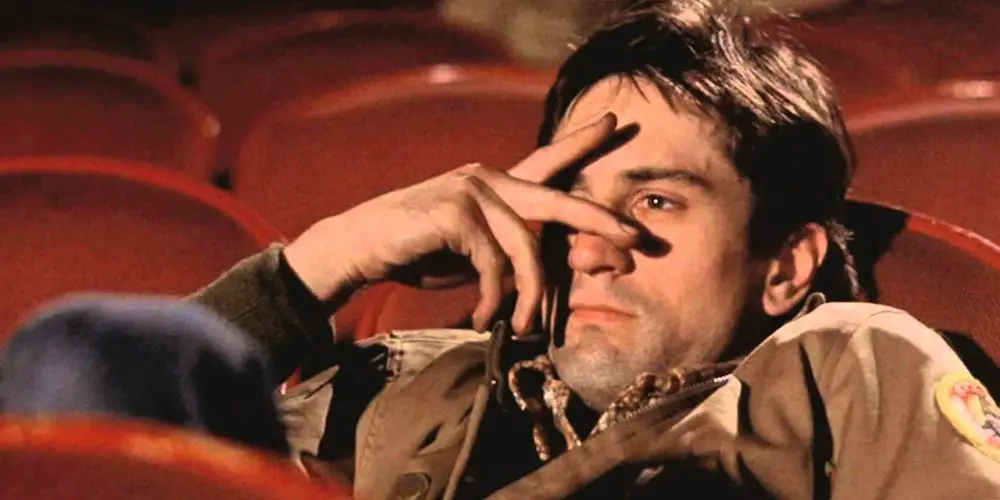
We hear a festinating beat, those sinuous nocturnal saxophones, see a belch of street steam. A ghostly yellow cab glides across the screen in slow motion. The anxious driver’s eyes are caught in a red light, then he’s off again through wet Manhattan streets, the shimmering multicoloured neon reflected in black asphalt. A nervous mood is quickly set in place. Here be monsters. Male monsters.
Twenty-six-year-old Travis Bickle, as played by Robert De Niro, craves more work. He haggles with his supervisor, admits to insomnia, is told: “There’s porno theatres for that.”
Welcome to a preposterously testosterone-fuelled world, one we might call ‘The Preposterone’. This is how director Martin Scorsese’s Taxi Driver begins, a movie celebrating its 50th anniversary this month. There’s aggression from the start: the supervisor warns Travis not to break his chops. Another driver, Wizard, is having an argument in a neighbouring office. The supervisor discovers he and Travis were in the Marines, and we presume they’ve both served in Vietnam, veterans of the carnage. There’s a captured Viet Cong flag in Travis’s hooch. He keeps a diary, is what the writer of Taxi Driver – Paul Schrader – calls “a lonely man in a room”. Schrader is the poet laureate of testosterone excess, of the Testo-Toxic.
Violence is signalled everywhere. We see cinema hoardings around Times Square advertising The Texas Chainsaw Massacre. Travis is hateful – as bile-filled as today’s far-right social media warriors – as he lists what he sees as the enemy: “Whores, skunk-pussies, buggers, queens, fairies, dopers, junkies”. He’s a racist homophobe, a frustrated incel – one of the involuntarily celibate, who rage at the world. You’re reminded of the likes of Nick Fuentes, Charlie Kirk. He’s one of those guys who love guns. He’s balls deep in The Preposterone.
Travis picks up a Jeffrey Epstein lookalike and his “beautiful little girl”. The sleazebag says she’ll get “a big tip if you do the right things”. A fire hydrant bursts, and an orgasmic wave of water hits the windscreen. Parked back at the garage Travis pops pills then cleans “the come off the back seat”. The excess of testosterone is literal. Sometimes there’s blood.
In addition to stimulants Travis drinks too much, we see him necking from a hipflask as he strolls outside those adult movie houses. His dammed-up libido is thwarted again when he tries to chat up the saleslady at one of the cinemas. The repetition of the word POP in the boxes of popcorn are a foretaste of his potential for explosion. The manager is called for: Troy, a hint of the war-like Trojan. De Niro’s face does that comical scrunched up thing it does when he asks for a packet of Jujubes. Bad juju: the fleapit hums with venality. A blurred dick shags up and down on the screen. Men sit alone jerking off. You can practically smell the place: B.O., sweat and semen. Testo-toxic.
Back in his room we see a table littered with drug containers. We’re reminded of the worries many young men have today, what Travis calls their “morbid self-attention”. Their desire to be more attractive, more muscular. Sexier. Witness the near logarithmic rise these days in the self-prescription of testosterone. Men are increasingly purchasing online, bypassing the evidence-based practice of the NHS. By needlessly supplementing themselves with testo they run the risk of polycythaemia (thicker blood), aggressive behaviours, liver damage, and testicular atrophy. Shrunken knackers: unless you’re a trans woman, who needs that?
Travis deeply wants to be normal, a person “like other people”. Here Schrader taps into contemporary notions of alienation. For a second the camera and its lonely gaze dwells on loving couples. Anticipating the likes of Tucker Carlson and other reactionary conservatives, Travis suspects true meaning in life can only occur with a wife and family. He’s agog when he sees Betsy, played by Cybill Shepherd. There’s a sly cameo here by Scorsese, ogling her beauty as she heads to work for a political candidate. Travis murmurs with the desperate desire of the incel: “They… cannot… touch… her.”
As for the male politcos, we see how they suppress their inner violence. Another helper in the cause is on the phone. Irritated, he says sarcastically: “Let’s not fight.” Betsy then robotically poeticises the candidate’s attributes. She’s like a prototype of the current Presidential press secretary, Karoline Leavitt. As if anticipating Trump’s hypertrophied world of The Preposterone, Senator Palantine is said to be “dynamic, intelligent, interesting, fresh, fascinating”. Betsy is castigated by her male colleague: “You forgot sexy.”
Today, worryingly, some young men think they must tick every one of Betsy’s boxes listed above, hence that upsurge in the profligate use of testosterone.
Taxi Driver quotes Walt Whitman: “I am the man. I suffered. I was there.” Male insecurities: those Schrader calls, “God’s lonely men”. There is data to back up the fears. Males are said to be three times more likely to be homeless or addicted; twelve times more likely to be incarcerated. One in seven young UK men are referred to as NEETS: neither in education, employment, or training. Suicide rates are a shocker.
Betsy spots Travis stalking her. Her colleague says he’ll “play the male in this relationship” and tells Travis to scarper. He drives off in a shot and then Bernard Herrmann’s maudlin sax theme recurs, what might be the most effective cinematic soundtrack to encapsulate male loneliness; a melancholic solo as good as that on Steely Dan’s ‘Deacon Blue’. Travis resembles the central character of that song, drinking whisky all night long, and dreaming of dying behind the wheel of his yellow cab. Signs for a movie called Nymphet revive the Epstein-nonce theme and soon Jodie Foster will make her entrance as Iris, an underage sex worker.
Travis makes for a diner, hangs out with his fellow drivers. Wizard makes a reappearance and calls Travis “a lady’s man” as if he’s deliberately intensifying Travis’ celibate pains. Wizard tells a story about a female passenger changing her pantyhose in the backseat. He says he jumped behind her and took his prick out, saying: “You know what this is?” Yet more ludicrous Trump-like bragging, a veritable o.d. of The Preposterone. But Wizard has a good gag on male silliness: “We call him doughboy because he’ll do anything for a buck.”
Travis, increasingly mute, doesn’t get the joke. Asked if he carries a piece, he’s then shown a bathroom tile from Errol Flynn’s house. Errol: Hollywood’s prime priapic cocksman. There’s a watermark suggesting three bathers. Yet another sign of The Preposterone, male excess.
A badge on Travis’s jacket reads ‘King Kong Company’ and there’s a picture of the giant ape wearing a helmet. King Kong, the pumped-up primate, overhyped with testosterone. Testo-toxic. Travis flexes his biceps when he says to Betsy that he’s “here to protect you”, even if he needs to get ‘organiz-ized’: a phallocentric gag. He bags a date but there’s the first inklings Travis is a “walking contradiction”. He harbours knight-like dreams of glory, redemption. But he flunks the evening by taking Betsy to see Swedish Marriage Manual, ranked ‘XXX (EXPLICIT!)’. Once again, we see The Preposterone at work. He says: “This is a movie that a lot of couples come to.”
Which is not a winning line on a date. Travis gets abusive, physical, and grabs her arm, but Betsy breaks free. She’s gone. Travis the incel, thinking women “cold and distant”, now rejected. Travis pulls self-defence stances he’s learned in the Marines. And then, uh oh, there’s the infamous scene where Scorsese himself plays a demented cuckold determined on revenge. Here we have the ultimate in what we might christen Cultural Testotoxicity, those lines of his about what a .44 Magnum pistol “can do to a woman’s pussy”. Impossible not to be reminded of Trump and his disgusting misogyny, his “grabbing”.
Referenced artists
Bernard Herrmann
Electric Dreams: Why There’s More To Synths Than The Keyboard
Paul Schrader
Sex and Pathology: 80 Years Of Cat People

Robert De Niro
Vinyl Staircase: July In Record Collecting Misery By John Doran
Harvey Keitel
Who Paints These Houses? On Harvey Keitel And Martin Scorsese
Travis could be a younger punkier nephew to Jake LaMotta in Scorsese and Schrader’s later project, Raging Bull. He’s a Mount Etna of a man about to erupt. He’s got “some bad ideas” in his head. Travis could be one of Stephen Sondheim’s Assassins, a John Wilkes Booth or a Lee Harvey Oswald. Wizard’s advice to Travis as incel? “Get laid.” As for Presidential candidate Palantine – his patter isn’t much better. Palantine hits us with Trumpian sexualised metaphors about his support. How it has seen “a rise to an unprecedented swell”.
Another toxic nutter on the streets screams he’s going to ‘kill that fucking bitch’. Travis then meets Easy Andy who sells him guns (‘little honey’s’) and offers him a deal on drugs: “Crystal meth? Nitrous oxide?” His equivalent today would probably add various preparations of testosterone. Travis then intensifies his exercise regime. Press-ups, pull-ups, weights. He’s getting into shape like some of today’s testo abusers. Watching those sex movies, Travis is getting harder and harder, he’s throbbing with violence: “Here is a man who would not take it anymore.”
Enter Iris and her pimp, a nonce and ponce called Sport (Harvey Keitel). Yet more male drunks tussle on the street. The scenes with 12-year-old Foster are profoundly disturbing. Despite the most exposing of them being shot by her sister Connie – who was seven years her senior – as body double, they still raise serious questions about the ethics of using child actors in such a manner. Foster herself has expressed recent disquiet about her life as an actor, some of her earlier, non-Taxi Driver roles. Travis, in Arthurian knight mode, wants to help her, rescue her from exploitation, abuse. He’s a character in the mode of Dante, trying to save Beatrice from the inferno. The final scenes are as cathartic as any in the history of cinema. Herrmann’s harps trill, mallets thump, menacing timpani, and threatening cellos ramp up the sense of catastrophe. There will be (more) blood.
Taxi Driver was prophetic, its contemporary relevance remains assured, its diagnoses of male insecurities and their psychopathology repeatedly confirmed through time. The key to its success is that many men who watch the film identify with Travis at some point in their lives, his frustrations mirror theirs, his desire to be good, to be a mensch, in a poisoned world. Saul Bellow was reported to have asked on his deathbed: “Was I a man or was I a jerk?” A man, a mensch. Like most men – like Travis – Bellow was a bit of both. Taxi Driver ends with Travis in his cab reunited, temporarily, with Betsy. She’s the eternal feminine of cliché: reserved, mysterious, an all-knowing Helen of Troy. Chivalrously, he doesn’t take her fare and they part forever. And then there’s that final glance of his in the rear mirror: feral, paranoid. He’ll never recover. We might blame that sometimes-preposterous hormone, testosterone. Cue Herrmann’s muted noir trumpets and a final saxophone lick that spirals like an evanescent wisp of cigar smoke drifting into infinity.