

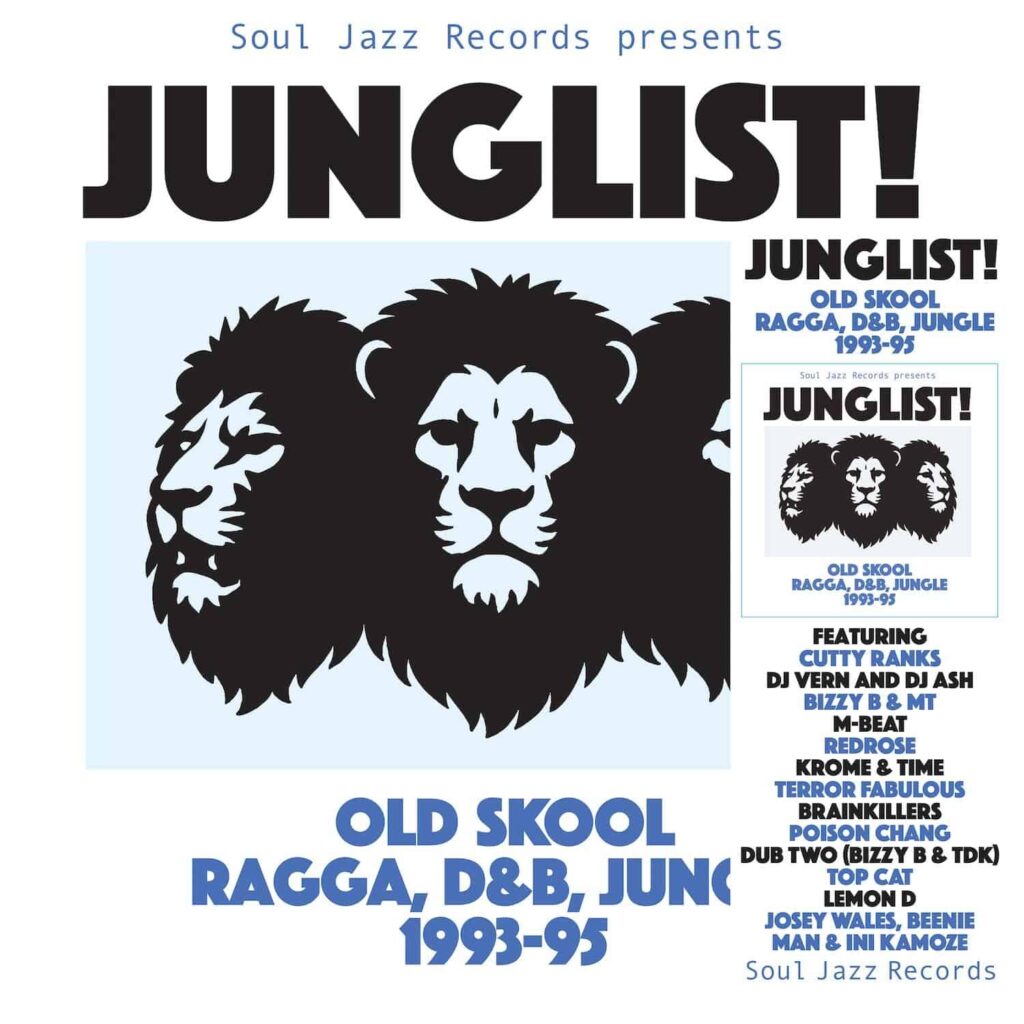
To create jungle music a cultural melting pot was needed: one with a taste for rave, but also one that could harness Jamaican flavours. Flavours like reggae and more contemporary off-shoot, dancehall, which spawned its own digital offspring, ragga; all of which are all present here. The other parts, for the record (pun intended) are elements of hardcore rave, Belgian nu beat, Detroit techno, hip hop breakbeats and of course the almighty Amen break from American soul group The Winstons’ ‘Amen Brother’, which even people who hate the genre can’t help but recognise. All elements unified by Cubase software on the then new Atari ST computers and the time stretching techniques that contemporary Akai samplers were capable of. Thus a new world was born.
This complex yet delicious musical recipe is presented on this Sounds Of The Universe compilation, Junglist! Old Skool Ragga, D&B, Jungle 1993-95. It is also explained very clearly by label boss Paul Ibiza and record shop owner Mike De Underground in director Rachel Seely’s seminal 1994 Channel 4 documentary ‘All Junglists: A London Somet’ing Dis’. I first sat spellbound in front of it in my parents’ Essex living room, seeing a technicolour world of raves, record shops, big bassy sounds and upfront Black music culture. This was pure manna from heaven to me, a bored British Asian teenager who knew there had to be more to life than the indie drivel popular at my private school. I had a nascent interest in hip hop and dance music already, but this new music – already deemed too ‘gangsta’ at my school, a covertly racist code for ‘too Black’ – was especially attractive as it was a British innovation that built on both. And when I watched the opening scene of MC Five-O toasting “Jungle: it’s not a Black thing, it’s not a white thing, it’s a music thing, a vibes thing and it definitely haffi run t’ings!” I knew I was home. That documentary was the first thing I thought of when listening to this compilation, because while the medium is different, that fresh underground attitude is defiantly the same on this record as it is on that film.
Now to return to Paul Ibiza, he’s got a short crop here instead of dreadlocks, so I’ll give my now-middle-aged self some credit. His label Ibiza Records is cited as vital to the rise of jungle by DJs Mickey Finn and AWOL’s Darren Jay, alongside the more widely acknowledged Reinforced Records. Michael Aymer, billed here as Mike De Underground, also drops vital knowledge about the genre’s mixed-up roots. He was one of the co-owners of Forest Gate’s De Underground Records, which from 1991 to 1996 was a jungle scene hub and helped popularize the kind of tunes on this compilation. The co-owners were his brother, Peter Aymer aka DJ Cool Hand Flex, Desmond Fearon aka the producer Uncle 22 and the late, great DJ Randall, which is a testament to how deep this shop used to roll. The De Underground site now even has a blue plaque dedicated to its importance to UK bass music history.
This mish-mash of influences that became jungle are present from the first track here as M Beat’s ‘Surrender’ blasts off into outer space with the opening of the Laurie Johnson Orchestra’s ‘The New Avengers Theme’, which rapidly cuts into dancehall artist Terror Fabulous’ ‘No Retreat No Surrender’, and mixes effortlessly into Kenny Knots’ ‘Watch How The People Dancing’ for a few seconds of sweet, sweet reggae, before ramming in an Amen backbreaker and some pure rave synth and then just mixes the pot until done. Later on in the mix, M-Beat’s ‘Rumble’ showcases his love of rapid cuts, as the inimitable sound of ragga-era Buju Banton thunders out over some very ravey keys, only to share sonic real estate with parts of Bagga Worries’ ‘Ride De Punnany’ and ‘The Badman Is Robbin’ by UK hip hop heroes, Hijack. Not for nothing is M-Beat a jungle legend.
But if you want pure Amen fury – and you presumably do or you wouldn’t be listening to a jungle compilation – you’ve gotta check Dub Two (aka Bizzy B and TDK) and their cut ‘Big Things’ for some truly hair-raising breakbeat antics. Originally a white-label only release back in 95, it still sounds very pleasingly of its time with a lovely ambient opening before bussing out into breakbeat fury only to mix the two together with real skill. Only serious bass-faces need apply.
Now those looking for a stronger Jamaican flavour will appreciate DJ Rap’s remix of the late Poison Chang’s ‘Love The Woman’. Chang was a Spanish Town-born Jamaican MC who met an untimely end in NYC in 1998 and this gruff yet soulful vocal shows what an immense waste that was – he is survived by his son, the MC, Stylo G. Sad history aside, the time-stretching of Chang’s vocal is in full-effect here as Rap incorporates a bouncy baseline with trademark skill. The track was originally released by Jungle Fashion, an off-shoot of Fashion Records, a British reggae label founded in 1980. Fashion was one of the first reggae labels to get jungle artists in to remix their roster. Remix officially, that is – as opposed to the early trend for jungle tracks featuring unauthorised reggae samples – which these new remixes would become ‘payment’ for in effect. Indeed Paul Ibiza mentions early in the All Junglists documentary that one of the things that drove him in the direction of “the reggae influence” was the amount of his dad’s vinyl he could access. This will obviously have been the case for many of the original jungle producers, as they were from similar West Indian backgrounds. Not that I’m alleging any of them have anything but the highest respect for music copyright laws, of course.
Finally though, it seems fitting to appreciate Lemon D’s spiritual and thoroughly rinsing ‘Jah Love’. Probably the track here that most anticipates the later popularity of drum & bass with its more spacey vibe, it’s still got the bass-weight and the reggae samples you want from a jungle track. The spiritual feel that this tune harnesses can’t help but make me think of Kenny Ken, still a young man in 1994, talking about what jungle means to him and what it meant to the wider community. “Certain man a few years ago, they wouldn’t dream of talking to a white person. And the same the other way around. But now we’re all under one roof raving.” He says this to the camera and thus directly to the viewer of A London Somet’ing Dis as an Amen break crests. This quote was so influential that Jamie XX even made a track inspired by it, but for me it will always remind me of this time, this music and this documentary. And of my teenage frustrations; of waiting for my life to start and of being hungry for experience.
Junglist! Old Skool Ragga, D&B, Jungle: 1993-95 is out today