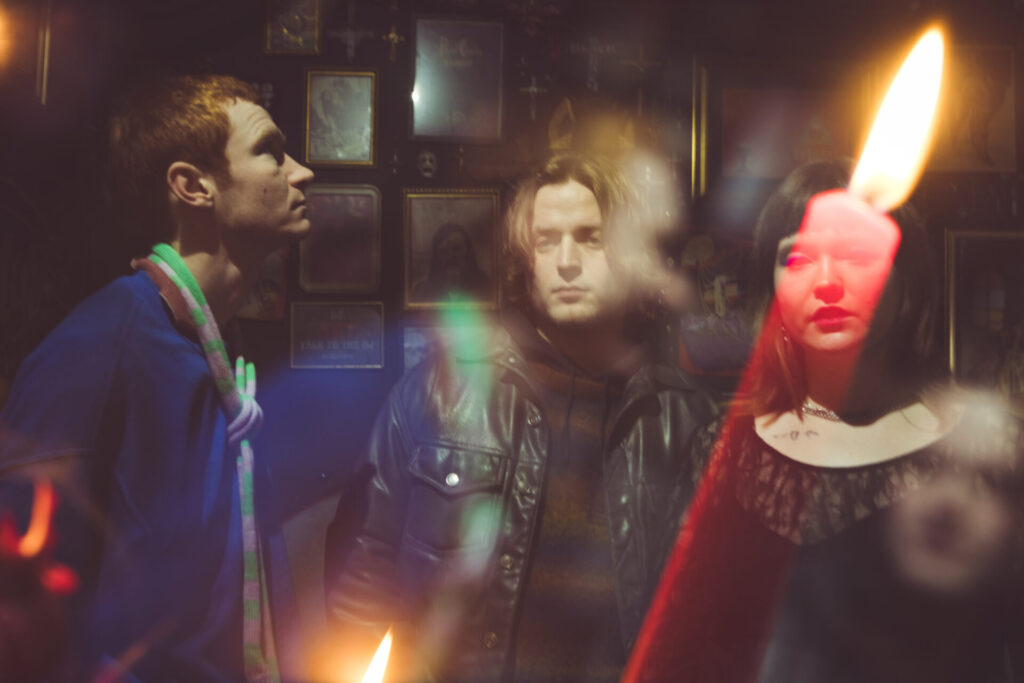
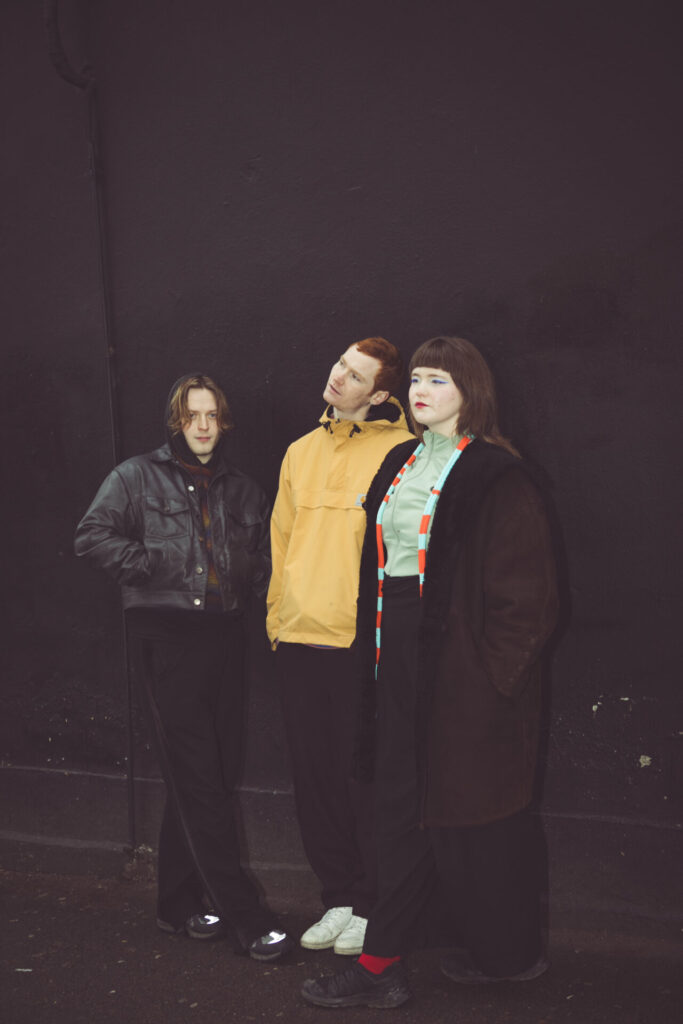
London trio PVA make music that sits somewhere between electronic pop, post punk, and sound art, driven as much by the physicality of their performance as any genre allegiance. Made up of vocalist and synth player Ella Harris, producer and multi-instrumentalist Josh Baxter, and drummer Louis Satchell, the band have spent the last eight years steadily building a practice rooted in collaboration, rhythm, and live intensity. Their second album, No More Like This, released this week, marks a decisive step forward for the trio.
Where their debut album Blush deliberately blended the musical conventions of IDM and post punk, No More Like This deconstructs convention altogether, whilst maintaining a tough new pop centre. The primacy of the human voice and singer-songwriterly conventions now take a back seat to cinematic and literary-influenced collage. This music is still recognisably PVA, but less concerned with surface cool and night fever, more willing to sit with vulnerability, ambiguity, and emotional density.
Exactly what that new process represents, however, is not something the band feel entirely certain about yet. Rather than rushing to define it, they’ve chosen to sit with the uncertainty and explore it using an older symbolic technology. Which is why, on a freezing cold January morning, we find ourselves standing outside a shuttered shop in Hackney marked The Moon Temple – locked out after an attempted break-in during the previous night – waiting for access and for answers. We seek refuge in Helgi’s Bar, a friendly heavy metal oasis, a few doors up the road.
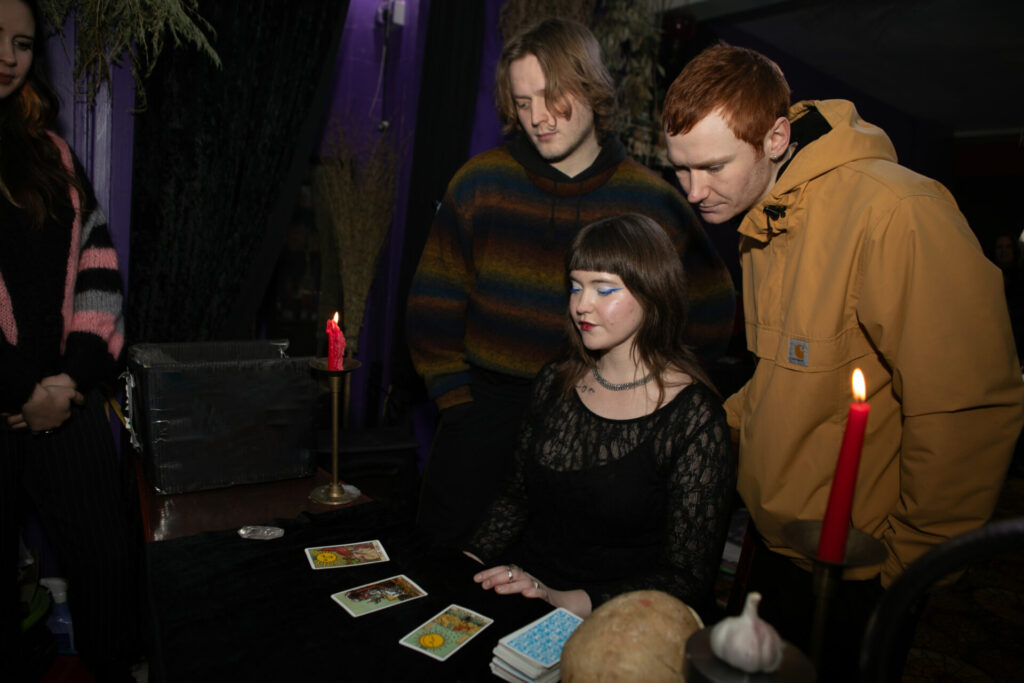
Tarot is a deck of illustrated cards that began as a late medieval card game and gradually developed into a symbolic system for storytelling and interpretation. From the nineteenth century onward it became closely associated with divination through the influence of the Victorian occult revival, which codified its imagery and meanings. Today, tarot is more often used as a reflective and psychological tool, helping people think through experiences, patterns, and personal narratives rather than predict fixed futures. We get word that things are auguring well for our feature over at The Moon Temple – the shutters have finally lifted and PVA are free to have their tarot read.
Reading for the band today is Francesca Way, an artist, filmmaker, and occult practitioner whose approach is conversational rather than hierarchical. She has been reading tarot for over a decade; and while the practice has been part of her life since childhood – “being around it as a child instilled a deep sense of curiosity early on” – in her early twenties she was gifted her first deck by a friend, and from there the practice “developed naturally”. Her sessions emphasise clarity, attention, and alignment over instruction, treating divination as a zone in which people can think rather than a system that tells people what to do. As she puts it, tarot is “a language” that people of many, many generations before us have used: “It helps us to relate to one another because it uses metaphors and symbols that we can all relate to. There’s a sense of comfort in recognising that people before us and others today, have similar experiences.”
In that sense, tarot operates much like art, music, or literature: not simply or solely as an amusement, but as a potential method for relating to the world and giving form to concepts that often sit just below conscious articulation.
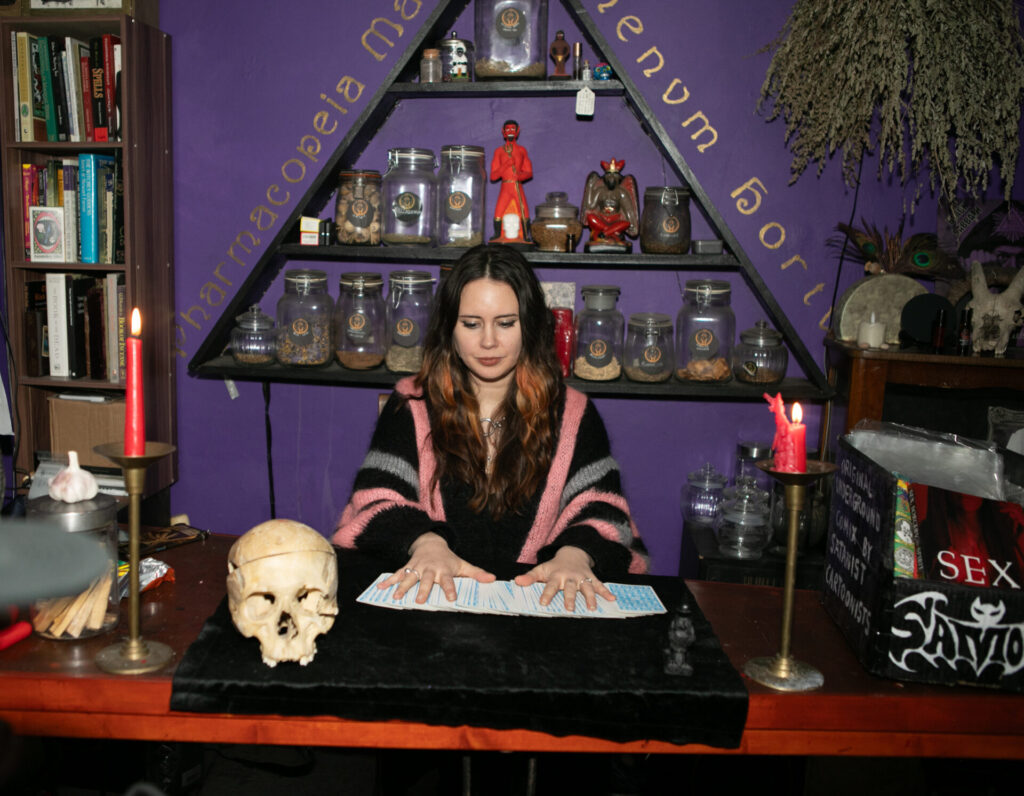
A few of PVA’s friends – including their driver on a previous tour – have an interest in tarot, and it’s clearly not their first rodeo, although I get the impression that this is the their first structured reading together, as a band. As a unit they already understand their art-making as a process of discovery and a means to work with and develop a symbolic language, so using the tarot as a means of freeing up clearer insight and deep diving further into such ideas seems appropriate. PVA already talk about the importance of symbolism and world-building in their creative process: so hopefully this will be something of an extension of that idea.
Just before her reading Ella Harris reveals how the process of developing symbolic language can produce a kernel around which a song can be formed: “You can create these little stories – and the worlds the stories exist in – that are maybe things that happened to you or feel like they could happen to you; things that you half remember. And through that process, the stories leave you and become a part of a collective unconscious; and then people have their own interpretation of it. It is influenced by other people’s stories and it influences other people’s stories. I love that. It’s called sublimation – when the story goes from in to out – and I think that’s really cool; I love it so much.”
Josh Baxter says that the singer has a way of creating images that are “super bizarre” while still making sense: “I don’t understand it, but I feel it.” He addresses her directly: “I don’t know exactly what you’re saying, but I ‘get’ the image and the vibe.” And then he adds, generally: “It makes sense, but at the same time, there is a sense of, ‘What is she talking about!?’“
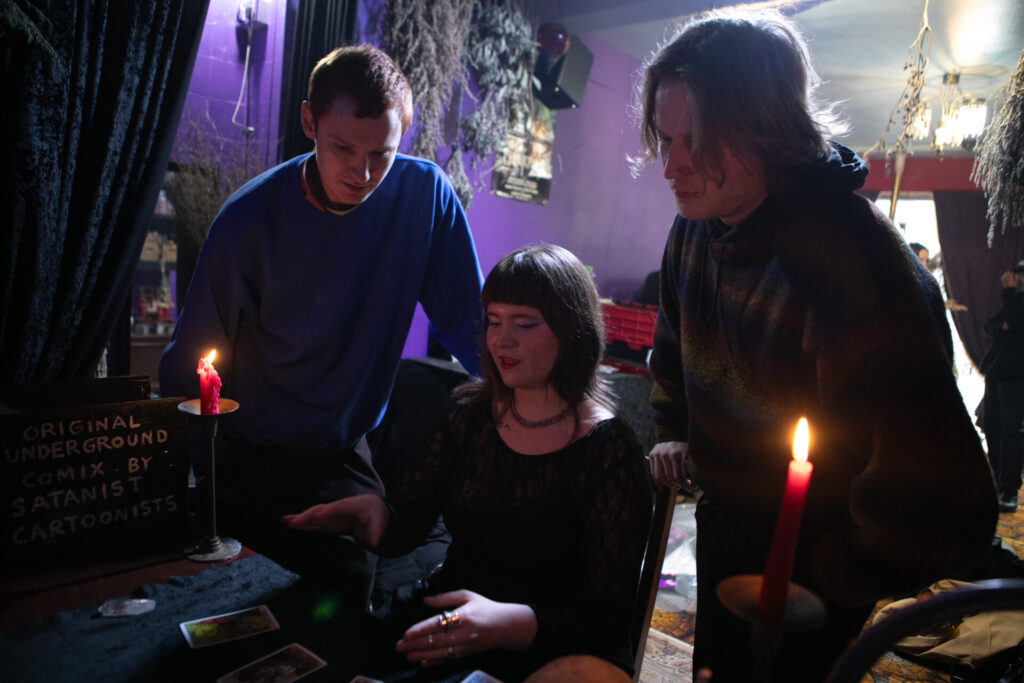
During Harris’ tarot reading – a three-card spread mapping past, present, and future – the card that represents the past depicts a bound and blindfolded figure encircled by upright swords. Francesca Way interprets its symbolism as a tension between potential abundance and restriction: the number eight suggests possibility and reward, while distant water hints at opportunity held at bay by danger and rigidity. The singer makes a link between this and the period of early excitement around making their debut album, a time shaped by a more commercially oriented environment and rigid process that they would later evolve from.
Way says that she doesn’t want to spend too long dwelling on the past but offers that the reading feels as if there was a sense of the band originally holding themselves back, trying to protect themselves, scared to experiment, and to step out of their then current paradigm: “It could be just because it was new to you […] There was a desire to explore new ideas, but you were stuck […] It’s interesting because eight cards are usually about blessings and abundance from the universe. With the swords here though, we’re coming inward. It’s more of a restriction.”
Harris says that she loves how the figure is being bound and blindfolded, and says that the feeling of restriction “really resonates” but she also draws attention to the water depicted at the bottom of the card.
Way tells her that water usually indicates a desire for abundance and for purification but that the weapons add a sense of jeopardy: “Because swords are sharp, they could genuinely hurt you, so this was like tipping your toe into the water. But then, ‘I’m bound. I’m scared.’”
In conversation before the readings, Harris had spoken about the band’s growing interest in mapping the phonetics of language onto rhythm and performance. She described the dynamic feedback loop between the lyric writing process and many aspects of their live performance, saying that the band are aware of how her body “jerks to the sibilance of the words”. She adds: “I find myself moving with the consonants. I’ve created this sort of dance that’s just fully flow state subconscious. The body jerking to the words.” She says that the way “the words provoke movement” is not accidental and it is something they will refine and refine. On the upcoming tour, they reveal, the synchronicity of certain words with “particular snare hits and key sounds” will be more choreographed, creating an occult pattern sparkling across several dimensions. But then the same concern surfaced not long afterwards, in the reading itself, refracted through the cards’ symbolism.
As Way speaks, an odd synchronicity is created with the singer’s synergistic ideas about her stage practice: “Your performance is an earthbound thing, and the body becomes a vessel to express what’s going on in your mind. This is an ancestral card that asks, ‘How can I make my work practical enough so that it serves me, but it also serves the traditions of those before me that have sentimental value for me?’ There’s alchemy here too because your performance must resonate with you and your nervous system so that you can create in a way that is of service to future generations. The bringing of a community together. It feels like the work you’re doing is resonating with people, and creating a space for them to come together.”
Reinterpreting the same card on a broader level, Way shifts the focus from the band’s internal process to how their work is experienced by other people. Collaboration with other artists, she suggests, for example, works best when it operates as a shared space rather than a hierarchy, where others are treated as equals rather than featured additions. As the reading continues, she interprets the present symbolism as being less about the musicians themselves as being dispersed across the entire project as a whole, connecting process, collaboration, and audience experience.
But if Harris’ reading is about community, continuity, and shared authorship, the picture shifts when it comes to the cards drawn by Josh Baxter with a reading that turns toward decision-making, learning, and authorship, reflecting his evolving role not just as a performer, but as a producer shaping the conditions under which the work comes into being. As he says bluntly: “Swords is a common theme in all my readings.”
As the band’s multi-instrumentalist and, increasingly, its producer, he has been deepening his studio craft, moving from work as a live sound engineer into freelance music production. The shift feels significant given that the band’s previous album emerged within a more restrictive framework. This time, alongside producer Kwake Bass, he developed his own voice alongside the band’s evolving sound. Against that backdrop, the reading describes a life path that already feels visible, before asking what remains unseen. What, if anything, lies behind the veil?
In her interpretation of the sequence of cards and their symbolism, Way treats the question as one of awareness and intention rather than destiny. This is no seaside pier amusement offering to divine the exact course of the future. One of his cards is the Page of Swords, concerning learning, curiosity, and unfinished mastery. Way frames it in straightforward terms: “Tarot in general, is also about mental clarity.” She is describing a mind still sharpening some of its toolkit. She suggests that this describes someone who is quick to grasp ideas and eager to act on them… sometimes before certainty has fully settled. Baxter recognises this immediately, describing a phase of refining skills and watching how learning feeds back into his work as both musician and producer. The cards suggest an instinct to leap into new situations to test the waters, a trait that shapes how he navigates work and life without strict separation.
With the Ten of Pentacles appearing, the focus turns outward. Way frames the card around legacy and community, observing, “As long as we’re on our path, it’s all blessings.” Baxter echoes this perspective, saying, “Music is a kind of service to people,” positioning his work as something offered rather than owned. The reading closes with The Lovers, pointing toward a year shaped by alignment and trust, where personal life, creative work, and production practice begin moving in the same direction, not competing for space.
Finally, Louis Satchell sits down for his reading while at something of a point of transition in his life. In parallel to the band, he has just begun to teach drums, adding a new practical strand to a life already structured around music. The question isn’t existential so much as logistical: should he commit fully to what’s already taking shape or keep space open for further possibilities. Way frames the moment as one of momentum, the cards represent to the drummer that forward motion, not over-planning, will generate clarity.
Talking with the band after the readings, their measured and positive responses resist closure. Rather than treating the interpretations they have as fixed, they approach the experience as provisional prompts, open to revision and interpretation. That openness mirrors the intent behind No More Like This: each member attempts to bring their own sensibility to the project while trying to allow space for what emerges between them. It’s precisely in that shared, uncertain territory, between archetype and intuition, taste and instinct, that PVA wish their work to take shape, driven by a collective intelligence and an ensemble dynamic, part ritual, part organic machine to be further reimagined when shared out to the world.
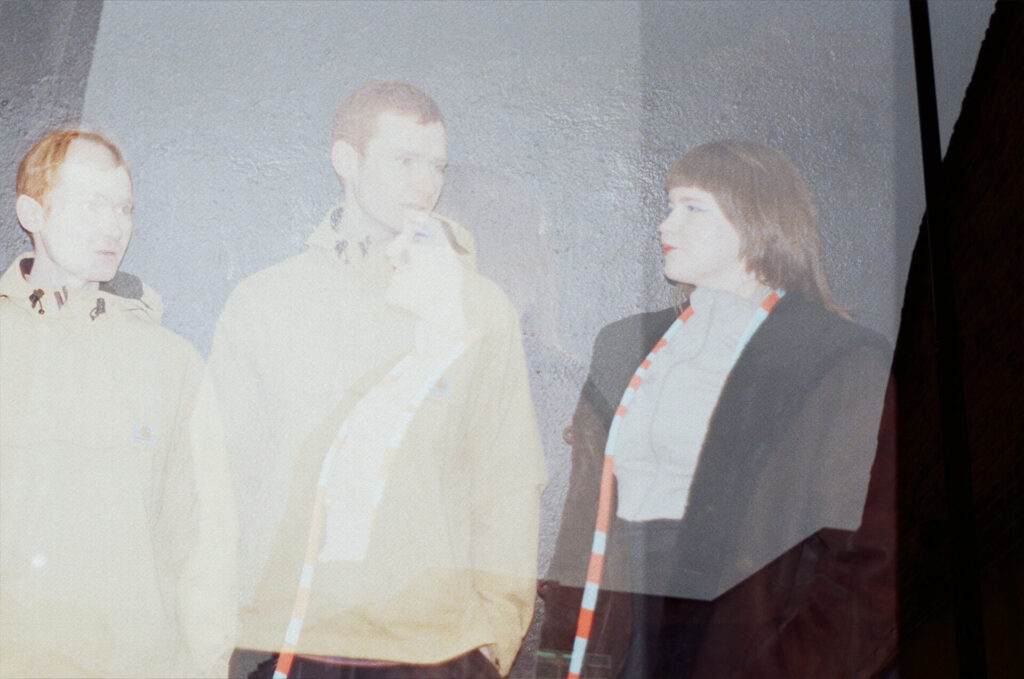
During the day we spend together, the band return repeatedly to the idea of parameters in their creative process: how working within limits can open up discovery rather than shut it down. Mythology and folklore reappear not as rigid narratives, but as flexible reference points for thinking through contemporary, lived experience.
Satchell refers to the parameters between two points and says: “The unconscious comes into play because rather than the [space between the] parameters being infinite, you end up in a more closed space. Earlier, when listening to our first demos for the new album, it just struck me they were like these pillars.”
Baxter adds: “There are ancient stories, religious texts and folk stories, and they are all ways for us to explain emotional, social entanglements. Fairy tales might seem esoteric but have a truth behind them because they’ve been developed verbally over hundreds of generations to reach this point in time.”
Referenced artists

Octavia Butler
Your Head It Simply Swirls: The Otolith Group in Dublin
On top of myth, religion and folklore they are also keen to discuss science fiction and fantasy, referencing writers such as Ursula K. Le Guin and Octavia E. Butler as examples of how canonical forms can be taken apart, queered, and reimagined; and how ideas such as xenofeminism and cyberfeminism utilise productive tension between the conservatism of genre convention, established folk forms, and the dynamic force of experimentation and deconstruction.
No More Like This, with its influences drawn from trip hop, jazz, and sound art within a pop framework, plays with archetypes, symbols, and convention on multiple levels at once and that’s where the band see the connection to folklore and mythology. Satchell says: “We’re playing with this idea that a lot of mythologies are based around the idea of predetermined fate, that the protagonist is going to succumb to. So, the album title No More Like This, asks, ‘How are we going to break those predetermined fates? Do I need all of these obstacles in my way?’ Today we’ve all been dealt really uplifting cards, powerful cards. So the question becomes a statement: ‘I don’t need to present myself with all of these obstacles all of the time. I’m just gonna allow myself to be passive sometimes.’ I’m creative when I’m passive because I’m just enjoying living.”
As we prepare to leave The Moon Temple and drift off in different directions into freezing cold Hackney, the band suggest that playing with the tropes of ancient symbolism can encourage more fluid, imaginative modes of thinking, offering an antidote to the rigid logic of late capitalist life and its attendant “brain rot”. PVA are drawn to the idea of enchantment as a counterforce to the neoliberal fragmentation of individual feeling and communal sense. No More Like This, indeed.
No More Like This is out this week via It’s All For Fun; PVA tour the UK and Europe starting next month
Contact the “emporium of witchcraft and magick”, The Moon Temple, for opening hours. Francesca Way can be contacted for tarot readings via her website