

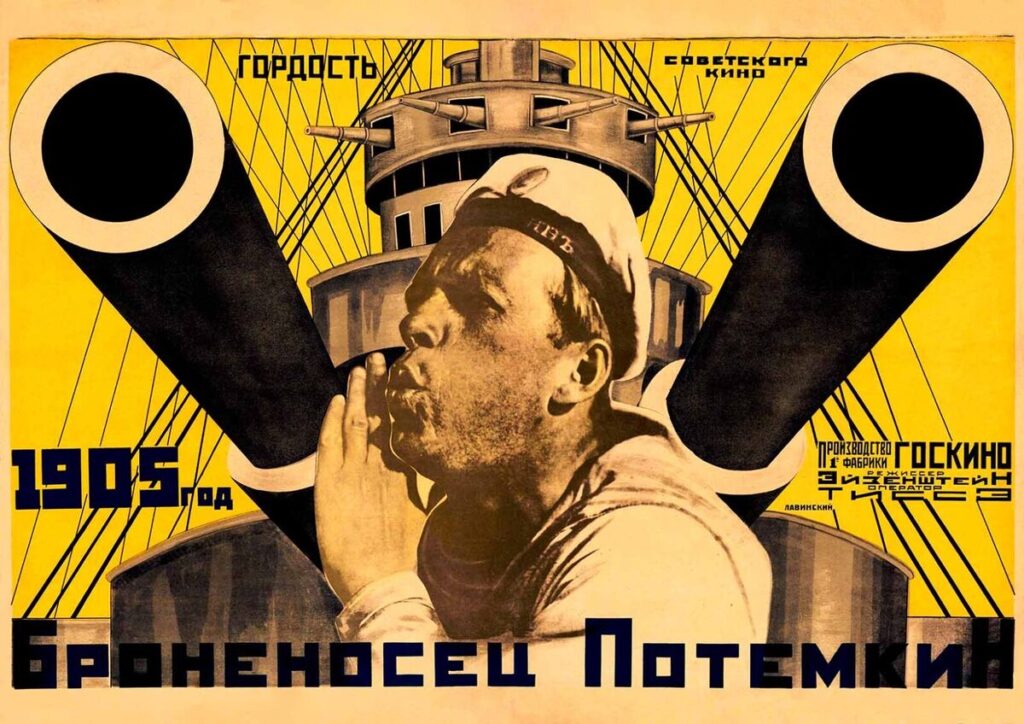
Battleship Potemkin serves as a technical landmark of the cinematic form. Its rhythmic, montage filmmaking which was directly influenced by the music of the time heralded a new era of meaning-through-editing. It is so dynamic and visually striking, that modern audiences around the world continue to be mesmerised by its set pieces.
But Eisenstein understood that what was technically progressive at one time was not guaranteed to be progressive at another. If Potemkin were to have long-lasting political power – that is, to cement the state’s idealized portrayal of the revolution that birthed it for many years hence, and justify the sacrifices made by so many through their direct action in the process – it would be down to the music which accompanied it (a word for this, ‘soundtrack’, would emerge before the end of the 1920s). Scholars have said that Eisenstein hoped the picture would be re-scored at contemporary moments long into the future to keep the movie relevant for new generations. Looking back on its long history, we can see that his hopes have come to pass.
The film has been re-soundtracked live and on record countless times over the last century. That it has been accompanied by everyone from Shostakovich, to Pet Shop Boys, to punks, improvisors and modern DIY collectives has even added to its radical value as the decades have passed. A century on Potemkin’s revolutionary politics are regularly placed in front of new audiences. It has frequently been used as a platform for experimentation where musicians are concerned. And while its propagandist tendencies are acknowledged but much less taken at face value than they once were, its universal themes of collaboration and organisation in the face of oppression are a useful vector for grassroots collectivism and DIY consciousness raising in the late capitalist age.
Potemkin had no official soundtrack initially. Beyond its early performances which featured accompaniment of some of the popular orchestral music of the day, it was the score by Edmund Meisel for its Berlin premiere that dramatically boosted the film’s popularity in Germany and prompted further screenings back in the Soviet Union. It was clear that Meisel’s sonic inventiveness – that included long stretches of propulsive repetition and a bespoke noise-maker called the Geräuschmaschine – had, according to Eisenstein, “intensified the picture” and elevated its political impact. It’s a glib but relevant part of the story, that it was the Nazis who caught on to its power early, with chief propagandist Joseph Goebbels remarking that “anyone who had no firm political conviction could become a Bolshevik after seeing the film.”
Despite Meisel’s achievements, his score was all but lost until a collection of recordings were discovered by historian Martin Reinhart in 2000. In a 2015 interview, Reinhart notes that “the Russians simply never had an interest in Meisel’s music.” By 1950, a “true” Russian soundtrack by Nikolai Kryukov was written and shortly thereafter, assorted symphonies by the celebrated Soviet composer Dmitri Shostakovich were retrofitted onto the film too. If you have seen Potemkin, you’ve likely seen it with Shostakovich’s pre-written pieces, or a version that credits a mix of his and Kryukov’s score.
For an exercise in post-production, the addition of Shostakovich’s symphonies succeeds in bringing great melodrama to the picture. Its sweeping strings are closer to what we might hear over a Hollywood film from the same era. Movements are comparatively brief and digestible – especially when taken in response to Meisel’s repetitious score. And while you can’t really argue against it being one of the more accessible of Potemkin’s accompaniments, it’s well suited to a post-Stalin world where recuts and changing attitudes were seeing the bans it had received start to be lifted, and when it would increasingly be listed alongside The Bicycle Thief and Citizen Kane as one of the greatest pictures of all time.
Here in the UK, Pet Shop Boys are perhaps responsible for the boldest attempt to present Potemkin’s radical politics to unsuspecting audiences. In the lead up to the film’s 80th anniversary, and following the band’s greatest hits release Pop Art, Neil Tennant and Chris Lowe presented their own take on the score to an audience of 25,000 in London’s Trafalgar Square. The pulsing electronics, initially sparked by leftover ideas Lowe had been working on for Pop Art, were said to represent the “collective heartbeat of the people” by Tennant. These were accentuated with the soaring orchestration of the Dresdner Sinfoniker and contemporary composer Torsten Rasch whose influences range from the choral tradition to Rammstein.
A standalone recording of this score was released in 2005 and further open-air performances in sites largely chosen for their protest history and links to class consciousness drew in crowds of thousands in the UK, Germany and Spain. The album was reissued last year to coincide with the centenary of the first ceremonial screening at the Bolshoi on December 21 1925, with screenings of a restored version of Potemkin alongside the remastered audio being shown in cinemas across the UK and Ireland.
The Pet Shop Boys’ electronic score, with its touches of orchestration and industrial styles, was a radical interpretation. But experimentation has never been far from Potemkin’s sonic ecosystem.
Eisenstein’s minimal direction for Meisel concentrated only on the final part of the film, where he instructed that “the music for this reel should be rhythm, rhythm and, before all else, rhythm.” Following his discovery of the recordings gathering dust at the Vienna Technical Museum, Reinhart noted other influences Meisel was weaving into his sonic tapestry: “Agitprop theatre, the jazz craze of the 1920s, Brecht’s speaking choirs, recitatives, and songs.” The result is a kind of Viennese mixtape – a heady brew when added to the sounds of the proto-industrial Geräuschmaschine, or the ever-ascending repetition that perfectly accompanies the Potemkin’s crew as they rally to arm the hulking ship before the film’s dramatic denouement.
Potemkin’s score has been subject to more far out and improvisatory treatment, too. Eric Allaman is accepted as the first person to conduct a fully electronic soundtrack for the picture, which was performed at the 1986 Berlin Film Festival. Ralph Records affiliates The Club Foot Orchestra have (in 2005) tackled the picture alongside many other classics of the silent film era. New York surf & roll supergroup Morricone Youth (which includes members of Pain Teens and Wilco) released their own version in 2023. And Edison Studio, the Italian electroacoustic collective, have issued an interpretation too in 2017. From acute re-orchestrations to full improvisation, if you keep looking it becomes very hard to find a musical subgenre that isn’t represented somewhere, at least in a small part, within some artist’s imagining of Potemkin’s music.
The industrial iconography of Potemkin is often mentioned by critics. From the machine-like movements of the Tsar’s soldiers, to the abundant close-ups of the pistons and weaponry on board the ship, it is unsurprising that many artists – including Meisel and Pet Shop Boys – draw on non-musical sounds to accentuate what’s happening on screen. A fully-fledged industrial re-score, with swathes of deconstructed sound and ominous drones, arrived in 2007 when Danish ex-punks Christian Rønn and Peter Schneidermann (aka Peter Peter) teamed up for a series of live performances at the Roskilde Festival. The thudding digital beats and tri-tone riffs might be one of the more incongruous accompaniments for Eisenstein’s century-old visuals, but the resulting album Panser is a key example of the timeless influence the film has had on the production of further pieces of countercultural art. The duo would go on to perform under the Panser name (panserkrydseren means ‘armoured cruiser’ in Danish) and would release a follow up record Chengdu Security in 2024.
Potemkin, free of any ur text for its score, is increasingly a decentralised open platform that invites musicians of all disciplines to bring something to it – to participate, rekindle, and recalibrate how it is experienced.
These happenings are more often occurring beyond cinemas, film festivals and concert venues. As each decade passes, we see more examples of the film being presented in alternative or underground spaces and being organised by groups who are decoupled from capitalist structures. This means more audiences and more freedom for musical experimentation. But it also recentres the themes of the picture within broader DIY and consciousness raising movements.
Several years prior to the Pet Shop Boys’ Trafalgar Square performance, veteran film critic Roger Ebert found himself at one such happening in Three Oaks, Michigan – an open-air screening of Potemkin accompanied by experimental noise trio Concrete. “Some 300 citizens settled into their folding chairs in the parking lot to have a look at it,” he writes in the Chicago Sun-Times. “It was an aggressive, insistent approach, played loud, by musicians who saw themselves as Eisenstein’s collaborators, not his meek accompanists.”
For Ebert, this performance – in such an unexpected context and with such an unexpected musical score – reawakens a love for Potemkin that he hasn’t tapped into since teaching shot-by-shot analysis at University of Chicago in the 1960s. Reminded of the political potency the film holds, he concludes: “The other night in that small-town parking lot I got a sense, a stirring, of the buried power it still contains, awaiting a call.”
Potemkin can bring didactic art into any feasible space where folks can gather and a projector can be rigged up. It can turn a carpark into a lecture hall. And in a curiously persistent twist, it’s never too far from university campuses either. It’s still a feature of Film Studies courses as much for its political perspective as its technical attributes. Even Boston’s Berklee College of Music has treated the picture as a core text for its pioneering film score program, where undergraduates study it for a full 15 weeks before playing a free live show for the public. Governments may no longer be worried about it inciting audiences to action. Its simple propaganda may appear cartoonish (as was Pauline Kael’s reading of it). But there’s something very heartening about its teachings of solidarity and comradeship – or to paraphrase Mark Fisher, that an alternative is possible – and that it can sit quite aptly in any context with these ideas at its core.

For the centenary, in my hometown of Plymouth, we had our own Potemkin happening. The Pit Orchestra – a freely evolving not for profit ensemble of both trained and untrained musicians – reclaimed a (not usually public) university space in the city for their own event and their own rewrite of the soundtrack. This came about after years of grassroots performances alongside both established films and original works by local filmmakers.
The Pit Orchestra’s approach – written with technical guidance by composer Simon Dobson – blended traditional Eastern European folk music with multifaceted choral approaches, as well as more contemporary forays into post rock and experimentation. What set it apart was its DIY spirit. Members swapped instruments and occupied that thrilling zone of playing at the edge of their abilities and just within the limitations of what can be done with 11 people on stage through a patchwork of assorted gear. Donated items and found noise-makers, including a megaphone and an old cassette deck, were incorporated into the mix. The hissing tape loop of Plymouth’s own dockyard siren emerged out of the cacophony as the credits rolled on the performance.
Approaching Potemkin with consideration of its nuances is ideal today. The underground, DIY scene is ripe for such consciousness raising and The Pit Orchestra’s event doesn’t shy away from acknowledging and critiquing the imperialist aims of Russian propaganda. What still really connected through their rescore was the celebratory fervour when it came to the mutinous sailors, the emotional outpouring of solidarity from the inhabitants of Odessa, and at the film’s close, the triumphant cooperation of the Tsarist squadron to join the Potemkin’s revolutionaries. 100 years on, Eisenstein’s idiosyncratic open source idea to invite rewrites of Potemkin’s soundtrack long into the future doesn’t mean the mythmaking of the founding of the Bolshevik state is perpetuated uncritically. But it ensures that its universal spirit of community and collective action continues to be promoted within a world that yearns for its message.
The Pit Orchestra’s Battleship Potemkin Score is available via Bandcamp