

One of the theories around pareidolia – the tendency to see recognisable forms in otherwise nebulous materials such as faces in clouds, or animal outlines in rocks – is that it bestows an evolutionary head start on those who have it. It gives the body a split-second response before any thought takes place, rather than allowing time for confirmation that there is a ravenous sabre-toothed tiger, or the last vengeful neanderthal, in the shadowy recesses of one’s cave. Approximations of faces are discernible virtually anywhere because it’s better to have false negatives than false positives. Our senses effectively work ahead of our consciousness, especially concerning danger. We are repelled by the sight of blue food or the smell of cadaverine before the mind even registers fungus or bacteria or dead bodies. Even lesser-known senses work ahead of and beyond our knowledge. “One of the most frightening things I’ve ever heard” the video game developer David Szymanski once tweeted, “is when someone pointed out that the existence of the uncanny valley implies that at some point there was an evolutionary reason to be afraid of something that looked human but wasn’t.”
Though not as immediately obvious as warning signs detected by sight, smell, taste or touch, hearing has its omens. The moment the forest turns silent. The growl of an apex predator. The whir of a plague of locusts. The fear of intruders or the poltergeist (‘rumble spirit’) that comes with the creaks of expanding and contracting furniture and floorboards at night. The same infrasonics, or ‘ghost frequencies’, employed in horror movies to create feelings of unease may be present in natural disasters. Other more audible sounds have been used in psychological warfare – the Celtic Carnyx battle horn, Aztec death whistles, Stuka “Jericho trumpets“. Then there are sounds that defy even the parameters of our fears, boundless horrors which filmmakers, editors and sound designers are adept at creating. For many years, I could not understand why David Lynch’s work disturbed me so much. Sure, there’s his exceptionally rare ability to present onscreen dreams that actually feel like you’re immersed in them, conjoining the phantasmic and trivial. Yet the fear didn’t come from the visuals, the backwards dances, the strobes, the grotesquery and kitsch. It was the sound that did it, from the siren of his first short Six Men Getting Sick (Six Times) to the unholy zenith of television that is Twin Peaks, Third Series, Part 8 (the H-bomb Threnody, the crackling ‘Gotta light?’, the slow-motion wounded animal moan of the passenger).The fear comes from the listener’s ignorance of the origin, the depths, the meaning, and how to respond when no rational consoling protective explanation can be found. Another kind of ignorance was at play too, for this viewer/listener at least. The art, complexity and genius of sound design, which I had scarcely considered beyond animation. An entire world we’d been subject to and yet I had not consciously realised was there.
On 5 December, Buried Treasure are releasing Rupert Hine’s original soundtrack to Jerzy Skolimowski’s film The Shout (1978). Best known for the novelty hit ‘The Lone Ranger’, Hine created and produced many unusual albums such as the ‘film without a screen’ Colditz Breakpoint!, Yvonne Elliman’s sitophiliac Food Of Love, Kevin Ayers’ The Confessions Of Dr. Dream And Other Stories, and Hine’s own imaginary band Thinkman. The Shout was different, but no less strange. The film is a relatively obscure supernatural psychosexual horror classic from 1978 starring Alan Bates as a malevolent visitor with mystic powers he’s acquired in the Australian Outback, who enters and overturns the lives of a placidly dissatisfied couple played by Susannah York and John Hurt. Bates’ character Crossley recounts the tale to the writer Robert Graves (played by Tim Curry), whose story the film is based upon. Leaving an infanticidal trail behind him, Crossley employs shamanic magic to seduce and obliterate, according to his whims.
The film gets under the skin for a number of reasons – a superlative cast, the director’s eye for narrative and scenic detail, the atmosphere of the Devon coast, a tightly structured and cleverly suggestive script, and a neat twist – but a large part of it is down to the understatement with which the film is handled. Even the Odyssean theme of Sirens, hinted at by the blocking of ears with wax, has a moth-like touch. Its peacefulness becomes eerie and amplifies almost any sound into a distressing intrusion or warning, even a door closing, laughter, church bells or a bird chirping. Never have the sounds of a cricket match felt so menacing. Silence itself is turned into pressure, mounting until the long-awaited shout of the title (a necessary reversal of the then-fashionable ‘it’s good to get it all out’ primal scream therapy of Janov), which somehow still catches one unprepared. A lot of this tension is down to the sound design, with the washes, noises, ambiences and builds of Hines’ soundtrack (plus music by Tony Banks and Mike Rutherford of Genesis) becoming indistinguishable from sounds like howling wind in sand dunes onscreen. At times, the speech of the characters has the same close and perturbing quality of Mark Jenkin’s much more recent and exceptional Bait. Hines created the sonic landscape to mirror the psychology of the electronic experimentalist/ foley artist character Anthony Fielding, played by John Hurt, utilising manmade tech and random objects. Fielding is an inspired dilettante dabbling with sound in a ludic way, while Crossley has mastered it. And how do we know when a force has been mastered? When it can be used to kill, of course. That is the way of civilisation, from splitting atoms to building robots.
Not all films have a foley artist (named after pioneer Jack Foley), creating sounds from scratch in post-production, but some delve into the fathomless rabbit hole of sound design and a multitude of treasures are to be found, ingeniously cobbled together or exquisitely refined. Often the sources are unlikely – a distorted leopard’s growl for ED-209 in Robocop, jelly and liver for ET’s movements, the twisting of a wallet for the head spin in The Exorcist. Occasionally, samples from foley sounds are incorporated into otherwise unrelated music; noises from the aforementioned killer robot ED-209 making it onto Aphex Twin’s ‘Green Calx’ and Burial’s ‘Pirates’. Sometimes, they go viral, even before there was an internet, as with the Wilhelm Scream.
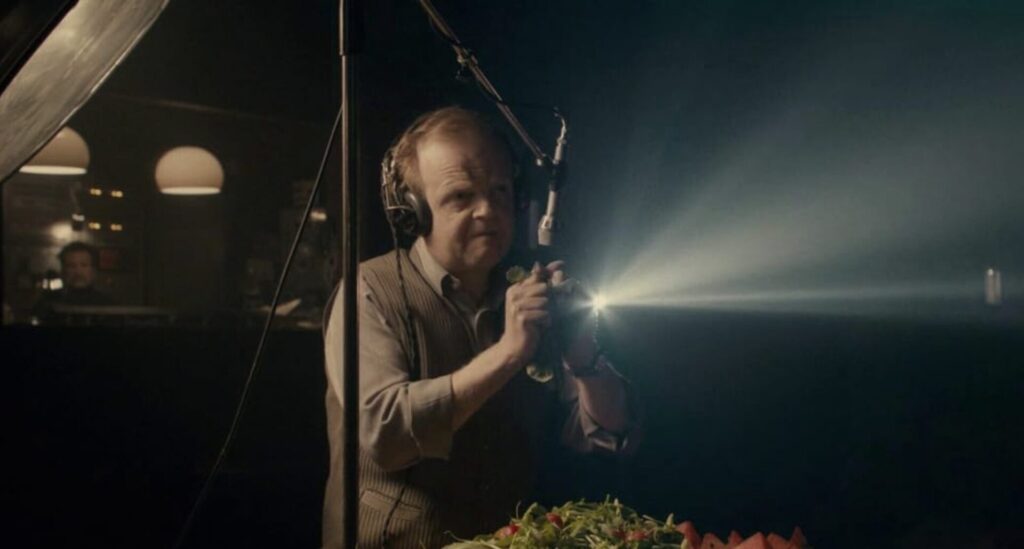
With the soundtrack for Berberian Sound Studio, the much-missed Broadcast mirrored the onscreen foley work of the lead character Gilderoy (Toby Jones) while also channelling the deep weird folk of England that had spawned ‘The Shout’ and centuries-worth of other uncanny tales. The combination of futurist synth and pagan hex, sine waves and incantations, church organs and industrial oscillations, shouldn’t work on paper but it does (recalling the strange overlap of archaic times and modern tech in ideas like Stone Tape Theory, to say nothing of skyquakes or ‘the ping’). There are almost-cameos of familiar faces – Goblin soundtracks (Gilderoy is working on a giallo slasher), Silver Apples, the BBC Radiophonic Workshop and Paul Giovanni’s perennial soundtrack for The Wicker Man – but something about the fragmentary nature of it, the mix of the pastoral, the paranormal and the paranoid, makes it feel unusually like a Shakespearean concoction, a modernist magic spell like Ophelia’s flowers or the Weird Sister’s cauldron potion electrified, with something wicked being conjured into coming or a spiralling descent like tape unwinding.
If foley work and electronic music share alchemical qualities, turning various forms of waste into gold, these films have darker Faustian intentions and outcomes in combining the two. In both movies, the search for perfection and authenticity exacts a terrible human cost. In both, sound is utilised to inflict deceive and harm, in contrast to the soothing restorative qualities traditionally associated with birdsong and music. This thread goes back way before cinema. In ancient mythology, there were sounds like the roar of a basilisk (as well as its gaze) that could wound or kill, the Sirens of Greek myth who sang sailors to shipwrecks and then feasted on them as worshipful living carrion, as well as the Gaelic banshee, whose howl foretold death and disaster. (The refusal to listen, as shown in The Zone Of Interest, can be equally ruinous and diabolical in real life.) “One night, in the year 1713 I dreamed I had made a pact with the devil for my soul”, the classical composer Giuseppe Tartini wrote, attributing his proudest work the Devil’s Trill Sonata to the contract. In modern times, songs like ‘Gloomy Sunday’ (aka the ‘Hungarian Suicide Song’) and ‘The Last Sunday’ (‘To ostatnia niedziela’) were said to curse those who listened to or sang them and were associated with an early death. Such warnings are encouragements to those in search of jeopardy and the forbidden, hence the use of the so-called ‘devil’s interval’ by Hendrix, Black Sabbath, King Crimson and so on.
What if, however, you genuinely heard something you should not have heard? What if the curse was knowledge? In Brian De Palma’s Blow Out, a foley artist Jack Terry (played by John Travolta) is recording sounds at a park when he witnesses a fatal crash following a tyre burst. Listening back to the recordings, he detects what sounds like a gunshot before the crash, indicating the blow out was a political assassination and not an accident. He is then dragged into a web of conspiracies that threaten his safety and sanity. Just as Blow Out brought the photographic discoveries of Antonioni’s earlier Blowup into sound, Coppola’s noir The Conversation brought the voyeurism of Hitchcock’s Rear Window into the sonic realm. Pino Donaggio’s score for Blow Out is lush, if conventionally romantic; David Shire’s soundtrack for The Conversation is a completely different proposition.
Francis Ford Coppola has claimed he didn’t base The Conversation on the Watergate scandal and the conspiracy therein. Nevertheless, it captured the contemporary paranoia and charted the birth of our surveillance age, utilising the leading investigative technology of the time. As the tagline states, Gene Hackman plays Harry Caul, “an invader of privacy. The best in the business. He can record any conversation between two people anywhere. So far, three people are dead because of him.” While working, Caul overhears the words, “He’d kill us if he got the chance”, which begins an ever-descending pursuit, mistaken as an ever-ascending one. As its genre suggests, it is partly about the dangers of uncovering a world you hadn’t known was there, paying attention to those who have been paying attention to you, and allowing your senses to be deceived by others or yourself. Caul is Catholic, not because of the possibility of grace or redemption but as an acknowledgement of a God that sees and hears everything, the ultimate spook.
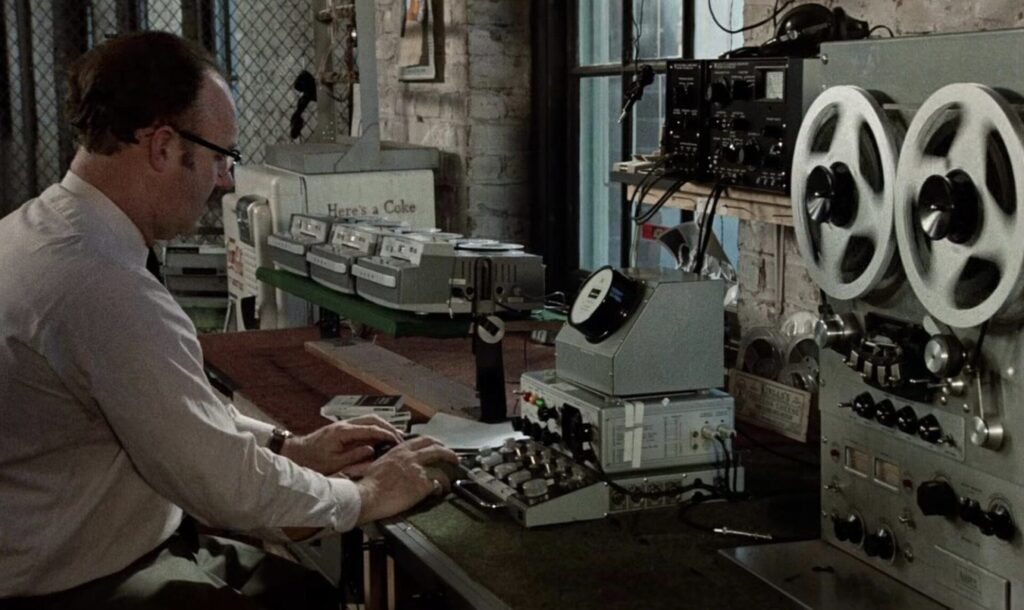
Working both against and with Walter Murch’s exceptional and innovative sound design, Shire’s soundtrack is minimalist due to a smaller than expected budget, a blessing as an ensemble version, while pleasant, doesn’t quite work. The music is tied to Caul. It is Caul. So, it needs to be pared down to convey the solitude of the character. It also needs to be slightly archaic, gifted but over the hill, borrowing from styles of jazz and ragtime that were already outdated. It has the makings of smooth but it starts to reveal itself as profoundly uneasy listening, before spiralling and eventually coming apart entirely, after some manic bursts of impending madness. The final theme feels like it has moved on to attach to someone else, like the parasitically roaming gaze of surveillance itself. Throughout the soundtrack, both against and accentuating the descent of the main motif, is a kind of pulsing of time. Time as a sense of imminence, a recording device, a dripping machine. It’s a brutal film but time is brutal, a film that suggests the only thing worse than being absolutely alone is not being left alone; existentialism and noir being at their true heart indistinguishable. The sense of Caul being secretly watched and listened to, even in his most vulnerable moments, increases throughout the film, throwing shade on the cinema audience enjoying the spectacle (for the full paranoiac home experience, ask the voice-activated spy device in the corner of the room to give Shire’s soundtrack a whirl).
It may seem a little odd to suggest that the sound world is an underrated one on The Quietus of all places, being the portal to so much music, but even here there is inevitably a bias towards the textual and visual. This is far more the case in wider life. Sound might well be the sense that accompanies us longest. The first thing we hear is our mother’s heartbeat. Sound appears to be the last sense to go at death, and, before then, songs are among the last surviving memoires for those with cognitive decline. Yet we would rarely envisage our lives as a sequence of sounds, the way we do photographs, no matter how deeply sound is entangled in our lives or how incomprehensibly epic sound is – take William Basinski’s On Time Out Of Time, a collaboration with LIGO (Laser Interferometer Gravitational-Wave Observatory) “to record the sounds of two black holes merging 1.3 billion years ago.” So far, so uplifting, but if these films and soundtracks have taught us anything it is that civilisation has also earned its comedown innumerable times over, sullying even sound as just another way of exploiting, manipulating, destroying and dominating each other. Who’s to judge? Out there, expanding in the silent vacuum of space, is a colossal radio bubble emanating from this glorious wretched planet, 200 light years in diameter and 100 light years in radius, waiting for a listener.