

The room that is now Dalston’s EartH Theatre first opened as a cinema in 1936, five years before the birth of Martin Carthy. In the decades since both man and room have endured swings in fortune. One of the most innovative guitarists and influential performers of the 1960s folk scene, Carthy spent the years that followed shapeshifting across all manner of collaborations – The Watersons, Steeleye Span, The Albion Band, Brass Monkey – to varying degrees of success. By 2022, however, Covid’s obliteration of what slender living could be made by touring meant that his daughter Eliza was forced to crowdfund to keep him and his wife (the similarly towering Norma Waterson, who died that same year) afloat. When known as the Savoy Cinema in the 30s, EartH was an art deco marvel, with capacity to host 2,700 punters at once. As the rise of television saw fortunes fade in the 1960s, it found new life in the 1970s as a bingo hall. This too declined, until by the new millennium it was closed for good, and for almost two decades all but forgotten entirely.
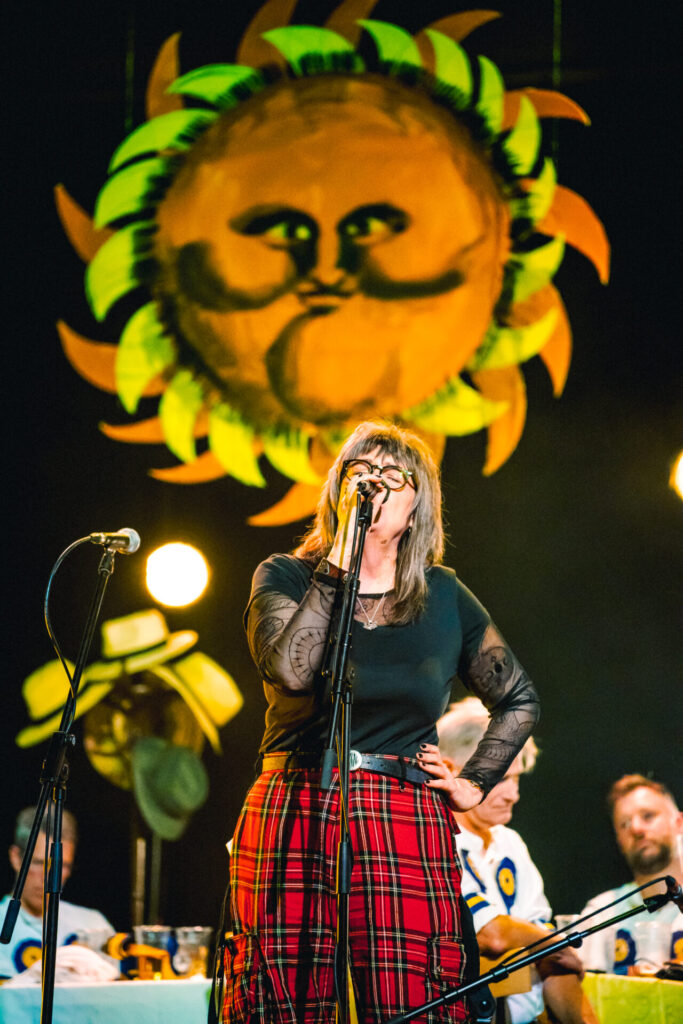
Today, both are experiencing a resurgence – EartH as one of London’s better mid-size venues, craftily renovated so that it has both a modern edge as well as echoes of its former splendour, Carthy as a Mercury Prize nominee for new album Transform Me Then Into A Fish, and a figure beloved across generations. You can sense that in the diversity of ages across those who gathered in EartH a few weeks ago for a marathon tribute to Carthy’s life and work, not just a packed audience lining the uncomfortable pews that leave me longing for the return of those old cinema seats, but onstage, too. There, a temporary pub made entirely out of cardboard has been erected as a backdrop, around which are chairs and candlelit tables that will be intermittently filled and vacated by Carthy’s long-time collaborators like John Kirkpatrick and Maddy Prior, those who took his influence into the 80s, 90s and 2000s like Billy Bragg and Graham Coxon, as well as a healthy representation from today’s resurgent scene. The set is peppered with references to Carthy’s career, some obvious – the pub is titled The North Country Maid, a sun painted to resemble the cover of Lal and Mike Waterson’s Bright Phoebus hangs over it – and some obscure. A piano (also cardboard) and a sword are tucked in one corner, in reference to an oft-repeated yarn about Carthy and Bob Dylan hacking apart one unfortunate old joanna for firewood in the early 1960s. (Dylan, to the audience’s gasps, makes an appearance himself via a montage of video messages to Carthy later on, declaring “that your songs and your melodies have been with me since we first met.”)
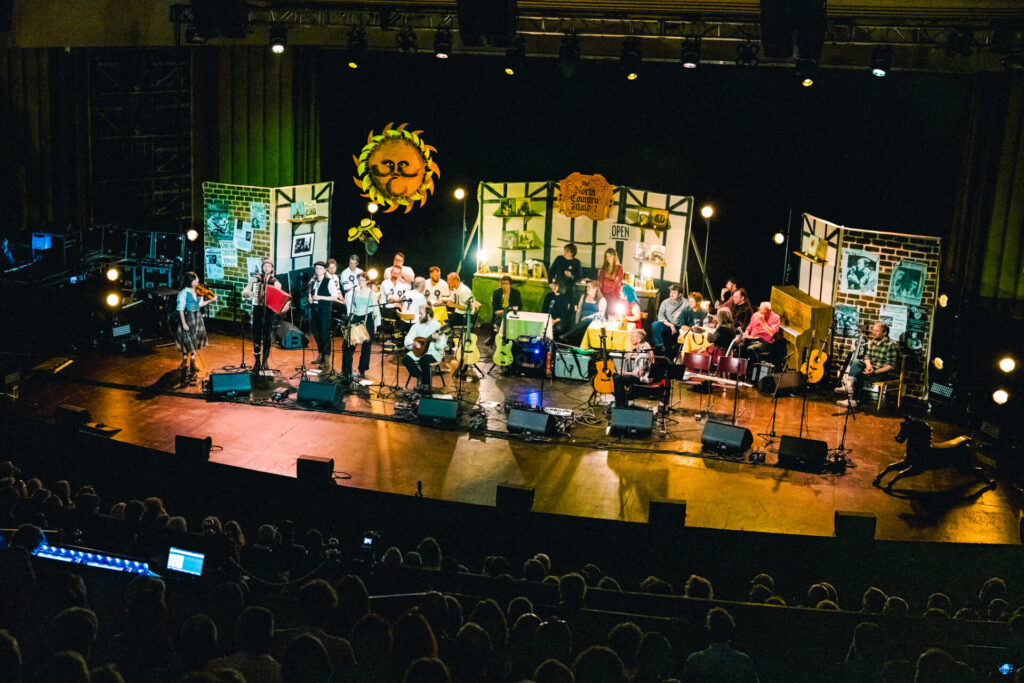
“It’s going to be ramshackle,” says Jon Wilks, the writer and musician who has co-organised the evening alongside Broadside Hacks’ Campbell Baum before the whole thing begins. “It’s going to be great.” He’s right on both counts. The next five hours are ostensibly divided into three sections that map Carthy’s career path – ‘Folk Troubadour’, ‘Innovator & Collaborator’ and ‘Just Don’t Call Him A Legend’ – and the progression of material roughly follows them. Bragg opens the first section, for instance with a spirited ‘Rock Island Line’, the skiffle song that first inspired Carthy to pick up a guitar, while Wilks and Coxon subtly evade the baggage that comes with ‘Scarborough Fair’ by warping it into a kind of ambient prog piece. In the second, material by The Watersons and Steeleye Span is abundant, while in the third Eliza Carthy grows in presence, recalling her formative years learning under – and collaborating with – her parents through the turn of the millennium. And yet, the gig is not just a straightforward journey from A to B to C. For one thing, the sheer size of the whole affair – in both run-time and personnel – means that neatness is essentially impossible. We skip back and forth in time, watch musicians flitter on and offstage, hear technical hiccups come and go.
Instead, the show is best enjoyed not as a sonic biography, but as a more amorphous and organic thing. In fact, it is more in keeping with the atmosphere of the pub they’ve chosen for their setting (and which features a working bar) than that of a straight-up gig. Just as crucial as the artists’ performances are their anecdotes and oral tributes – sometimes touching, sometimes affably meandering – and the way you see the older musicians craning to watch the younger ones give them a run for their money; the way members of the Waterson/Carthy clan keep ribbing Martin when they spy his attention slipping or him forgetting that he needs to talk on mic; the way Goblin Band’s Rowan Gatherer gleefully undermines the aura of Bob Dylan just after his video message by asking the crowd nonchalantly, “who was that guy?”
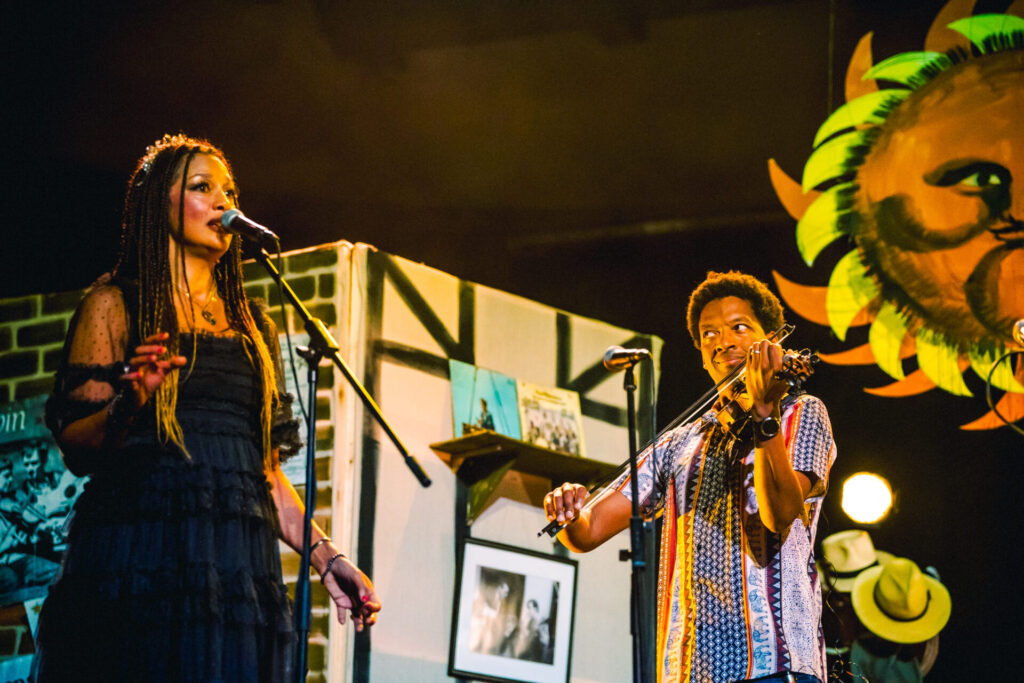
Within the night’s long ebbs and flows there are points where the energy slows, but then again there are others of tremendous power. Although it’s a shame their time onstage is brief compared to most of the other acts, Angeline Morrison’s exquisite rendition of ‘The Brown Girl’ with violinist Hamilton Gross is one of them. She credits hearing Carthy’s version as being “the first time I felt there might be a place for me” as a person of colour within the English trad scene. Elsewhere, an appearance from the Hammersmith Morris Men, who also danced for the long queues as they snaked into venue in the afternoon, provides further evidence for my argument that Morris dancing is a thing of transcendent power. Then there is Marry Waterson’s version of ‘Fine Horseman’, originally by her mother Lal and her uncle Mike, which heaves with overwhelming melancholy – I am biased, in that it’s one of my favourite songs, but here it’s enough to bring me to tears. Similarly affecting is when Carthy himself wipes at damp eyes as he and his daughter play an emotional ‘When I First Came To Caledonia’ with Wilks and Tim Van Eycken.
Carthy, notably, doesn’t actually perform that much himself (although when he does, it is wonderful), so as a result the show has the air of a tribute not just to him, but the myriad others that he intersected with throughout that career – and, indeed, the way the younger artists onstage are carrying that energy forwards. As Eliza points out in the final third, recalling how some fans had asked her in the interval whether her father minds sitting back and watching others for the majority of a night that’s supposedly in his honour: “He wants other people to sing these songs, that’s why he does it.” It speaks to a central truth – towering though Carthy and so many others drinking at the North Country Maid might be, these songs are everyone else’s too.
With that spirit in mind, then, here are my ten favourite new records that don’t just stand as statements from their creators, but additions to our collective canon too.
GreetI Know How To DieDry Cough
On his debut album as Greet, Matthew Broadley wastes no time reaching transcendence. Opener ‘Keening’ is simply gorgeous, a great wave of harmonium and layered vocals. The track’s title, of course, refers to the Gaelic funereal tradition of vocalising one’s grief through song; on this album death is either looming or has already arrived. And yet it is presented here with that sorrow mingling with beauty (in a way that puts me in mind of Irish musician Róis’ own exploration of death on last year’s essential Mo Léan, which I covered here). It makes a spoken word passage from Steve Von Till – “I know how to die, yet I am here still. Battle worn, my purpose not fulfilled” – all the more moving, before the drone carries us through to the slow and meditative ‘No More’, and then again to ‘Revelry’, where a sudden stomp of percussion and a breezy ukulele (played here to sound more like a lute) suddenly dance into the fray, an injection of lightness that nonetheless feels hefty and powerful when housed the record’s wider atmosphere.
Storm clouds gather once more on ‘The Leather Knight’, an altogether darker piece from the perspective of a peasant suffering under the tyranny of the titular (entirely fictional) figure, their anguish giving way to rage as a new rhythm – a sinister lollop – takes hold. Then, on ‘May’, that rage gives way in turn to a rich melancholy, a ballad that finds the narrator longing for the peace of a now-distant home. Through the rest of the record, Greet plumbs further into emotional extremes – an eldritch horror on ‘The Seer’, a foreboding war march on ‘The Battle’ – all of which are unified by that relentless churn of harmonium. Only a brief interlude titled ‘The Dig’, the sound of tools scraping in the mud while birds twitter in the distance, provides respite, though is transfixing in its own way thanks to the sudden juxtaposition of quiet.
Then, however, comes the closer, ‘Eulogy’. Suddenly something at the record’s core has shifted. The song, Broadley notes in accompanying text, concerns the death of a friend who he’d drifted apart from in the year before his death, with the mixed emotions (guilt, grief fond reminiscence) that his passing evoked now pushed to the surface. After a gentle guitar melody the harmonium returns, more tender and emotional this time, rising in power along with marching snares and a thrust of violin into a final cathartic crescendo that reveals the deep emotion at the core of the record that’s really been present throughout. The more I listen to this album, the more I love it. Also worth checking out is his version of ‘Hares On The Mountain’, with vocalist Vex, released earlier this year as a single – as sublime a version of the song as has ever been recorded.
UArchenfieldLex
One of the things I love about folklore is its haziness around the edges, the way that having lost and gained meaning with the interpretation of each successive generation, faded in and out of relevance as the zeitgeist shifts, the idea of a didactic meaning, a concrete truth or a right and wrong to our traditions is essentially moot. The way in which local customs and folk tales are by their nature hyper-specific, but nevertheless still yours to interpret how you will. The way collective memories are, like all memories, unreliable – better served as shapeless energy to let seep through one’s own lived experiences than any kind of instruction manual.
It’s this feeling of mutability that emerges most for me when I listen to U’s new album Archenfield, a deeply immersive, occasionally unsettling but frequently extremely beautiful collage of electronic music, found sound, brass, piano, organ and snippets from films, television programmes and YouTube videos, all of which relate in one way or another to the titular region of Herefordshire. From a cloud of crackling vinyl and warped ambient we hear excerpts of a supernatural audio drama, the testimonies of a ghost hunter, the singing of a child chorister, fragments from a meandering discussion on the biblical Dives and Lazarus, the bustle of locals in a pub approaching last orders, poetry and more. Crucially, we linger on each just long enough for their individual energies to take deep root, but not too long for any to become the sole focus, so that they blur into one another. Though it captures the atmosphere of a specific place so well, this haziness at the edges means that Archenfield could really be anywhere at all.
Old SawThe Wringing ClothLobby Art Editions
New England collective Old Saw have declared that The Wringing Cloth will be their final album. With that in mind, it’s hard not to view the record as a culmination. After 2021’s debut Country Tropics attracted (slightly reductive) tags of ‘ambient Americana’ for the way it evoked a rich rural American melancholy via languid sweeps of lap steel and gentle flickers of banjo, with each successive release their work has taken more and more concrete shape. On 2023’s Sewn The Name the mood shifted into darker and more unsettling territory – more resistant to passive consumption, while on last year’s Dissection Maps, fractured melodies began to emerge at the centre. Now, on their final record, they develop those melodies one step further, at times even bordering on ‘songs’. Hypnotically repetitive acoustic guitar arpeggios on ‘Tilt Of The Lamp’ hint at early Leonard Cohen; the luxuriant sweep of ‘Blood Sumac’ hinges on a slide of straight-up country; ‘Mock Silver’ has a simple yearning urgency.
We’re speaking in relative terms, of course; by most metrics this is still abstract folk music, where individual instruments can detach and weave with one another into a singular fog, and where the use of tape loops and electronic manipulation toy with the temporal. Old Saw still dedicate most of their energy to the margins, creating something deeply evocative while leaving it to the listener’s imagination to define what it’s evocative of. And yet, there’s also a newfound dynamic drive here, and marked shifts in emotion. Opener ‘Song For Paloma’ is shimmering and beautiful, while ‘Ribbons Of Marble’ is almost crushing in its rich sadness. On ‘Long Distance Engraving’, a dark electronic drone and fragments of percussion gives way slowly to a gorgeous weave of guitar and fiddle, which in turn starts to fray until it becomes something ghostly and unsettling. If this is to be Old Saw’s last work, then they leave us with their most complete statement of all.
The Greater London Banjo TrioDo Not Do Doing NotThanet Tape Centre
The Greater London Banjo Trio brings together members from two of the most important projects on the London folk scene’s experimental wing – Jacken Elswyth and Daniel S. Evans of Shovel Dance Collective, and a member of Milkweed known only as R – on a tape that pushes their practise even further out than ever before. Do Not Do Doing Not consists of two sidelong pieces, ‘Sameness Without Difference Is Sameness Wrongly Conceived’, and ‘Difference Without Sameness Is Difference Wrongly Conceived’, that have been fed through a mangle of fuzzy lo-fi production. The first finds the three ploughing a single furrow of repetitive twanging strikes for a quarter of an hour, intensity building slowly but firmly into something that verges on warped beauty until it suddenly, jarringly halts. After a quick pause, the banjos return in completely different form, all scattered and disjointed, squirming and skittering like a barrel of beetles. Then, another pause, and a final rush where it’s as if all three instruments are playing the same song in a different font. Though at first the second side begins more straightforwardly (by their own standards at least) with a lattice of interweaving melodies, it gradually deconstructs into chaos.
This would be a challenging listen were it not so strangely pretty, but it’s still unabashedly audacious. And yet, in spite of the sanitising efforts of millionaire stomp-clap Dust Bowl fetishists in the 2010s, in Britain the banjo has long been a vehicle for these kinds of big creative swings. As the band note in an accompanying text, they exist in the wake of the Bohee Brothers, Black Canadians who initiated a craze for their fretless thimble style playing when they arrived in England in the 1800s that forced established players into retirement, of Bob Buckle’s quest to introduce banjos to schoolchildren across the country in the 1970s with a focus on fostering enthusiasm rather than rigid technique, and of the regional banjo rallies held by the Westminster Banjo Circle in an attempt to keep the flame alive during the 1990s.
Goblin BandA Loaf Of Wax (Live From MOTH Club)Broadside Hacks
I’ve been thinking about a precise point at a Goblin Band gig at Hackney’s MOTH Club for over a year now. It was when they performed ‘Willie’s Lady’, specifically a point about two thirds through where, having gradually raised in tempo and intensity over ebbs and flows of concertina, the song reached a point at which something seemed to snap, the band careening into a flurry of violin, a jangling stomp of percussion and hurried recorders, vocalist Sonny Brazil almost breathless as they tried to keep up. In a packed and sweaty crowd, there was something about the energy that made me feel euphoric to the point of transcendence, floating up towards the venue’s glittery arched ceiling. It was only at the song’s close that the scale of the cheers from a packed crowd broke the spell – and indicated that I wasn’t the only one who’d experienced the same thing.
How pleasing, then, to have that moment immortalised as it is here on the band’s debut album, recorded entirely at that show. There are other moments of a similar power – an unabashedly heart-on-sleeve ‘Hard Working Boater’, for instance – but also more tender moments (the drinking song ‘Rosin The Beau’), sparse tension (‘The Wild Wild Berry’, setting Gwena Harman’s raw solo vocals to violin and drone), and outright macabre melodrama (a quite gloriously over-the-top version of ‘The Worms’). Though on the surface it’s a little unusual for a band’s debut album to be a live recording like this, in Goblin Band’s case it’s also something of a masterstroke. Though elsewhere I’ve written about the band’s backstory and politics and musicianship in my attempt to point out just why I think they’re among the outliers in the new folk scene, it’s really the deep, straightforward and electric connection between them and their audience that’s evidenced here that makes them so marvellous.
Madala Kunene, Sibusile XabakwaNTUMushroom Hour Half Hour / New Soil
74-year-old Madala Kunene is often referred to as the ‘King of the Zulu Guitar’. He is revered as the greatest living master of the maskanda guitar tradition, which as co-labels Mushroom Half Hour and New Soil explain in extensive and fascinating liner notes for new album kwanTU, was long overlooked by the outside world; during apartheid most of maskanda’s torchbearers remained in South Africa, while those who worked in exile and in other musical styles received international attention. Recognition for maskanda has been building slowly over the last few decades, however, with Kunene – who released his first album in the same year that negotiations to end apartheid began in 1990 – among those leading the way. On kwanTU, however, he doesn’t just affirm his legacy but also looks forward, working in duet with Sibusile Xaba, 33 years his junior, an acclaimed guitarist in his own right who has been studying under Kunene for the last decade. Given the chops of those involved, it should go without saying that kwanTU is a beautiful listen, delicate and intricate and powerful. Deeper than that, though, the baton-passing that lends an extra sense of profundity – the passing forward and survival of tradition heard in real time.
Kishun古界 | Kokaiato.archives
Kishun is a duo consisting of Ishikawa Ko and Nakamura Kahoru, who, on Kokai, explore the ancient court music of Japan, gagaku. More specifically, they delve into the kangen form of gagaku, which is purely instrumental (rare in Japanese tradition) and typically performed by a large ensemble of drums, strings and wind instruments. Kishun, however, use solely the shō mouth organ and the gaku-biwa (a traditional short-necked lute), intentionally stripping away any of the style’s typical delicate melodies in search of what lies beneath. Between the percussive plucks of biwa and crystalline sweeps of shō, what they find is something of strikingly beautiful minimalism.
Weston OlenckiBroadsidesOutside Time
In 2023, Weston Olencki embarked on a journey from the town of their birth in South Carolina, through the mountains of West Virginia and to the banks of the Mississippi River, during which the seeds of new album Broadsides were planted. Ostensibly, then, this is a road trip album – and yet as a descriptor that doesn’t quite do justice to its depth. Rather than just providing a soundtrack to the American South, Olencki establishes a dialogue with its environment, allowing cracks of thunder, chittering insects, babbling waters and hulking trains to fundamentally shape their music just as much as they offer a sonic response. On ‘My Father’s Clocks’, for instance, they perform using an autoharp that has literally been warped by the region’s humidity, providing a hideous creaking lurch as they play it with a bow. That sound is set to a field recording from the musician’s father’s home, an eerie collage of overlaying ticks from his clock collection, the overall result carrying an unease and sinisterness that does away with the warmth you might typically expect from a homecoming song. Elsewhere, Olencki engages directly with the traditional music that is as much a part of the Southern environment as its rivers, valleys and mountains, but again is resistant to do so straightforwardly. Bluegrass standard ‘Foggy Mountain Breakdown’, for instance, begins conventionally enough, plucks of banjo set to the sound of a lapping river. Gradually, though, their playing rises in pace and intensity, and then all-of-a-sudden bursts into this dizzying and euphoric crescendo, the musician feeding three-finger licks through an algorithmic computer process so that they layer over and over one another into a lattice beyond comprehension.
Ciaran MackleSitting Still For A LivingAdhuman
Sitting Still For A Living is Ciaran Mackle’s first album under his own name, though he’s been working across various projects within avant garde and sound art circles for some time. It’s that energy he brings to this record, where – interspersed by three long-form instrumental compositions on tin whistle and recorder – folk songs are deconstructed to the point at which they become mumbles and hums, interpretations that are only just recognisable if you know the songs already. Mackle says he was trying to sing them as if a human sampler, chopping them up while also trying to maintain their fundamental melodies, although they were recorded in one uninterrupted take. On one level it reflects the way a folk song worms your way into your subconscious and then emerges as you go about your day, the way I often find myself humming little snippets as I hoover or wash dishes, but there’s also a performative aspect to Mackle’s style – the emphasis he puts on non-linguistic vocalisations that feels intended to reach a little deeper, perhaps in search of whatever human impulse made homo sapiens want to sing before we had even developed the capacity for words, and that still runs through the core of oral tradition today.
NuèitBatalhas en l’aireTroglodisques / Reverse Tapes
Though born in Montpellier in Southern France, part of the wider Occitania region where the Occitan language (or òc) persists today as a local dialect, Nuèt didn’t start learning it herself until she moved to Brittany in 2010 and began going through antique audio recordings of native speakers. “I was familiar with the òc language, but I didn’t think much of it,” she tells me via email. “When I was little I was hearing the same songs over and over again at my little town festivals, I got so bored of it. I hadn’t realised that I had grown in this culture until I moved far from it. I don’t like to sing in French, and with òc I feel like I sing with my true voice. Singing in òc is deeply personal, but it has a collective and political dimension too. I didn’t know about “inside colonialism” (oppression of regional cultures) until quite late, but thanks to the political struggles here in Brittany and there in Occitania I finally leaned about it. With this project I feel like I’m part of something bigger than me.”
Nuèit fuses this experimental noise impulses of her project xəbərdarlıq, as well as explorations from her other, improvisational and violin-driven outfit called Säkkriñ. The first, ‘Castels En L’Aire’ (Occitan for ‘Castles In The Air’), interprets a poem by the 17th century writer Pèire Godolin – via a version by 20th century singer Pèire Boissière . Even when mangled through Google Translate, the poem’s dreamlike, gently psychedelic articulation of yearning as an act that’s both deeply futile and essential to the human condition, bodily and yet somehow rings clear, and it’s a similar energy they elicit on their recording – vocals floating and layering around a woozy Yamaha organ that loops and loops and echoes into the dark. The second, a peasant song called ‘La Batalha d’Achòs’, about a war between two villages over a valley, is more psychedelic still – a terrific arrhythmic thud slowly building beneath swirls of synthesisers and singing until it takes over entirely.