

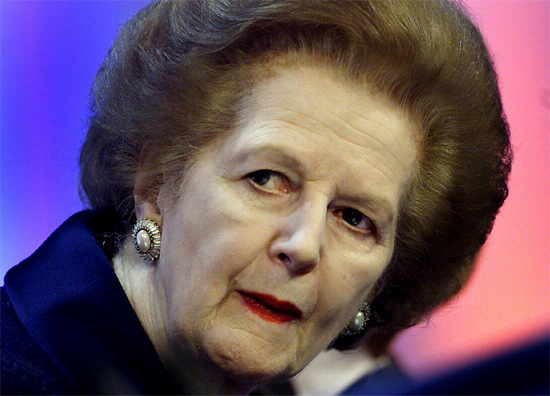
Some critical reaction to The Iron Lady has it that although the film is light on politics, it draws its strength from Meryl Streep’s virtuoso performance as Thatcher, which surely would have to be more human and engaging than the snarling latex caricature of Spitting Image yore if she’s to be in with a shot at an Oscar. As the notes as my local cinema put it, "Thatcher’s will to eschew expectation and prejudice to become the first female leader of the Western world makes for inspiring cinema, whatever your view on her policies." This call to bury old hatchets and contemplate Thatcher the rounded and exquisitely Streeped woman seems pernicious and less apolitical than it might appear. It comes at a time when plans are afoot for Thatcher to be given a state funeral – the first PM to be thus honoured since Churchill. But whereas Churchill, despite rabidly right-wing views which at one point saw him call for compulsory sterilisation of the lower orders was indubitably a unifying figure in wartime, Thatcher never was. Many of us refuse to accept the protocol that being a British PM she cannot have been truly awful and are suspicious of attempts to cast her as an icon to whom, now that she is is the twilight of her years, we must maturely bow our heads in acknowledgement.
Of course, the filmmakers would urge you, for obvious reasons, to "Make up your own minds!" but this feels like one of those occasions where one should resist with prejudice, rather than enrich the producers of this dubious project. But Black Sky Thinking requires food for thought, so down to the multiplex to see the thing, if only – who knows? – so that others don’t have to.
The film begins with a scene in which an elderly Lady Thatcher wanders out to her local convenience store to buy milk, is unrecognised and barged aside by an ironically neo-Thatcherite suit barking into a mobile before making her purchase. Turns out she’s evaded her minders, and husband Denis (Jim Broadbent) wryly chides her for getting her police detail into trouble. Only it soon emerges that this Denis (who died some years ago) is a figment of her addled imagination, with whom she will converse throughout the film. These opening scenes are, initially, bleakly affecting, as we see Lady Thatcher forced to live with the reality of her declining powers and faculties, with only her long term memories and senile delusions for company.
These are the scenes which have upset Thatcher’s Tory admirers, who feel they are disrespectful towards their Dear Leader and invasive of her dignity, especially as she is still among us. However, as the film proceeds, flashing back across her life commencing with her wartime days as Margaret Roberts, the grocer’s daughter, you understand why they are so extensively included by the filmmakers: to vaseline into the Thatcher story some much-needed poignancy. Because boy, does it need it. And if in this case it means, hey, she’s grown very old and a bit sad like people do, well, that’ll have to do.
Granted, you feel a little for her as a young prospective candidate and later newly arrived MP, coping with the ingrained sexism and condescension of the Tory establishment and the Houses of Parliament. But this doesn’t last long, as you realise that by the age of 15, in the thrall of her Alderman father whose trite, narrowcast homilies about self-help rather than ‘handouts’ she eats up with wide-eyed ardour, her Ladybird book worldview of thrift, hardworking shopkeepers, friendly bobbies and incorrigible bad sorts has been set obdurately in stone for life. She’s no more pervious to dissenting voices, or challenges to her stubbornly twinset mindset, in youth or middle age then she is in her dotage.
This, of course, is promoted as her great virtue, and we see her hurtle – compact, eyes blazing and uncompromising – to success. And it’s in the familiar period of her political fame that the problems really begin. After an unfortunate appearance as a Minister at the dispatch box when she is accused of ‘screeching’ by her Labour opposite number, Tory grandees try to make her over. But, apart from lowering her voice a semitone or so, they don’t really succeed. Even toned down, Thatcher as PM still comes across as a brutally anachronistic Aunt Sally figure, a Wodehouseian or Wildeian Aunt let loose on the 1980s, not for turning.
All of which is a problem for both the filmmakers and for Meryl Streep. She does a tremendous impersonation of Thatcher, for sure, but we can tell this because we remember, with a shudder, that Thatcher existed. Had this been made up, we’d be lampooning Streep for her hideously hackneyed, cartoon parody of Tory womanhood. Where is the dramatic arc, the character development, the nuance, the capacity for reflection, the interior life, the learning and the consequences – all the stuff she’d expect to sink her teeth into were this a fictional character working their way through three acts? Thatcher is simply Thatcher throughout: determined, myopic, unrepentant. This eventually becomes wearing on the viewer, looking for some point of engagement. She’s especially obnoxious in the scenes involving the Falklands conflict, berating one of her male minions who dares even to think of pointing out she has never been to war. "I’ve done battle every day of my life!" she announces, oblivious to the difference between someone with a personal relish for adversarialism and the tragedy of warfare.
We’re swept through the ’80s at an unseemly brisk, staccato pace; riots, war, IRA bombs, the miners’ strike, Union Flag-soaked election triumphs, more riots, and then, finally, her undoing as her teeth-grating hectoring and domineering are seen, eventually, to be too much. This results in some ridiculous compressions, such as the victory in the Falklands appearing to unlock a boom in the UK economy. And yet, you just want it to pass as soon as possible just to be relieved from the repugnance. Hence the relief when she finally snaps, "Sink it!" in the situation room as the Belgrano steams away. Yes, yes, drown those wretched, retreating sailors; whatever it takes to get us closer to the end of this damn movie.
The historical flashbacks are depicted from Thatcher’s perspective, which mostly involves scenes of the unwashed not-one-of-us brigade smashing up things or shouting mutely at her through her car window, or plummy male wets crowding round and talking down to her, urging compromise, only to be skittled by the resolve of a strong woman who would sooner skank on Alderman Roberts’s grave than back down. The grievances of the opposition are articulated – in a brief Michael Foot tirade, in background, truncated radio broadcasts and the occasional Sergeant Wilson-esque murmur from Geoffrey Howe – but it’s the bare minimum. Anyone who did not know the history might assume all this rioting was the convulsions of a torpid Britain resisting its strong medicine, all these dissenting voices the mere harrumphing of a sexist, condescending establishment. Denis Thatcher’s ghost is her only real match, and occasionally he plays a Jiminy Cricket-type role in her imaginary conversations with her in widowhood. He pricks her conscience; but only to say things like "You’re drinking too much", rather than, say, "You presided over the dismantling of the UK’s manufacturing base, sold off the country’s commonly owned silverware to a bunch of money-grubbing, pinstriped opportunists, practically eliminated the country’s social housing stock and eroded the welfare state by unleashing the worst of which the British people are capable – fear, ruthless greed and small-minded loathing, racism, xenophobia and homophobia – adding insult to injury by administering all this with a sickly, acrid, old-fashioned dose of castor oil moralism. It is just that you rot in senile purgatory and die a lonely death." Generally, Denis encouraged rather than tempered her delusions of righteousness.
"We are governed by people who care more about feelings than thoughts and ideas," snorts Thatcher late on in the movie, scoring a rare point. But The Iron Lady pulls out every stop and trick, stacks everything up as best it can in order to make us feel something, anything, for the woman with whom the viewer is forced to spend 90 intimate minutes in a darkened room. There are frequent, heavily lacquered applications of sentimentally lachrymose orchestral music. Mark Thatcher is not represented on screen at all, which is just as well, for watching her dote on that pillar of toss would only make her seem more repellent (here is a woman only capable of engaging with one out of two parents and one out of her two children). They try to suggest that she was a feminist role model but are forced, honestly, to concede that it was her own emancipation and advance in which she was interested, not women generally, virtually none of whom entered her cabinet.
Furthermore, she is depicted as a lone warrior, the one against the many, drawing solely on her heroic resolve to prevail. We know this is untrue. What we are not shown is that an establishment with a right-wing bent was four square behind her: business, the military and, not least, the press, including the ghastly apparatus of Rupert Murdoch, whom the filmmakers choose to ignore altogether. The idea that she advanced through sheer personal strength of character alone is a nonsense: she was a convenient wrecking ball for wider, invisible, abstract and malign forces. Barbara Castle, from the left, could never have made such an advance. Chris Mullin’s A Very British Coup, meanwhile, in which Harry Perkins, an ex-steel worker, becomes Prime Minister gives a probably accurate indication of what were to happen if a leftist equivalent of Thatcher were to enter Number 10 and how the press, military and financial institutions would respond under those circumstances.
The Iron Lady set itself an invidious task. Who knows, they might have done the best of all possible jobs given the time and brief, although this film will prove neither satisfactory to the Left, for all its gross omissions, or to the Right, for its morbid dwelling on her old age. But the story skimpily told here might have been better suited to an epic, six or 12 part series, featuring other stories, other characters, aspects and strata of 1980s society that allowed the more complex picture to unfurl. For this is the thing: the ’80s, and Thatcherism, were far larger than the rather small, psychologically uninteresting and obdurately pathetic figure of Thatcher herself. Any day, week or month now she will die and there will be ding-dong celebrations from some, nauseatingly enforced grieving from others. But what hasn’t died is the legacy of the era over which she presided, whose greatest trick may have been rhetorical: "there is no alternative." The schisms and open wounds left in those ravaging years we are supposed now to accept as the natural running rivers and gorges of New Britain. There were, are and always will be alternatives. And one of them is to give this desperately confected treatment of a figure whose very repugnance served as comic distraction from what was really being done in the 1980s, a wide berth.